Model Context Protocol (MCP) & the 4-Stage Trust Framework
What is an AI machine agent, and how is it different from a copilot?
How do governed agents earn trust before they earn autonomy?
How many IT labor hours could machine agents free up for your team?
AI machine agents are the next step after today's AI copilots: instead of only suggesting an answer, an agent is given a real responsibility and works it end to end, under policy gates a person controls. This guide explains what that shift looks like inside an ITSM environment, and the companion calculator turns your own ticket volumes into a first-pass estimate of the IT labor hours and dollars it could free up.
Inside the Guide: How AI Machine Agents Will Change IT Operations
Most IT teams have already met AI in the form of a copilot: you ask, it suggests, a person does the work. A machine agent is the next step — software given a real responsibility, such as handling vulnerability-remediation tickets for non-clinical endpoints, that reads the triggering event, gathers context, proposes a fix, requests approval where policy requires it, and closes the ticket once the work is verified. The guide walks through what that means for IT leadership, in plain English, with an actual worked example from endpoint security.
How Agents Earn Trust, One Stage at a Time
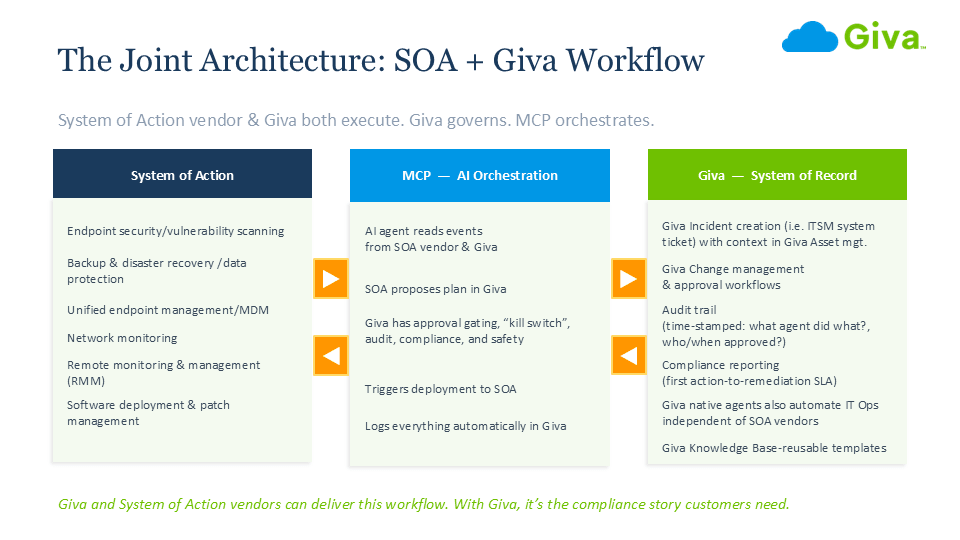
No agent starts with full autonomy. In Giva's design, every workflow moves through four defined stages: Shadow, where the agent only observes and records what it would have done; Suggest-only, where it proposes and a person decides; Approve-to-act, where it executes but pauses at every policy gate; and Supervised autonomy, where it handles proven, low-risk work on its own while high-consequence actions stay gated. There's no stage five labeled "unsupervised" — human oversight of high-consequence work is a permanent design feature, and your organization decides if or when a workflow advances.
Why the ITSM Platform Is the Right Control Point
Turning agents loose on real IT operations is a governance problem before it's an AI problem. The guide makes the case that the system of record already holding your tickets, assets, changes, and approvals — not a bolted-on chatbot — is where role-based access, change approval, and audit trails already live, and where an agent's kill switch and approval gates belong. It also covers Model Context Protocol (MCP), the open industry standard — think "USB-C for AI" — that lets an agent connect securely to the tools it operates, always inside the permissions your organization grants.
Why Now
Agent capability has been roughly doubling every few months industry-wide, and Model Context Protocol has moved from a new standard to broad vendor adoption in about two years. The guide covers four industry trends shaping how quickly this shift arrives, and a section-by-section action plan for IT leaders and back-office staff to prepare before the transition — regardless of when your organization deploys its first agent.
Inside the Calculator: Estimate Your IT Labor Savings
Every AI savings estimate is only as good as the math behind it. The companion calculator is a real Excel tool, not a locked demo: every input is a yellow cell you can see and change, and every assumption is documented with the reasoning behind its default, right next to the cell.
How the Model Works
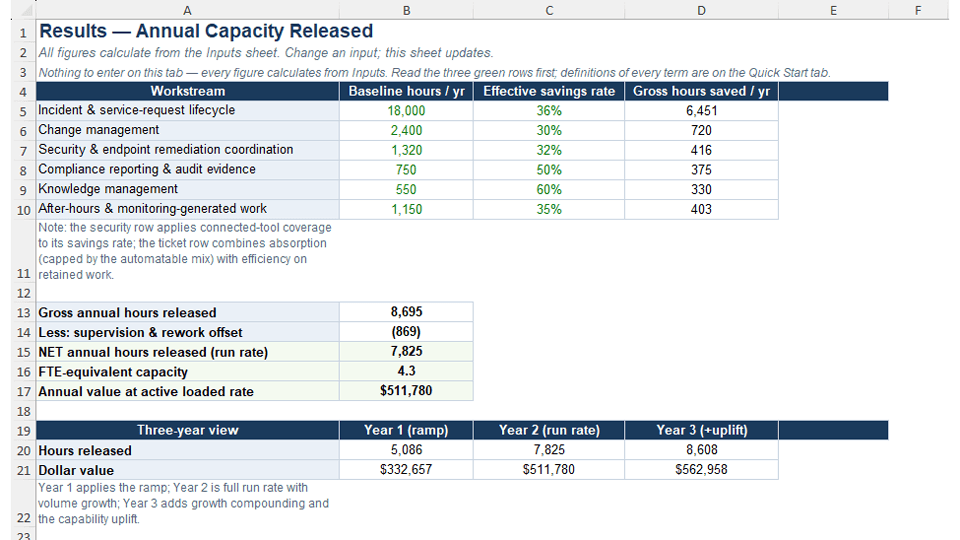
The calculator works in five steps: it sizes the baseline hours your organization spends today across six ITSM-connected workstreams (ticket lifecycle, change management, security and endpoint remediation coordination, compliance evidence, knowledge maintenance, and after-hours work), applies an absorption rate and an efficiency rate to each one, nets out the new supervision work agents create, converts the result to FTE-equivalent hours and dollars using your own loaded labor rate, and spreads it over three years as workflows graduate through the trust stages.
What You'll Need
Four numbers — IT headcount, tickets per year, change requests per year, and managed assets — produce a defensible first-pass estimate in about ten minutes, and the calculator's Quick Start tab walks you through it. Pick Conservative, Expected, or Optimistic from a drop-down, or switch to Custom and set every rate yourself against a pilot's real numbers.
Both are free. Download the guide and the calculator together, and start preparing your team, your data, and your governance policy — before the industry makes the timeline for you.