IT Service Desk Software: Complete Guide to Features, AI's Effect, Best Practices and How to Choose
 By Ron Avignone
When employees hit a technical snag, they need help fast. But without a structured system, requests get lost in email threads, ownership is unclear, and resolution times are anyone's guess. IT teams end up reactive, constantly triaging instead of improving.
IT service desk software solves this. It gives every request a home, a workflow, and a clear resolution path, so nothing falls through the cracks and your team can actually measure how well they're performing. The help desk software market is projected to reach $21.8 billion by 2027, reflecting how central this tooling has become to modern IT operations.
This guide covers:
- What IT service desk software is, and how it compares to a help desk or full ITSM suite
- The core features that drive efficient IT support operations
- How AI and automation are reshaping service delivery
- What to evaluate when choosing a platform for your organization
- The KPIs and best practices that drive measurable, sustained improvement

What Is IT Service Desk Software?
IT service desk software is a centralized platform that manages the full lifecycle of IT support interactions, from the moment a user submits a request through to resolution and closure. It serves as the single point of contact (SPOC) between the IT organization and the people it supports, handling everything from password resets and hardware failures to software provisioning and complex infrastructure changes.
Unlike a basic ticketing system, which is essentially a queue, IT service desk software includes structured workflows, SLA tracking, a knowledge base, reporting, and alignment with ITIL practices. It's built to help IT teams not just respond to issues, but manage service delivery as a discipline.
IT Service Desk vs. Help Desk vs. ITSM
These three terms are often used interchangeably, but they describe different things. Understanding the distinction helps you choose the right type of platform for your organization:
-
What Is a Help Desk?
An IT help desk is a reactive support function focused on resolving individual user issues quickly. Its primary ITIL practice is incident management. When a user can't log in or their printer won't work, the help desk handles it. Help desks are tactical: they fix problems as they arise.
-
What Is a Service Desk?
A service desk is a more comprehensive function that goes beyond break-fix support. It manages incidents, service requests, change notifications, and communications with users, all through a consistent, ITIL-aligned process. The ITIL 4 framework defines a service desk as "the single point of contact between the service provider and the users." Service desks are proactive and customer-centric, focused on the quality of service delivery, not just resolving individual tickets.
-
What Is ITSM?
IT Service Management (ITSM) is the overarching framework that governs how IT services are planned, designed, delivered, and continuously improved. ITSM encompasses 34 practices defined in ITIL 4, including incident management, problem management, change enablement, knowledge management, and IT asset management. The service desk is a component of ITSM, not the same thing. Some organizations also adopt Enterprise Service Management (ESM), which applies ITSM principles and the same service desk tooling to non-IT departments like HR, Finance, and Facilities.
Summary of Key Differences Between Help Desk, Service Desk and ITSM
Help Desk |
Service Desk |
ITSM |
|
Focus |
Break-fix, incident resolution |
Full service lifecycle management |
End-to-end IT strategy and service delivery |
Approach |
Reactive |
Proactive and customer-centric |
Holistic and continuous improvement-focused |
ITIL Scope |
Incident management primarily |
Multiple ITIL practices |
All ITIL practices |
User Orientation |
Tactical problem solving |
Service quality and experience |
Business alignment and strategy |
For most organizations, the right question isn't which model to pick, but rather how much of the service desk and ITSM functionality you need. Smaller teams often start with help desk software and expand. Larger or compliance-driven organizations typically need a full service desk with ITSM capabilities from day one.
Key Features of IT Service Desk Software
Not all IT service desk platforms are built the same. Here are the capabilities that matter most and what to look for in each:
-
Incident Management
Incident management handles the end-to-end process of logging, categorizing, prioritizing, assigning, and resolving disruptions to IT services. Good incident management in service desk software means automated ticket creation from multiple channels, smart routing to the right team or agent, escalation rules when SLAs are at risk, and a full audit trail for every incident.
Most platforms also support major incident management, a separate escalation track for high-impact, business-wide outages (sometimes called P1 or Sev 1 incidents) that require coordinated response across multiple teams and real-time stakeholder communication.
-
Service Request Management
Not every IT interaction is an incident. Service requests, such as onboarding a new employee, granting software access, or ordering a replacement laptop, follow a different workflow. IT service desk software should handle both incident and service request management through a service catalog that lets users submit and track common requests without calling or emailing IT.
-
Self-Service Portal and Knowledge Base
A self-service portal lets end users resolve common issues on their own, without creating a ticket. Paired with a searchable knowledge base, it reduces incoming ticket volume significantly. End users get 24/7 access to documented solutions, FAQs, and guided troubleshooting steps. This is what ITIL calls Tier 0 support, and it's the highest-leverage investment an IT team can make in terms of reducing workload.
-
Ticket Routing and Workflow Automation
Manual ticket routing is slow and inconsistent. Modern service desk software uses rules-based and AI-assisted routing to automatically assign tickets to the right team, trigger approvals, send notifications, and escalate overdue items. Automation rules generate canned responses for common questions, add internal notes for mid-stream handoffs, and trigger provisioning workflows for repeatable requests like password resets and access grants.
-
SLA Management
Service Level Agreements define the response and resolution time commitments your IT team makes to users. SLA management in service desk software means tracking SLA status in real time, alerting agents before a breach occurs, and reporting SLA compliance over time. Teams that manage SLAs in spreadsheets rather than purpose-built software typically discover compliance gaps only after a commitment has already been missed.
-
Asset Management and CMDB
An asset management module tracks hardware and software assets across the organization: laptops, servers, licenses, configurations. A Configuration Management Database (CMDB) maps relationships between those assets, so when an incident occurs, IT can quickly see which systems are affected and what depends on them. This context dramatically speeds up diagnosis and reduces the blast radius of IT changes.
-
Change Management
Uncontrolled changes are one of the leading causes of IT incidents. Change management in service desk software enforces a structured review and approval process for proposed IT changes, whether routine (standard changes like patch updates), normal (changes requiring CAB review), or emergency. ITIL change enablement practices, when supported by software, reduce change-related failures and keep the environment stable.
-
Multi-Channel Support
IT teams receive requests through email, phone, chat, self-service portals, and collaboration tools like Microsoft Teams and Slack. Good service desk software consolidates all of these into a single omnichannel queue so nothing is missed and agents work from one place regardless of the channel the user came through. This omnichannel approach replaces the fragmented shared inboxes and email threads that most teams rely on before adopting a proper service desk platform.
-
Reporting and Analytics Dashboards
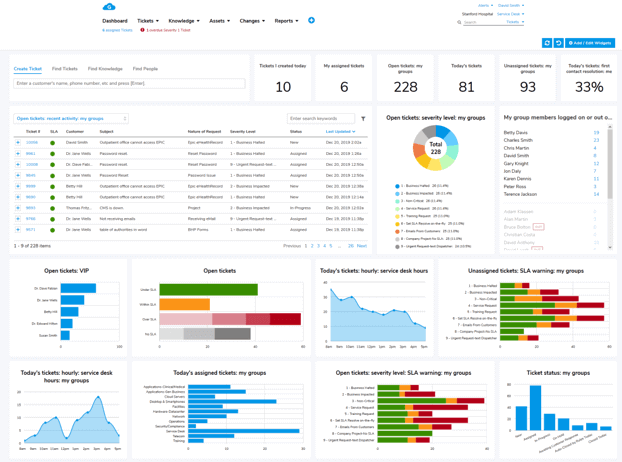
Without data, IT management is guesswork. Service desk software should offer real-time dashboards showing ticket volume, SLA compliance, agent workload, and resolution times, plus scheduled reports for management review.
The best platforms allow custom report building and export to other BI tools, so you can slice the data however your organization needs.
-
Mobile Access
IT agents don't sit at a desk all day. Mobile apps for iOS and Android let technicians manage tickets, update statuses, and close issues from anywhere, which is especially valuable for field support teams or on-call engineers responding to incidents outside business hours.
Benefits of IT Service Desk Software
The right IT service desk software doesn't just organize tickets. It changes how IT operates:
-
Faster Issue Resolution
Automated routing, built-in knowledge base recommendations, and AI-assisted diagnosis all reduce the time it takes to move a ticket from open to closed. When agents have full context, clear ownership, and the right tools at hand, resolution times drop measurably.
Mean Time to Resolution (MTTR) is one of the first metrics to improve after a well-configured service desk goes live. Faster resolutions also mean less time users are blocked by technical failures, directly reducing the cost of downtime across the organization.
-
Reduced IT Team Workload Through Ticket Deflection
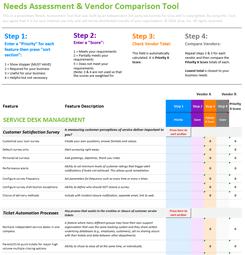
A self-service portal powered by a well-maintained knowledge base can deflect a significant portion of incoming tickets before they reach the queue, with AI-driven virtual agents resolving common requests like password resets automatically. This frees agents to focus on complex, high-value problems rather than repetitive tasks.
-
Consistent, ITIL-Aligned Processes
When every incident follows the same intake, triage, assignment, and resolution workflow, quality becomes predictable. ITIL-aligned service desk software enforces process consistency across the team regardless of which agent handles a ticket, which reduces errors, improves first contact resolution, and makes training new staff easier.
-
Better SLA Compliance and Accountability
SLA tracking built into the platform makes commitments visible to everyone: agents see SLA countdowns on every ticket, managers see compliance rates in real time, and users receive automatic updates when resolutions are running late. This transparency drives accountability and gives leadership the data to have honest conversations about capacity and priorities.
-
Improved Visibility with Real-Time Dashboards
IT managers who rely on spreadsheets and weekly status meetings are always operating on stale information. Service desk dashboards show live ticket counts, team workload, escalation trends, and SLA status. When something is off, you know now, and not at the end of the week.
-
Lower Cost Per Ticket
Automation and self-service reduce the fully loaded cost of handling each support request. Fewer tickets need agent involvement, and the tickets that do get resolved faster. Over time, this lowers the cost per ticket, one of the clearest financial metrics for IT support efficiency.
-
Stronger Security and Audit Trails
IT service desk software maintains a complete, timestamped record of every action taken on every ticket. For organizations in regulated industries, such as healthcare, finance, or government, this audit trail is essential for compliance.
Plus, role-based access controls ensure that agents only see what they need to, protecting sensitive data within the platform.
5 Ways AI and Automation are Being Used in IT Service Desk Software
AI is no longer a differentiator in service desk software. It's becoming the baseline. According to the 2026 State of AI in IT report from ITSM.tools and Atomicwork, 74% of organizations already have AI working inside at least one service management team, and 82% of those who have invested in AI report tangible results. The platforms that don't incorporate AI are falling behind:
-
AI Chatbots and Virtual Agents
AI chatbots handle common requests through natural language conversation, and are available 24/7 through the self-service portal, email, Microsoft Teams, or Slack. They understand intent rather than just keywords, so a user who types "can't get into my laptop" gets routed to the right resolution path, not a generic FAQ page. When the chatbot can't resolve an issue, it creates a ticket automatically with the full conversation context attached, so the agent doesn't start from zero. AI-driven self-service portals are projected to enable employees to resolve up to 60% of IT issues on their own.
-
Intelligent Ticket Routing
AI routing uses natural language processing (NLP) and machine learning to examine the content, context, and history of every incoming ticket, then assigns it to the best-suited team or agent automatically. This reduces misrouted tickets, cuts first response times, and makes sure complex issues reach specialists rather than sitting in a general queue.
Setup quality matters more than the AI itself. Teams that define clean ticket categories and invest time tuning routing rules before go-live see misrouted rates drop within the first few weeks. Those that deploy with default settings and skip category hygiene often find the AI routes tickets faster to the wrong queue.
-
Predictive Analytics and Proactive Alerting
Rather than just reporting on what happened, AI-powered analytics identify patterns before they become incidents. Predictive models can flag recurring infrastructure issues, forecast ticket volume spikes, and score proposed changes for risk, shifting teams from reactive response to proactive service management.
-
AI-Generated Knowledge Articles
Gartner predicts that by 2027, generative AI will create more IT knowledge base articles than humans will. Modern service desk platforms already use AI to draft knowledge articles from resolved tickets, summarize long ticket histories for new agents, and surface relevant articles during active troubleshooting. This keeps the knowledge base current without requiring agents to manually document every solution.
-
Automated Remediation for Common Issues
For well-understood, repetitive issues, such as password resets, software license assignments, and VPN access requests, AI can trigger automated resolution workflows that close the ticket without any human involvement, reducing Tier-0 ticket volume and freeing agent capacity for higher-value work.
Importantly, AI augments agents rather than replacing them. Routine requests get handled automatically. Complex problems still land with experienced engineers, who now have better context and better tools to resolve them quickly.
How to Choose IT Service Desk Software: Step by Step
Choosing the wrong platform means months of painful workarounds or a costly replacement project down the road. Work through these criteria before you commit to a vendor:
-
Step 1: Assess Your Organization's Needs
Start with your current state. How many agents handle IT support, and what is your average daily ticket volume? Do you support one location or multiple sites? Are there regulatory requirements like HIPAA or SOC 2 that the platform must address? The answers shape every feature and vendor decision that follows.
-
Step 2: Evaluate Core Feature Requirements
At minimum, the platform should handle incident management, service request management, and SLA tracking. From there, decide which additional capabilities you need:
- Asset management and CMDB
- Change management workflows
- AI chatbots and virtual agents
- Problem management for root cause analysis
- Service catalog for standardized request handling
- Multi-channel intake (email, Teams, Slack, phone, portal)
Don't pay for capabilities you won't use, but also don't pick a platform you'll outgrow in 18 months.
-
Step 3: Decide on Deployment Model
Cloud-based (SaaS) platforms dominate the market because they require no infrastructure investment, deliver automatic updates, and are accessible from anywhere. On-premises deployments give organizations more control over data and customization, but they require internal IT resources to manage and maintain. Most organizations should default to cloud unless there's a specific compliance or sovereignty reason not to.
-
Step 4: Understand Pricing and Total Cost of Ownership
Per-user per-month pricing is the most common model. Ranges vary widely:
- SMB platforms: roughly $10–$30 per agent per month
- Mid-market platforms: $30–$100 per agent per month
- Enterprise platforms: $100–$150+ per agent per month
The license fee is only part of the total cost of ownership. Factor in implementation, data migration, training, and ongoing administration. A cheaper platform that takes six months to configure is often more expensive than a slightly pricier one that goes live in a week. Always request a free trial before signing a contract.
-
Step 5: Confirm Security and Compliance Needs
At minimum, look for role-based access controls, data encryption in transit and at rest, single sign-on (SSO) support, and a clear data residency policy. If your organization is in healthcare, confirm HIPAA compliance. If you're in financial services, verify SOC 2 certification. Organizations operating in the EU or handling EU resident data should confirm GDPR compliance. Organizations in regulated industries typically pay 15–20% more for compliance-certified platforms, but the alternative is far more expensive.
-
Step 6: Check Integration Capabilities
Your service desk won't operate in isolation. It needs to connect with your identity provider (Active Directory, Okta), collaboration tools (Teams, Slack), monitoring systems, HR software for onboarding and offboarding, and potentially your CRM or ERP. Weak integration stories mean manual data entry, data silos, and a service desk that never becomes the single source of truth it's supposed to be.
8 IT Service Desk Best Practices
Software alone doesn't create a high-performing service desk. The platform is only as good as the processes and habits built around it:
-
Build and Maintain a Robust Knowledge Base
Start by documenting solutions to the 20 most common issues your team resolves every week. These become the foundation of both your agent knowledge base and your self-service portal. Set a quarterly review cadence to remove outdated articles and update anything that's changed. A stale knowledge base is worse than no knowledge base, because users lose trust in it quickly.
Most teams find their gaps not through scheduled audits, but through ticket patterns. When three different agents answer the same question in one week, that's a knowledge article waiting to be written. Building from real ticket data is faster and more relevant than trying to anticipate everything from a blank page.
-
Define Clear SLAs Before You Configure Anything
SLA targets drive a lot of platform configuration: escalation rules, notification thresholds, priority tiers, and reporting. If you don't define your SLAs before setup, you end up configuring around defaults that may not reflect your actual commitments. Start with agreed response and resolution times per priority level, then build the platform around them.
-
Implement a Self-Service Portal Early
The self-service portal is one of the fastest ways to reduce ticket volume, but it only works if it's populated with useful content before you launch. Coordinate with your knowledge base build to ensure the portal has answers to the most common requests from day one.
-
Structure Your Team Using Tiered Support
A tiered support model (Tier 0 through Tier 4) ensures each issue is handled at the right level of expertise:
- Tier 0 is self-service
- Tier 1 handles common issues with scripted responses
- Tier 2 handles more complex technical problems
- Tier 3 involves specialists and engineers
- Tier 4 involves vendor escalation
Clear tier definitions reduce escalation bottlenecks and help agents develop expertise in their domain.
-
Automate Tier-0 and Tier-1 Requests First
Password resets, account unlocks, access requests, and software license assignments are the highest-volume, lowest-complexity tickets most IT teams handle. These are the best candidates for automation. Automating Tier-0 and Tier-1 requests frees agents to work on problems that actually require human expertise, which improves morale as well as metrics.
-
Review KPIs Weekly, Not Just Monthly
Monthly reports tell you what went wrong last month. Weekly dashboard reviews catch problems while there's still time to course-correct. Track at minimum: FCR, MTTR, SLA compliance rate, ticket volume trends, and ticket backlog size. A growing backlog is an early warning sign that capacity is falling behind demand, before SLA breaches begin to show up in the numbers. If any of these deviate significantly from baseline, investigate the cause before the month-end review.
-
Train Agents on Both the Software and Customer Service Skills
Technical training on the platform is obvious. What's often overlooked is training on communication: how to write clear status updates, how to manage user expectations on timelines, and how to handle frustrated users professionally. IT support is a customer-facing function, and CSAT scores reflect it. Both dimensions of training pay dividends.
-
Use Problem Management to Address Root Causes
When the same incident recurs three times in a month, it's a problem, not just a series of incidents. Problem management is the ITIL practice that finds root causes and implements permanent fixes. A service desk that skips this step becomes a recurring-incident treadmill: responsive but never improving.
Consider a practical example: five tickets arrive in one week, each reporting slow VPN performance, each resolved by rebooting the client. The service desk closes every ticket on time. But on the sixth occurrence, a problem record is opened. Root cause analysis identifies an incompatibility between the VPN client version and a recent OS update. A patch is deployed organization-wide. The incidents stop.
A well-run problem management process reduces incident volume over time rather than just processing it faster. This connects directly to the ITIL principle of continual improvement: the service desk should be getting measurably better quarter over quarter, not simply sustaining the same performance.
8 Critical IT Service Desk KPIs and Metrics to Track
Metrics tell you what's happening. KPIs tell you whether what's happening is good enough. Here are the most important ones to monitor:
-
First Contact Resolution (FCR)
FCR measures the percentage of tickets resolved during the first interaction, without escalation or follow-up. A high FCR indicates that agents have the skills, tools, and knowledge to solve problems on the spot. Low FCR is a leading indicator of knowledge base gaps, insufficient agent training, or issues being handled at the wrong tier. Industry benchmarks vary, but many well-run service desks target FCR above 70%.
-
Mean Time to Resolution (MTTR)
MTTR is the average time from ticket creation to full resolution. It's a core operational metric that directly affects SLA compliance and user satisfaction. Watch for MTTR trends rather than just the number itself: a rising MTTR over three consecutive weeks signals a workload or process problem worth investigating.
-
SLA Compliance Rate
This is the percentage of tickets resolved within the committed SLA timeframe. It's the metric most visible to users and leadership because it directly reflects whether IT is meeting its stated commitments. Track response SLA compliance and resolution SLA compliance separately, as they often have different root causes when they slip.
-
Customer Satisfaction Score (CSAT)
CSAT surveys sent after ticket closure measure user perception of the support experience. Unlike operational metrics like MTTR, CSAT captures the human dimension: was the agent helpful, was communication clear, was the resolution effective? CSAT can be high even when resolution times are slow if the agent communicated well throughout. It can also be low even when MTTR is excellent if the resolution was technically correct but poorly communicated.
-
Ticket Volume and Trend Analysis
Tracking ticket volume over time reveals demand patterns: peak days, seasonal spikes, and the impact of IT changes that generated incidents. More importantly, monitoring the trend tells you whether your self-service and automation investments are working. If ticket volume keeps rising despite a functional self-service portal, something in the knowledge base or portal design needs attention.
-
Escalation Rate
The escalation rate measures how often tickets are escalated from Tier 1 to Tier 2 or higher. A high escalation rate suggests Tier 1 agents lack the knowledge or authority to resolve issues at the first tier, which increases costs and delays resolution. It's a useful diagnostic metric when FCR is low.
-
Cost Per Ticket
Cost per ticket is calculated by dividing total IT support costs (staff, software, overhead) by the number of tickets handled in a period. It gives leadership a financial lens on service desk efficiency. As automation increases and ticket deflection improves, cost per ticket should trend down even as total support quality improves.
-
Reopen Rate
The reopen rate measures how often tickets are reopened after being marked resolved. A high reopen rate indicates that issues are being closed prematurely, or that resolutions aren't sticking because root causes weren't properly addressed. It's a quality signal that complements FCR.
KPI Reference Summary
Metric |
What It Measures |
Why It Matters |
FCR |
Tickets resolved on first contact |
Efficiency and knowledge depth |
MTTR |
Average time from open to close |
Speed of service delivery |
SLA Compliance Rate |
Tickets resolved within SLA window |
Commitment reliability |
CSAT |
User satisfaction with support experience |
Human quality of service |
Ticket Volume Trend |
Demand patterns over time |
Capacity and self-service effectiveness |
Escalation Rate |
Tickets moved to higher tiers |
Tier 1 capability and training gaps |
Cost Per Ticket |
Financial efficiency of support |
ROI of automation and process improvements |
Reopen Rate |
Tickets reopened after closure |
Resolution quality and root cause discipline |
How to Choose the Right IT Service Desk Software for Your Team
IT service desk software is the operational backbone of any IT organization that takes service delivery seriously. It brings structure, accountability, and visibility to support operations that would otherwise run on email chains and institutional memory.
Most organizations follow a natural maturity progression as they build out their service desk capabilities:
- Stage 1 - Structured ticketing: Every request has a defined owner, a status, and a tracked timeline. Email threads and shared inboxes are replaced with a purpose-built queue.
- Stage 2 - SLA management: Response and resolution targets are defined by priority. Compliance is tracked in real time, not discovered in hindsight.
- Stage 3 - Self-service portal: Users resolve Tier-0 issues independently. Ticket volume drops and agents focus on work that actually requires their expertise.
- Stage 4 - ITSM practices: Change management, problem management, a service catalog, and CMDB are layered in as organizational complexity grows.
- Stage 5 - AI and automation: Intelligent routing, virtual agents, and predictive analytics scale service delivery without scaling headcount.
In the end, the goal is the same: less firefighting, more reliable service, and an IT team that can demonstrate its value in numbers, not just effort.
Ready to Upgrade Your IT Service Desk Support Operations?
If you've worked through this guide and you're now evaluating platforms, the criteria are clear: ITIL alignment, SLA management, a real self-service portal, and a roadmap to AI and automation as your team matures. The gap between platforms that check those boxes on paper and ones that deliver in practice often comes down to implementation experience and total cost of ownership.
Giva's ITSM Software is built for exactly this kind of environment. It's HIPAA-compliant, ITIL-aligned, and designed to be usable after just one hour of training, with no months-long implementation project required. With AI Copilots, automated workflows, and real-time dashboards, Giva gives IT teams the tools to resolve incidents faster, keep SLAs on track, and shift from firefighting to proactive service delivery.
Beyond incident management, Giva's platform covers Help Desk Software and IT Change Management, so your team has a single system to handle the full service lifecycle. Whether you're supporting a 50-person organization or a 5,000-person enterprise, Giva scales with you without the complexity or cost of heavyweight enterprise platforms.
Get a demo to see Giva's solutions in action, or start your own free, 30-day trial today!
Frequently Asked Questions About IT Service Desk Software
-
What is the difference between an IT service desk and a help desk?
A help desk is focused on resolving individual IT incidents quickly and reactively. An IT service desk does everything a help desk does, but also manages service requests, change notifications, SLA reporting, and broader ITIL-aligned processes. The service desk is more strategic, treating IT support as a managed service rather than a break-fix function.
-
What ITIL practices does a service desk support?
A well-implemented IT service desk supports multiple ITIL 4 practices, including incident management, service request management, knowledge management, change enablement, problem management, IT asset management, and SLA management. The service desk itself is defined as a practice within ITIL 4. Most organizations start with incident and service request management and add practices like change and problem management as their ITSM maturity grows.
-
How much does IT service desk software cost?
Pricing varies significantly by platform tier and features. SMB-focused platforms typically cost $10–$30 per agent per month. Mid-market platforms range from $30–$100 per agent per month. Enterprise platforms can exceed $150 per agent per month. Many vendors offer free trials, and some provide free tiers with limited functionality for small teams. When budgeting, include implementation, training, and any integration development costs in addition to the license fee.
-
How does AI improve IT service desk software?
AI improves service desk software in several concrete ways: chatbots and virtual agents handle common requests automatically, intelligent routing assigns tickets to the right agent or team without manual triage, predictive analytics identify recurring issues before they escalate, and AI-generated knowledge articles keep the knowledge base current. The overall effect is faster resolution, lower ticket volume through deflection, and more time for agents to focus on complex problems.
-
Can small businesses use IT service desk software?
Yes. Many platforms are specifically designed for small IT teams, with simplified setup, lower per-agent pricing, and cloud deployment that requires no infrastructure investment. Even a small IT team handling 50–100 tickets per week benefits from structured ticketing, SLA tracking, and a basic knowledge base. The alternative, managing everything through email and shared spreadsheets, creates invisible workload and makes it impossible to demonstrate IT's value to leadership.
-
How do I measure IT service desk performance?
The most important metrics are First Contact Resolution (FCR), Mean Time to Resolution (MTTR), SLA compliance rate, and Customer Satisfaction Score (CSAT). Track these on a weekly basis using dashboards built into your service desk software. Supplement them with ticket volume trends, escalation rate, and cost per ticket for a complete operational picture. The goal is to catch performance problems early, not just document them after the fact.
Related Giva Resources



Categories: IT, Help Desk