Ticket Deflection Fully Examined Plus Strategies and How-To's
Every support team has the same problem: a ticket queue clogged with requests that never needed to reach an agent in the first place. Password resets. Simple how-to questions. Billing lookups. These tickets are easy to answer, but they stack up fast and eat through agent capacity that should be going toward complex, high-value work.
Ticket deflection is the strategy that addresses this directly. When it is working well, customers and employees find answers on their own before a ticket is ever created. Support volume drops, costs fall, and agents get back time for the work that actually requires their expertise.
This guide covers what ticket deflection is, how to measure it, the strategies that drive it, and the common mistakes that undermine it.
What Is Ticket Deflection?
Ticket deflection is a support strategy that resolves customer or employee issues through self-service tools so they never need to open a support ticket. When a user finds the answer to their question in a knowledge base, chatbot, FAQ page, or community forum, the ticket is deflected: the issue is resolved, no agent time is spent, and the queue stays shorter.
You will also see it called automated ticket resolution. The term covers the same concept regardless of the label: the customer or employee solves the problem on their own, with the help of resources your team has built.
Ticket deflection applies in two distinct contexts. In customer service, deflected tickets are typically questions about accounts, orders, billing, or product use. In IT Service Management (ITSM) environments, the same principle applies to employee-facing requests: password resets, software access, VPN issues, and device troubleshooting are all high-volume, repetitive tasks that self-service can handle without involving the help desk.
How Ticket Deflection Works
The basic process is straightforward. A user encounters a problem and seeks help. Instead of jumping directly to a support form or phone call, they are routed through a self-service layer first. If that layer resolves the issue, no ticket is created. If it does not, the user escalates to an agent, usually with context from the self-service attempt already captured.
The three main forms of ticket deflection each operate differently:
-
Self-Service Deflection
The user finds the answer independently through a knowledge base, FAQ page, help center article, or product documentation. No interaction with a bot or agent is required. This is the most scalable form of deflection because a single well-written article can serve thousands of users.
-
Automated Deflection
A chatbot, virtual agent, or automated workflow handles the request without human involvement. The system identifies the user's intent using Natural Language Processing (NLP) and Natural Language Understanding (NLU), surfaces relevant information or completes an action (such as resetting a password), and resolves the issue in real time. Modern AI-powered agents can handle a broad range of requests this way.
Machine Learning (ML) makes these systems progressively more effective over time. As the AI processes more interactions, it learns which responses actually resolve issues, which types of questions require escalation, and how to better match user intent to available answers.
Generative AI (GenAI) has further expanded this capability: GenAI-powered agents can generate contextual, conversational responses rather than just retrieving pre-written articles, which significantly improves deflection rates for complex or nuanced queries.
-
Community Deflection
A user posts a question to a community forum and receives an answer from a peer or a community moderator without requiring agent involvement. This model scales well for complex products where experienced users are often the fastest path to an answer. Higher Logic research distinguishes between direct deflection (someone answers the post) and indirect deflection (the user finds an existing thread and gets their answer without posting at all).
Most effective deflection strategies use all three forms. A self-service portal might surface knowledge base articles, trigger a chatbot when articles do not resolve the query, and point to community threads as a secondary resource.
How to Measure Ticket Deflection Rate
Ticket deflection rate is the primary metric for how effectively your self-service strategy is performing. You may also see it called the self-service score, or in AI and chatbot contexts, the containment rate, measuring how many interactions an AI system handles before they reach a human agent.
Getting the measurement right requires a consistent formula, a clear definition of what counts as a deflected ticket, and a few supporting metrics to give the number context.
The Standard Formula
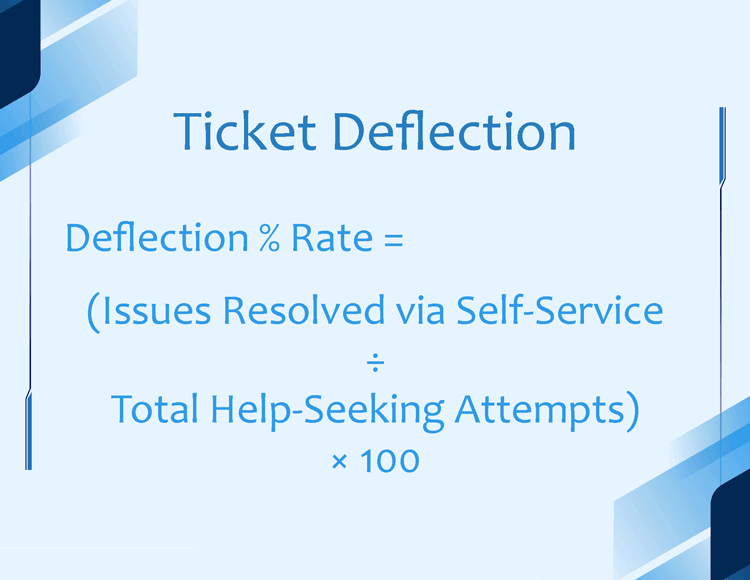
The most widely used formula is:
Ticket Deflection Rate = (Issues resolved via self-service / Total help-seeking attempts) × 100
For example: if 600 customers resolve their issues through self-service out of 1,000 total help-seeking attempts (self-service sessions plus tickets created), the deflection rate is 60%.
Some teams prefer a stricter, conservative version that only counts interactions where the user clearly attempted to contact support:
Conservative Rate = Deflected conversations / (Deflected conversations / Tickets created after a self-service attempt)
Whichever formula you use, document it clearly and apply it consistently. Mixing methods across reporting periods makes trend analysis unreliable.
What Counts as a Deflected Ticket?
A deflected ticket is an interaction where the user's issue was fully resolved through self-service, and they did not contact a human agent about the same issue within a defined window, typically 24 to 72 hours.
Page views alone do not equal deflection. A user who lands on a knowledge base article, reads three sentences, and then submits a ticket was not deflected, but they just failed to find the answer. Use engagement signals to validate actual deflection:
- Time on page (longer engagement suggests the content was useful)
- Scroll depth (did the user actually read the article?)
- Thumbs-up/thumbs-down feedback on the article
- Absence of a follow-up ticket or chat within 24–72 hours
Ticket Deflection Rate Benchmarks
Industry benchmarks vary considerably based on product complexity, support model, and how deflection is measured. The table below shows typical performance ranges, including the 23% technology industry average from ServiceXRG research:
Performance Level |
Deflection Rate |
Most organizations |
20–30% |
Technology industry average |
~23% |
Teams using AI-powered deflection |
40–60% |
Best-in-class AI implementations |
Up to 85% |
The right target depends on your context. A company handling complex enterprise software queries will naturally see lower deflection rates than one handling high-volume, simple consumer requests. Benchmarking by intent category (e.g., password resets vs. complex configuration questions) gives more actionable data than a single overall number.
Related Metrics to Track Alongside Deflection Rate
Deflection rate tells you how many tickets were avoided. It does not tell you whether users actually got their problems solved. Combine it with the following:
- AI resolution rate: The percentage of self-service interactions where the issue was fully closed
- First Contact Resolution (FCR): The percentage of tickets resolved on the first interaction with an agent
- Self-service engagement rate: The percentage of users who interact meaningfully with self-service content
- Customer Satisfaction (CSAT) score on self-service interactions
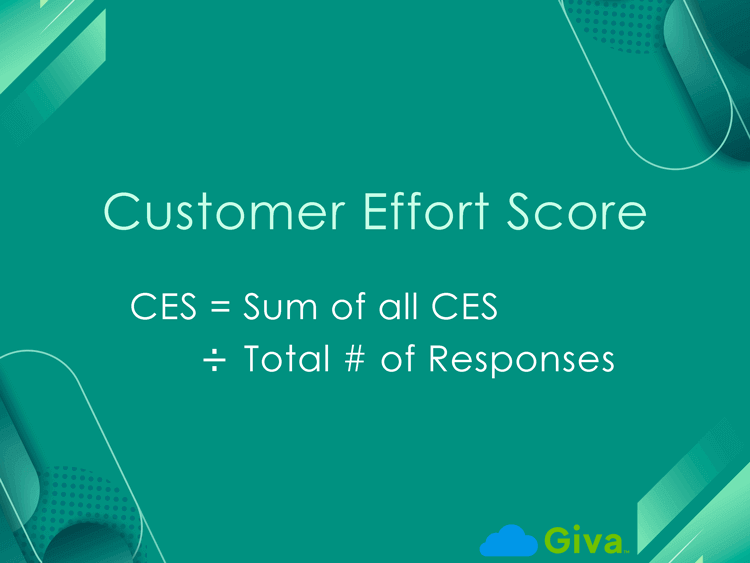
- Customer Effort Score (CES): Measures how easy or difficult users find it to resolve issues through self-service
- Cost per ticket: Tracks whether deflection is translating to financial savings
Key Benefits of Ticket Deflection
-
Reduced Agent Workload
Tier-1 support requests, which are the repetitive, low-complexity kind, consume up to 40% of an IT support agent's time on average. Ticket deflection removes this burden, freeing agents to focus on complex, high-value work that genuinely requires their judgment and expertise.
-
Lower Support Costs
Industry estimates put the cost savings from a single deflected ticket at $15–$20. For SaaS teams, the fully loaded cost per ticket (agent time, tooling, overhead, management) typically runs $4–$12. At scale, even modest deflection rates produce significant savings: a team deflecting 290 tickets per month at a $15 average saves over $50,000 a year.
To calculate deflection ROI:
Multiply monthly deflected ticket count by cost per ticket to get monthly savings, then subtract the cost of your self-service tooling.
For example, a team receiving 5,000 tickets per month with a 30% deflection rate (1,500 deflected tickets) at $10 per ticket saves $15,000 per month. If the self-service platform costs $2,000 per month, net monthly savings are $13,000, or $156,000 per year. The ROI calculation is: (total savings minus AI investment) divided by AI investment, times 100.
-
24/7 Availability
Knowledge bases, chatbots, and self-service portals do not keep business hours. A customer reaching out at 11 p.m. can get an answer immediately through self-service rather than waiting until morning. This is especially valuable for global organizations with users across time zones.
-
Faster Resolution for Users
When self-service works well, resolution is faster than any agent interaction. The user does not need to wait in a queue, explain their issue, wait for a response, and follow up. They type a question, find an article, and solve the problem in minutes.
-
Scalability Without Proportional Hiring
Growing your customer or employee base should not require a proportional increase in support headcount. Effective ticket deflection breaks this relationship: a well-maintained knowledge base and AI chatbot can absorb growth in support demand without adding agents.
-
Higher Customer and Employee Satisfaction
Most users prefer to resolve issues on their own when the right tools are available. Higher Logic research puts this in concrete terms: 84% of customers try self-service before contacting support, and 79% expect those tools to be there. When deflection works, satisfaction improves, and users get faster answers without waiting in a queue.
-
Consistent, Accurate Responses
Self-service tools deliver the same answer every time. Unlike agent responses, which vary by individual knowledge and mood, a knowledge base article or chatbot response is consistent across all users and all hours. This reduces the risk of conflicting information reaching customers.
8 Ticket Deflection Strategies That Work
-
Build a Comprehensive Knowledge Base
A knowledge base is the foundation of any deflection strategy. It is a centralized repository of articles, how-to guides, troubleshooting steps, and FAQs that users can search before submitting a ticket. The quality and coverage of the knowledge base directly determines how much deflection is possible. Go beyond written articles: include video tutorials for visual learners, step-by-step screencasts for complex processes, and downloadable reference guides where appropriate.
The most common failure here is breadth without depth. An article that answers 80% of a question will still generate a ticket. Each article should fully resolve the issue it targets, and the base should be reviewed regularly to catch outdated content.
Knowledge-Centered Service (KCS) is a widely used knowledge management methodology for building and maintaining knowledge bases by capturing resolutions as they happen rather than scheduling periodic content audits.
-
Deploy AI-Powered Chatbots
AI chatbots using Natural Language Processing (NLP) and machine learning can resolve a wide range of tier-1 requests in real time. Unlike older rule-based bots, modern conversational AI understands user intent, not just keywords. It can handle complex phrasings, follow multi-turn conversations, and pull answers from your knowledge base dynamically.
The quality of a chatbot's responses depends directly on the quality of the data it is trained on. Connect your chatbot to your knowledge base, product documentation, and resolved ticket history so it can draw from the most complete source possible. A chatbot that only knows what it was manually programmed to say will plateau quickly.
-
Create and Maintain FAQ Pages
FAQ pages address the most common questions directly and accessibly. They work best when they are organized by topic rather than listed as a single long page, when questions are written in plain language matching how users actually phrase them, and when they are updated every time a new question pattern emerges in the ticket queue.
Examine your ticket data regularly to identify FAQ gaps. If the same question is appearing in tickets, it does not yet have a satisfactory self-service answer and should be added to the FAQ.
-
Launch a Self-Service Portal
A self-service portal gives users a dedicated space to search the knowledge base, check ticket status, submit requests, and complete common actions (such as resetting a password or updating account information) without agent involvement. Integrated with your ticketing system, it can pre-populate ticket forms with context from the user's self-service attempts, reducing agent ramp-up time on escalated tickets.
In an ITSM context, the IT service catalog within the portal plays a particularly important role. A service catalog is a structured list of available IT services, such as software installs, hardware requests, access grants, and similar items, that employees can browse and request without calling the help desk. When paired with a knowledge base and AI suggestions, the service catalog becomes a core deflection tool by routing employees to the right service path before they turn to an agent.
-
Use Proactive Content Suggestions
When a user begins typing a ticket subject line, the system can analyze the text in real time and surface relevant knowledge base articles, FAQs, and resolved tickets before the user submits. If the suggested content answers their question, they abandon the ticket form and the issue is deflected without any additional effort.
This is one of the most effective deflection mechanisms because it catches users at the exact moment they are seeking help and presents self-service at the point of maximum relevance. Teams implementing this consistently report measurable reductions in ticket volume within weeks.
-
Offer Omnichannel and Multilingual Self-Service
Users seek help across multiple channels: web, mobile, email, Slack, Microsoft Teams, and social media. Your self-service tools need to be present wherever users are, not just on the help desk portal. An AI chatbot embedded in a Slack workspace, for example, can deflect IT requests without employees ever leaving the tool they already work in.
Omnichannel self-service ensures that your deflection coverage has no gaps by channel. For organizations with global user bases, multilingual support is equally important: a knowledge base or chatbot that only operates in English will fail to deflect tickets from users in other languages, and those users will escalate regardless of how strong your English-language content is.
-
Leverage Community Forums
For products with engaged user communities, peer-to-peer support can deflect a significant share of questions that would otherwise reach agents. Community forums are especially effective for complex or niche questions where experienced users often have faster, more contextual answers than the support team itself.
Community deflection requires active management to stay effective. Outdated or incorrect answers in forum threads generate their own support tickets when users follow bad advice. Moderation, pinned authoritative answers, and periodic content reviews are necessary to maintain quality.
Here are some best-practice tips:
- To get a community forum working as a deflection channel, seed it with resolved tickets converted into searchable posts before you expect organic activity.
- When conflicting answers appear in a thread, moderators should pin the authoritative response and mark it clearly, since unresolved disagreements in forum threads are a common cause of follow-up tickets.
- Define an escalation path for questions that go unanswered or generate only low-confidence replies. The forum should hand off to the support team, not leave users without an answer.
Community deflection works best for products with established power users and technically complex question types. For simple, high-volume requests (password resets, billing questions), a knowledge base or chatbot will outperform peer support on both speed and consistency.
-
Build Feedback Loops for Continuous Improvement
Deflection is not a one-time implementation. A knowledge base that was accurate six months ago may be outdated today. A chatbot trained on last year's product may not know about new features. Build explicit feedback mechanisms into every self-service touchpoint: article rating buttons, chatbot satisfaction prompts, and post-interaction surveys all generate data you can act on.
Review articles that are frequently visited but still followed by ticket submissions. These are your clearest content gaps. The ticket queue itself is a continuous signal: any question appearing repeatedly in tickets should trigger a self-service content update.
Ticket Deflection vs. First Contact Resolution (FCR)
Ticket deflection and First Contact Resolution (FCR) are related but measure different things. Confusing them leads to misreading support performance data:
- Ticket deflection prevents a ticket from being created in the first place. The user resolves their issue through self-service before any formal support interaction begins. The ticket queue never sees the request.
- First Contact Resolution (FCR) measures how effectively an existing ticket is closed on the first interaction with an agent. It applies after a ticket has already been created. FCR is a quality metric; it says nothing about how many tickets were prevented upstream.
A third concept, resolution rate, measures what percentage of support requests (including self-service interactions) are actually solved, not just deflected. A high deflection rate does not guarantee a high resolution rate: if your chatbot deflects tickets by timing out or giving users irrelevant articles, those are counted as deflections but the users' problems remain unsolved. Track resolution rate alongside deflection rate to catch this.
Here is a summary comparison table:
|
Ticket Deflection |
First Contact Resolution (FCR) |
Resolution Rate |
When it applies |
Before a ticket is created |
After a ticket is created |
After a self-service or agent interaction |
What it measures |
Percentage of help-seeking attempts prevented from becoming tickets |
Percentage of tickets resolved in one agent interaction |
Percentage of requests where the issue was fully solved |
Focus |
Reducing ticket volume |
Quality at first agent contact |
Actual problem-solving outcome |
Who handles it |
Self-service tools (KB, chatbot, FAQ) |
Agents or automation at first contact |
Self-service or agents |
The most effective support operations optimize all three. High deflection with low resolution rate signals that self-service is failing users. High FCR with low deflection signals that agents are effective but the self-service layer is not doing its job.
How to Get Started with Ticket Deflection
The strategies above work best when introduced in a deliberate sequence. Trying to launch everything simultaneously leads to inconsistent content, fragmented user experiences, and difficulty attributing results.
Here is a practical starting sequence for most organizations:
- Audit Your Ticket Queue First: Pull 3–6 months of ticket data and identify the top 10–15 request categories by volume. These are your primary deflection targets. Do not guess, but build your content foundation around what users actually ask, not what you assume they ask.
- Build Content for Your Highest-Volume Intents: Write or improve knowledge base articles and FAQ entries for each of the top request categories you identified. Aim for full resolution in each article, not partial answers. This step comes before deploying any chatbot or AI tool, having self-service content as the foundation that AI builds on.
- Make Self-Service Visible: Embed links to your knowledge base and FAQ at every point of contact: the product interface, the support form, email auto-responses, and the channels where users seek help. If users cannot find self-service, it cannot deflect anything.
- Deploy AI Gradually: Start with a chatbot or AI agent covering your top 10–15 intents, not your entire catalog. Expand coverage as accuracy exceeds agreed thresholds (most teams aim for 90%+ confidence before broadening scope). AI that answers confidently on a narrow range beats AI that guesses across a wide one.
- Measure and Iterate: Instrument deflection rate, resolution rate, and CSAT from day one. Review metrics monthly. Use feedback signals (article ratings, escalation patterns, repeat contacts) to identify content gaps and refine AI responses. Ticket deflection improves over time only if you act on what the data shows.
Most teams see initial results within 30–60 days of completing steps 1–3. Full optimization of an AI-powered deflection program typically takes 3–6 months as the system learns from real interactions and content quality improves.
Common Ticket Deflection Pitfalls to Avoid
-
Outdated or Thin Knowledge Base Content
A knowledge base that is not regularly maintained stops deflecting tickets and starts generating frustration. Users who follow outdated instructions, find irrelevant articles, or get partial answers will submit a ticket anyway, often more frustrated than if they had never tried self-service. Assign ownership of knowledge base maintenance, build review cycles into your team's workflow, and treat content gaps as actionable defects rather than low-priority backlog items.
-
Hiding Self-Service Tools
Many organizations build excellent knowledge bases and then bury them at the bottom of a page, behind a login wall, or in a location users would not think to look. Self-service tools need to be visible at the point of need: on the product itself, in the support widget, at the start of the ticket submission flow, and in the channels where users seek help. Discovery drives adoption.
-
Treating Deflection as "Set It and Forget It"
Deploying a chatbot or launching a knowledge base is a starting point, not a completed project. Ticket deflection requires ongoing investment: content updates, AI retraining, feedback analysis, and periodic audits. Teams that launch and move on typically see deflection rates plateau or decline as content ages and user needs evolve.
-
Optimizing the Metric Without Checking Resolution Quality
A deflection rate can be inflated by chatbots that time out conversations, article views that go unrated, or portal sessions that end without confirmation that the issue was resolved. High deflection with declining CSAT or rising repeat contacts is a red flag that the metric is being gamed rather than earned. Always cross-reference deflection rate with self-service satisfaction scores and resolution rate.
-
Lack of Integration Between Self-Service and the Ticketing System
When self-service tools operate in isolation from your ticketing system, you lose visibility and continuity. If a user spends ten minutes in your knowledge base before escalating to an agent, the agent should see that context. Integration enables more accurate deflection measurement, automatic ticket suggestion at the point of submission, and automatic population of ticket fields from chatbot conversations.
-
No Measurement or Feedback Loop
Teams that do not measure deflection cannot improve it. Without data on which articles are driving deflections, which chatbot paths are failing, and which ticket types still lack adequate self-service coverage, improvement is driven by guesswork. Instrument every self-service touchpoint from day one, even if the initial data is imperfect.
-
Deploying AI Without Guardrails
GenAI-powered chatbots can generate confident, plausible-sounding responses that are factually wrong. When this happens, the ticket is counted as deflected but the user has been misled. In a support context, a hallucinated answer to a billing, compliance, or technical question can cause real damage and erode trust in your self-service tools faster than almost any other failure mode.
Guardrails are not optional. Set confidence thresholds that route low-certainty responses to a human agent, ground the AI strictly to your verified knowledge base rather than open-ended generation, and run regular audits of AI-resolved interactions to catch systematic errors early. Deflection rate and CSAT on AI-resolved tickets together will reveal whether the AI is actually solving problems or just deflecting them.
Ticket Deflection FAQs
-
What is the difference between ticket deflection and first contact resolution?
Ticket deflection happens before a ticket is created. It measures how many support requests were resolved through self-service without ever reaching an agent. First Contact Resolution (FCR) measures how effectively agents close tickets on the first interaction after a ticket already exists.
They measure different stages of the support process. A support operation can have high FCR (agents are effective) and low deflection (too many easy tickets are still reaching agents), or high deflection and low resolution rate (self-service is deflecting but not actually solving problems). See the comparison section above for a full breakdown.
-
How does AI improve ticket deflection?
AI improves ticket deflection in several concrete ways. Natural Language Processing (NLP) allows AI systems to understand what a user is asking even when the phrasing is informal, incomplete, or includes typos. This dramatically expands the range of questions a chatbot can handle compared to keyword-matching systems.
Machine learning continuously improves the system by analyzing which responses actually resolved issues. Over time, the AI becomes more accurate at matching user intent to available answers, and can identify knowledge base gaps by flagging question patterns that it cannot currently resolve.
In practical terms, teams using AI-powered deflection typically see deflection rates jump from the 20–30% range (typical of knowledge-base-only approaches) to 40–60% or higher. Response times also improve dramatically, since AI resolution is essentially instantaneous compared to agent queue times.
-
What tools are used for ticket deflection?
The main tools for ticket deflection are:
- Knowledge base software: A searchable repository of articles, guides, and FAQs
- AI-powered chatbots: Conversational agents that resolve requests in real time using NLP
- Self-service portals: Dedicated user interfaces for browsing services, submitting structured requests, and taking self-service actions
- Proactive suggestion widgets: Embedded tools that offer relevant articles at the ticket submission stage
- Community forums: Peer-to-peer support platforms for questions that benefit from experienced-user input
These tools work best when they are integrated with your ticketing system so that self-service attempts are tracked, context is passed to agents on escalation, and deflection data is captured accurately.
-
How long does it take to see results from ticket deflection?
With basic automation and a well-organized knowledge base, most teams see measurable reductions in ticket volume within 30–60 days. The initial gains typically come from addressing the highest-volume, easiest-to-answer request types.
More complex AI-powered deflection takes longer to optimize. AI systems learn from interaction data and improve over the first 3–6 months as volume accumulates. Full ROI from a complete deflection program typically takes 6 months to a year, depending on implementation complexity and the quality of the content foundation.
-
When is ticket deflection NOT the right goal?
Ticket deflection is not universally the right optimization. Pursuing a higher deflection rate in the wrong contexts produces outcomes that are measurably worse for users and, ultimately, for the business.
-
High-stakes or complex issues should not be deflected: A user troubleshooting a billing dispute, a compliance-sensitive configuration change, or a data loss incident needs a human. Routing these interactions to a chatbot or a knowledge base article does not reduce support costs, but it erodes trust, prolongs resolution, and often creates a worse ticket downstream when the user eventually escalates anyway.
The most effective deflection programs exclude high-severity and high-complexity intent categories from their deflection targets entirely, routing them directly to agents regardless of self-service availability.
-
Relationship-sensitive interactions are also poor deflection candidates: Enterprise customers with active contracts, users in onboarding, and high-value accounts often expect direct human access as part of the service they are paying for. Forcing these users through self-service when they have explicitly chosen to contact support signals that the organization is optimizing for cost reduction over customer success.
The deflection rate for these segments should not be a primary performance metric.
The underlying goal is appropriate deflection, not maximum deflection. A 70% deflection rate built on resolved, satisfied users is a strong outcome. A 70% deflection rate built on chatbots timing out and knowledge base articles that do not fully answer the question is a liability.
Always keep a clear and simple escalation path: users who cannot easily reach a human when self-service fails will leave, and not just submit a ticket.
-
High-stakes or complex issues should not be deflected: A user troubleshooting a billing dispute, a compliance-sensitive configuration change, or a data loss incident needs a human. Routing these interactions to a chatbot or a knowledge base article does not reduce support costs, but it erodes trust, prolongs resolution, and often creates a worse ticket downstream when the user eventually escalates anyway.
What is a good ticket deflection rate?
Most organizations achieve a deflection rate of 20–30%. Teams using AI-powered chatbots and well-maintained knowledge bases typically reach 40–60%, and best-in-class implementations have reported rates up to 85% for high-volume, routine request types.
The right target depends on your context. A help desk handling complex enterprise software issues will see lower deflection rates than one supporting simple consumer products. More useful than a single overall rate is benchmarking by request type: you might achieve 80% deflection on password resets but only 25% on configuration questions, and both numbers tell you something different about where to invest.
Related Giva Resources
- Complete Guide to ITSM Ticket Management + Best Practices
- Complete Guide to Customer Service Knowledge Management
- 10 Top Knowledge Base Benefits & How to Choose the Best Software
- AI Knowledge Base: 10 Benefits & 7 Top Providers
- IT Help Desk Ultimate Guide
- Benefits of Customer Self Service Portals
Ticket Deflection: The Foundation of a Scalable Support Operation
Ticket deflection is not a shortcut for avoiding user problems. Done well, it is the opposite: it gives users faster, more consistent access to answers while freeing your team to do the work that genuinely requires their expertise. The organizations seeing 40–60% deflection rates are not manipulating a metric but have built knowledge bases their users actually trust, deployed AI that understands real questions, and put self-service in front of users at the exact moment they need it.
One distinction worth keeping clear: a ticket that bounces from a chatbot back to an agent is not a deflection success. A user who finds the answer in two minutes through your knowledge base is. Measure resolution alongside deflection rate not as an afterthought, and let both numbers drive where you invest next.
Start with the highest-volume, most repetitive request types. Build or improve the self-service content for those first, instrument deflection and resolution rates, and iterate. Every percentage point reduction in ticket volume translates directly into agent capacity, cost savings, and faster resolution for users, and those gains compound over time.
See How Giva Supports Ticket Deflection at Scale
Effective ticket deflection requires the right platform underneath it, one that combines a well-organized knowledge base, a self-service portal, and a ticketing system that captures self-service context and escalates cleanly when needed.
Giva's help desk is built around exactly this combination:
- The integrated knowledge base and AI Copilots surface accurate answers to users without requiring them to submit a ticket.
- When escalation is needed, agents receive full context from the self-service session, reducing resolution time.
For customer service and IT teams alike, Giva brings these tools together in a single platform designed to reduce volume and improve outcomes.
Whether you are building a deflection strategy from scratch or looking to improve an existing one, the right tooling makes a measurable difference.
Get a demo to see Giva's solutions in action, or start your own free, 30-day trial today!


Categories: Help Desk