Call Center Shrinkage: How to Calculate and Improve for Streamlined Service
Managing a high-performing call center requires more than recruiting, training, and retaining a team of talented agents and using the latest, most useful AI-powered software.
Behind every successful operation is careful workforce management. An essential part of that is understanding and controlling call center shrinkage. Shrinkage directly impacts your ability to meet service levels, control costs, and maintain customer satisfaction.
What Is Call Center Shrinkage?
Call center shrinkage is the difference between the time agents are scheduled to work and the time they actually spend handling customer interactions.
Unlike more accurate resourcing tools, such as an Erlang calculator, working out "shrinkage" is more of an "estimate-based" approach to planning. And yet, it provides a more realistic layer for planning staff levels and their alignment with service delivery levels, KPIs, and Service Level Agreements (SLAs).
Simply put, shrinkage is the percentage of paid hours during which agents aren't able to handle customer calls, messages, or Live Chats.
Further Breakdown of Call Center Shrinkage
The definition of call center shrinkage encompasses any activity that prevents agents from being productive during their scheduled shifts. Realistically, it's humanly impossible for agents to sit through an entire shift taking calls and doing wrap-up work, even if we take out basic human needs, like eating, drinking, and bathroom breaks.
Shrinkage includes both planned and unplanned absences from their workstations. Unlike attrition (which measures employees leaving vs. new hires), shrinkage measures time lost during the average shift, week, month, quarter, and year.
Shrinkage falls into two main categories:
-
Planned Shrinkage (also called Discretionary Shrinkage) includes scheduled activities that are necessary but non-productive:
- Breaks and meal periods
- Team meetings and huddles
- Training sessions and coaching
- One-on-one meetings with supervisors
- Planned vacation time
- Company events or town halls
- System maintenance downtime
-
Unplanned Shrinkage (also called Non-Discretionary Shrinkage) includes unexpected absences and activities:
- Sick leave and unexpected absences
- Technical issues and system outages
- Extended bathroom breaks (if a person is unwell, for a variety of reasons)
- Being late or having to leave early (if someone has unexpected childcare issues or gets stuck in traffic)
- Unscheduled personal time (which happens to any of us at times)
- Administrative tasks that run long, like an extra-long piece of wrap-up work, because of a complex issue with a customer
Understanding both types of shrinkage is essential. You can anticipate and schedule around planned shrinkage. But unplanned shrinkage creates gaps that directly affect service levels and result in longer customer wait times. In turn, this impacts KPIs and other measurements.
Internal vs. External Shrinkage
Call center shrinkage is also commonly categorized by where the cause originates:
- Internal shrinkage occurs when agents are present (or logged in, for remote teams) but unavailable to handle contacts due to team meetings, training sessions, system downtime, or extended after-call work. Because these activities happen inside the operation, they are largely within the call center's control and can be scheduled, batched, and optimized.
- External shrinkage is caused by factors outside the workplace: planned vacations, public holidays, sick leave, tardiness, and unscheduled personal time. These are harder to prevent entirely but can be planned around with accurate historical absence tracking.
Why Call Center Shrinkage Matters
Shrinkage has a multiplying effect on workforce requirements in every call center. If your shrinkage is 30%, you need to schedule about 43% more agents than your base staffing requirements. For a team that, on paper, needs 70 agents on the phones, you'd actually need to schedule about 100 agents to account for shrinkage.
High shrinkage rates lead to:
- Higher labor costs without more productivity
- Longer customer wait times and worse service levels
- Agent burnout from understaffing during peak periods
- Difficulty meeting Service Level Agreements (SLAs)
- Lower customer satisfaction scores (e.g., CSAT, NPS, etc.)
Further, call centers that treat shrinkage as a primary Workforce Management (WFM) indicator by factoring it into headcount decisions at the hiring stage, and not just scheduling models after hiring, consistently achieve higher service levels at lower cost. When shrinkage informs how many agents are recruited in the first place, the overstaffing and understaffing cycles that drive burnout and missed SLAs become far less frequent.
Call Center Shrinkage Benchmarks
Overall
Global benchmarks have an average call center shrinkage range between 30% and 35%. High-performing centers often maintain rates between 20% and 25%. Centers with shrinkage above 35% typically face significant operational challenges.
However though, in extreme cases, particularly in high-churn BPO environments or poorly managed retail contact centers, shrinkage can reach upwards of 60%. At that level, staffing requirements approach triple the baseline agent count, and maintaining consistent service levels becomes operationally unsustainable without structural intervention.
By Industry
Shrinkage levels vary widely depending on the type of call center, the industry regulated requirements, and the complexity of support offered:
Industry |
Range |
Reasons |
Healthcare and Insurance |
20% – 28% |
Strict compliance requirements, regulated workflows, and lower tolerance for schedule variance keep shrinkage on the lower end. |
Financial Services and Banking |
20% – 30% |
Strong adherence culture, but high training/coaching needs increase planned shrinkage. |
Retail and Ecommerce |
30% – 40% |
Seasonal peaks, younger workforce, higher turnover, and more schedule volatility increase both planned and unplanned shrinkage. |
Technology and SaaS |
25% – 33% |
Frequent product updates, regular training, and multichannel support create more planned shrinkage. |
Travel and Hospitality |
28% – 38% |
Highly seasonal demand, long average handle times, and complex issue types contribute to higher shrinkage. |
Utilities and Telecom |
25% – 32% |
Stable staffing models but higher technical troubleshooting and escalations increase wrap-up time and coaching needs. |
Government / Public Sector |
22% – 30% |
Structured scheduling and lower absenteeism but high training and compliance needs maintain moderate shrinkage. |
30% – 40% |
Wide variability across clients, rapid onboarding, diverse workflows, and high employee churn elevate shrinkage. |
How to Calculate Call Center Shrinkage
Calculating call center shrinkage requires understanding two key metrics: total scheduled time and total productive time (also called available time or handle time).
The Call Center Shrinkage Formula
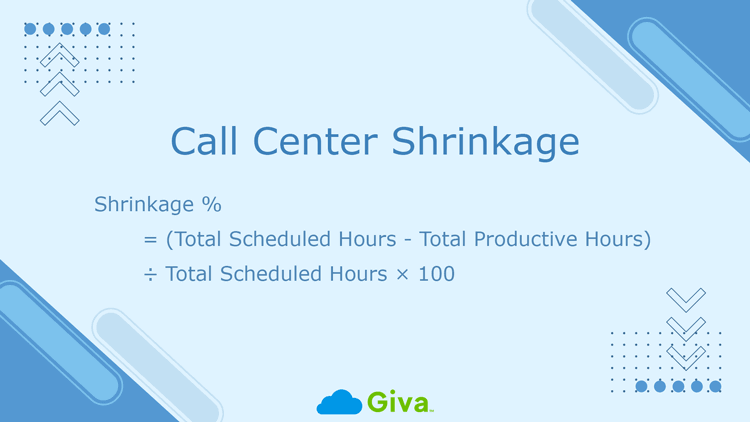
The basic call center shrinkage formula is:
Shrinkage % = (Total Scheduled Hours - Total Productive Hours) / Total Scheduled Hours × 100
Or expressed another way:
Shrinkage % = Total Non-Productive Hours / Total Scheduled Hours × 100
This is usually calculated over a 12-month period. Let's break down what each component means:
- Total Scheduled Hours: All hours agents are paid to be at work
- Total Productive Hours: Time agents spend actually handling customer contacts (calls, chats, emails)
- Total Non-Productive Hours: The difference between scheduled and productive time
Step-by-Step Calculation Example
Let's walk through a practical example to show how the call center shrinkage formula works.
Scenario: You have 50 agents working 8-hour shifts (40 hours per week each).
-
Step 1: Calculate Total Scheduled Hours
- 50 agents × 40 hours per week = 2,000 total scheduled hours
-
Step 2: Identify Non-Productive Time
-
Planned shrinkage:
- Breaks: 2 × 15-minute breaks per day = 30 minutes per agent per day = 2.5 hours per week × 50 agents = 125 hours
- Lunch: 30 minutes per day × 5 days = 2.5 hours per week × 50 agents = 125 hours
- Team meetings: 1 hour per week × 50 agents = 50 hours
- Training: 2 hours per week × 50 agents = 100 hours
-
Unplanned shrinkage:
- Sick time: Average 2% of workforce absent = 40 hours
- Technical issues: Average 1 hour per week per agent = 50 hours
- Miscellaneous (tardiness, extended breaks): 30 hours
-
-
Step 3: Calculate Total Non-Productive Hours
- Total non-productive time = 125 + 125 + 50 + 100 + 40 + 50 + 30 = 520 hours
-
Step 4: Apply the Formula
- Shrinkage % = 520 / 2,000 × 100 = 26% shrinkage
-
Step 5: Calculate Required Staffing
- If you need 50 agents available for productive work, with 26% shrinkage, you actually need:
- Required staff = 50 / (1 - 0.26) = 50 / 0.74 = 68 agents scheduled
Breaking Down Shrinkage by Category
For better workforce management, calculate shrinkage rates for different categories:
- Planned Shrinkage Rate = (Total Planned Non-Productive Hours / Total Scheduled Hours) × 100
- Unplanned Shrinkage Rate = (Total Unplanned Non-Productive Hours / Total Scheduled Hours) × 100
Using our example:
- Planned shrinkage = (400 / 2,000) × 100 = 20%
- Unplanned shrinkage = (120 / 2,000) × 100 = 6%
- Total shrinkage = 26%
This breakdown helps identify specific areas for improvement. If unplanned shrinkage spikes to 10% or higher, you know you have attendance or technical issues to address.
Advanced Calculations
Adherence vs. Shrinkage
It's essential to know the difference between shrinkage and adherence. They measure different things:
- Shrinkage measures the percentage of scheduled time when agents aren't available to handle contacts
- Adherence measures how well agents stick to their assigned schedules when they are available
An agent might have good adherence (follows their schedule) but still contribute to high shrinkage if they take all allowed breaks and scheduled time off.
Poor time management means that call center agents aren't following their schedules even when they should be productive. This has a negative impact all around, especially if you've factored in shrinkage, and then agents are wasting even more time.
Daily and Interval-Level Shrinkage
Most teams calculate shrinkage at the weekly or monthly level, but shrinkage can fluctuate hour-by-hour, and even sometimes minute-by-minute. Looking only at long-term averages hides these spikes, which is why daily and interval-level shrinkage tracking is so valuable.
When interval shrinkage increases, service levels drop fast, especially during high-volume windows. Tracking these fluctuations lets you adjust schedules more precisely.
Call centers commonly measure shrinkage in 15, 30, or 60-minute intervals to reflect real workload patterns.
For example, a center may show 24% shrinkage for the full day, but the 9:30–10:00 a.m. interval might spike to 36% because multiple teams take breaks, meetings overlap, or agents are transitioning between channels.
Example of interval shrinkage tracking:
- 9:00–9:30: 22% shrinkage
- 9:30–10:00: 36% shrinkage (breaks + coaching)
- 10:00–10:30: 18% shrinkage
- 10:30–11:00: 26% shrinkage (technical outage)
By identifying these peaks, teams can stagger breaks, rearrange training, introduce micro-coaching instead of long sessions, or adjust staffing requirements for specific intervals. Over time, this reduces unexpected service level drops and smooths out daily performance.
Shrinkage in Remote and Hybrid Call Centers
Remote and hybrid call centers operate differently from fully onsite environments, and their shrinkage patterns differ too. While remote work offers flexibility and broader talent availability, it can introduce new sources of unplanned shrinkage that aren't as common onsite.
Common causes of remote/hybrid shrinkage include:
- Home internet outages or bandwidth limitations
- Device or VPN failures
- Longer ramp-up time when switching between tools
- Distractions or childcare obligations
- Communication gaps that slow down coaching or feedback cycles
- Delayed logins or early logouts that are harder to detect without real-time visibility
These issues can add 3–8% to unplanned shrinkage if not carefully managed.
Remote teams can achieve shrinkage levels equal to or lower than onsite teams, but only with strong visibility, structured communication, and reliable technology.
Common Calculation Mistakes to Avoid
- Not tracking all shrinkage components: Missing categories like coaching time or admin tasks underestimates actual shrinkage.
- Using inconsistent time periods: Mixing daily, weekly, and monthly data creates inaccurate calculations.
- Forgetting to convert time formats: Mixing minutes and hours leads to errors.
- Not separating planned vs. unplanned: This prevents targeted improvement efforts.
- Ignoring seasonal variations: Shrinkage often increases during holidays and summer months.
How to Improve Call Center Shrinkage
Reducing shrinkage by even a few percentage points can significantly impact your bottom line. A call center with 100 agents earning an average of $15/hour working 40-hour weeks represents $3.12 million in annual payroll.
Reducing shrinkage from 30% to 25% could save about $156,000 annually, making your whole call center more cost-effective.
-
Implement Accurate Forecasting and Scheduling
Proper workforce management begins with understanding your actual shrinkage patterns:
-
Track historical data: Analyze at least six months of shrinkage data to identify patterns. Look for:
- Day-of-week variations (shrinkage often spikes on Mondays and Fridays)
- Seasonal trends (higher shrinkage during holiday periods)
- Time-of-day patterns (certain shifts may have higher shrinkage)
- Use the data to schedule smarter: Once you understand your patterns, build shrinkage into your scheduling models. If your Monday morning shrinkage averages 35% due to team meetings and training, schedule 35% more agents for that period.
- Create schedule flexibility: Use shift bidding or flexible scheduling, where high-performing agents get first choice of schedules. This increases satisfaction and reduces unplanned absences.
-
-
Establish Clear Attendance Policies
Unclear attendance policies create problems. Your policies should clearly define:
- Break protocols: Specify how long breaks should last, when agents can take them, and what happens if they run over. This should all be in training, and if anyone runs over their break, make sure to remind them of the consequences. Use automatic timers or scheduling systems that send reminders.
- Tardy and absence procedures: Use a progressive discipline policy that's consistently enforced. Many centers use a point system. Each absence or tardy incident accumulates points, with consequences at specific thresholds.
- Exception request process: Create a formal system for requesting time off, shift swaps, or schedule changes. Digital systems work better than paper processes. They provide better visibility and faster approvals.
- Communication expectations: Define how and when agents should report absences. Clarify what counts as adequate notice for planned time off.
-
Optimize Planned Shrinkage Activities
You can't eliminate breaks and training, but you can make them more efficient:
- Consolidate meetings: Instead of multiple short meetings throughout the week, consider one comprehensive team meeting. Use team communication platforms for quick updates that don't require everyone to be offline at once, like Slack or anything else your workplace uses.
- Schedule strategically: Hold team meetings, training sessions, and coaching during lower-volume periods. Most call centers have predictable call volume patterns. Use your historical data to identify the best times for non-productive activities.
- Improve training efficiency: Move from scheduled classroom training to self-paced eLearning modules, to make training more efficient and reduce its impact on shrinkage.
- Agents can complete these during natural workflow gaps. Reserve live training sessions for skills that need real-time, in-person interaction.
- Leverage technology for coaching: Use call recording and quality-monitoring tools for coaching that doesn't happen in real time. Managers can review calls and provide feedback through written notes or recorded videos. Agents review these during downtime rather than being pulled offline for live coaching sessions.
-
Address Unplanned Shrinkage Root Causes
Unplanned shrinkage is often a symptom of deeper issues:
-
Conduct absence analysis: Don't just track attendance; make a point of understanding why agents are absent, or why shrinkage is creeping up. High unplanned absence rates may indicate any of the following issues:
- Burnout from poor scheduling or insufficient breaks
- Low engagement or job satisfaction (which is often reflected in not hitting KPIs, especially time or customer-satisfaction-based scores)
- Health issues potentially related to the work environment
- Personal situations that might be addressed with flexible scheduling
-
Improve agent engagement: Engaged employees have lower absence rates. Consider the following:
- Recognition programs that reward good attendance and performance
- Career development opportunities
- Regular one-on-ones to address concerns before they escalate
- Team-building activities that foster connection
-
Enhance workplace wellness: Implement programs that support agent wellbeing, such as but not limited to:
- Ergonomic workstation assessments
- Stress management resources
- Flexible break policies that allow agents to step away when needed
- Mental health support and employee assistance programs
- Monitor and respond to trends: Use real-time monitoring to identify and address shrinkage spikes immediately. If you notice Tuesday absences trending upward, investigate and address the cause before it becomes a pattern.
-
-
Leverage Real-Time Monitoring and Accountability
As the saying goes, what gets measured gets managed, and if you measure shrinkage, then you can do something about it. Here are ways you can do that:
- Real-time dashboards: Use systems that display current shrinkage levels. This allows supervisors to make immediate staffing adjustments. When unplanned shrinkage creates gaps, managers can shift agents from back-office tasks or request voluntary overtime.
- Individual accountability: Track shrinkage at the agent level, not just at the team level. Agents who know their shrinkage is being monitored tend to be more careful about following schedules.
-
Gamification:
- Create friendly competition around shrinkage reduction.
- Display leaderboards showing teams or individuals with the best adherence and lowest unplanned shrinkage.
- Offer incentives for consistent performance
- Regular shrinkage reviews: Make shrinkage a standing item in performance reviews. When agents understand how their individual behavior impacts team performance, they're more likely to improve.
-
Create a Culture of Accountability
The most effective shrinkage reduction comes from cultural change:
- Lead by example: Supervisors and managers should model the behavior they expect agents to display. If managers regularly show up late or take extended breaks, agents will do the same. This goes double if you have teams working from home (WFH). You've got to show attendance, while also being flexible to what the staff needs.
- Transparent communication: Share shrinkage metrics with the team. Explain how high shrinkage impacts everyone through understaffing, increased stress, and potentially reduced bonuses or pay increases.
- Peer accountability: Foster an environment where team members support each other in maintaining schedules. When everyone understands that one person's unplanned absence creates a burden for others, social pressure can also prevent too much more of the same (unless it's for a good reason, like physical or mental health, looking after children, or an elderly relative or parent).
- Celebrate improvements: When shrinkage rates improve, acknowledge the team's effort, and share how it's benefiting the organization and customers. Whenever possible, reward the team meaningfully, such as with a bonus or gift vouchers.
Ready to see how the right software can transform your call center management? Start a free trial of Giva's customer service platform or get a demo to see real-time reporting and analytics in action.
How Software and Tools Can Help Manage Call Center Shrinkage
Modern call center software provides powerful capabilities for tracking, analyzing, and reducing shrinkage. Manual methods simply can't match what technology offers:
-
Advanced Workforce Management and Real-Time Analytics
Advanced workforce management platforms offer capabilities specifically designed to combat shrinkage. Many features are incorporated into call center software to manage and monitor anything that impacts workforce management, including shrinkage:
- Automated time tracking: Systems automatically record when agents log in, take breaks, and handle calls. This eliminates manual tracking errors and provides precise shrinkage data. Automation removes guesswork and ensures you're working with accurate, real-time data.
- Predictive analytics: Machine Learning (ML) algorithms analyze historical patterns to predict future shrinkage rates with remarkable accuracy. These systems can identify that Tuesdays following three-day weekends have 40% higher shrinkage, making it easier for you to schedule accordingly.
- Real-time visibility: Modern dashboards display current shrinkage levels, adherence rates, and service level status in real time. When shrinkage exceeds thresholds, supervisors receive instant alerts. This makes it easier for you to take immediate action; whether reassigning agents, approving overtime, or adjusting break schedules.
- Comprehensive reporting: Advanced reporting engines let managers drill down into shrinkage data by agent, team, time period, or shrinkage category. This helps identify specific problem areas and measure the impact of improvement initiatives.
-
Integrated Scheduling and Absence Management
Call center software with built-in scheduling capabilities streamlines shrinkage management:
- Schedule optimization: These systems automatically build schedules that account for historical shrinkage patterns. This ensures adequate coverage even with expected absences. The software calculates exactly how many agents need to be scheduled to maintain service levels after accounting for breaks, meetings, and typical absence rates.
- Self-service portal: Agents can request time off, swap shifts, or update their availability through digital portals. Supervisors receive instant notifications and can approve requests with one click. This reduces administrative shrinkage and provides better visibility into upcoming absences.
- Automatic notifications: When scheduled agents don't log in on time, the system automatically alerts supervisors. They can quickly call in backup coverage before service levels suffer.
- Absence tracking: Comprehensive absence management modules automatically track sick time, vacation usage, and who is often late, and by how many minutes. The system can flag agents approaching policy thresholds. This enables proactive intervention before attendance becomes a disciplinary issue.
-
Performance Management and Agent Engagement Tools
Call center support platforms provide features that directly support shrinkage reduction:
- Intuitive interface: When software is easy to use, agents can resolve customer issues quickly. They spend less time on administrative tasks and more time being productive. Giva's emphasis on intuitive design means agents require minimal training, often in just one hour. This reduces training-related shrinkage significantly.
- Knowledge base integration: Built-in knowledge management features reduce the time agents spend searching for information or consulting supervisors. When agents can instantly access the answers they need, average handle time decreases and productive time increases.
- Rapid deployment: Giva's cloud-based platform can be deployed in days rather than months. This minimizes implementation-related downtime. With less time spent on system setup and training, teams can return to full productivity faster.
For call centers looking to gain better control over shrinkage, comprehensive customer service software like Giva provides the visibility, automation, and efficiency needed to identify problems quickly and take corrective action. With robust reporting capabilities and an intuitive interface that reduces training time, Giva helps centers maintain lower shrinkage rates while improving overall operational efficiency.
Conclusion: Taking Control of Call Center Shrinkage
Managing call center shrinkage effectively requires accurate measurement, strategic planning, and the right technology. When you understand your actual shrinkage rate using the proper formula, breaking it down into planned and unplanned components, and implementing targeted improvement strategies, you can significantly enhance workforce efficiency and reduce unnecessary labor costs.
Remember that industry-leading call centers maintain shrinkage rates between 20% and 25%. The average hovers between 30% and 35%.
Even a 5% shrinkage reduction in a 100-agent center can translate into 6 or 7 additional Full-Time Equivalents (FTEs) available to serve customers, without adding headcount.
Treat shrinkage as a strategic priority, not just a workforce management metric. Use technology to gain visibility into patterns. Establish clear policies and accountability measures. Address root causes of unplanned absences. Create a culture where agents understand how their individual choices impact team performance.
With consistent focus and the right tools in place, you can bring shrinkage under control, improve customer service levels, and customer satisfaction scores, and drive better business outcomes.
Additional Call Center Resources
- Giva's List of 24 Top Call Center Statistics for 2025
- Top 12 Mission-Critical Call Center Metrics: A Comprehensive Guide for CX Leaders
- Customer Service Resource Center
- 20 Top Strategies for Proactive Customer Service Plus Examples
- Buyer's Guide: The Best Customer Service Software Solutions
Giva Can Help Streamline Your Call Center Operations
Supercharge your call center agents and team performance with Giva's Customer Service Software. Giva comes with a simple, clean design.
- Start serving customers after just 1 hour of training
- Resolve issues quickly and effortlessly with AI Copilots, automation, and smart workflows
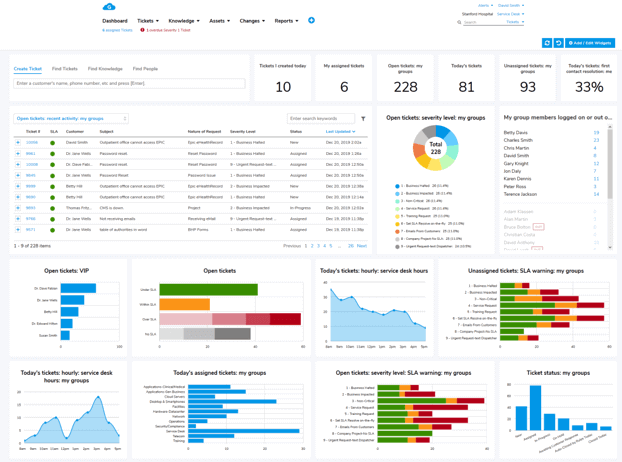
- Get immediate and actionable customer insights with highly visual dashboards, reports, charts, and graphs
Ready to see how the right software can transform your call center management? Start a free trial of Giva's customer service platform or get a demo to see real-time reporting and analytics in action.



Categories: Customer Service