Case-Based Reasoning (CBR): What It Is, How It Works, and How It's Used in Help Desks
AI systems help companies in a variety of ways including improving customer satisfaction ratings, reducing operational costs, and increasing revenue. AI has many other advantages for customer service that human agents cannot compete with — it is always available, 24/7 and never gets tired or distracted. One of the leading AI systems in this area is Case-Based Reasoning, with the capability of learning from every ticket they resolve and get progressively better at matching new problems to proven solutions.
What is Case-Based Reasoning?
Case-Based Reasoning (CBR) is an artificial intelligence and cognitive problem-solving methodology that solves new problems by retrieving and adapting solutions from similar past experiences, rather than building answers from scratch or relying on static rule sets. When a new problem arrives, the system searches a library of resolved cases, identifies the closest match, adapts that stored solution to fit the new situation, and then adds the result to its library for future reference.
For example, if a help desk ticket comes in about a printer error, the system looks up similar past cases, finds the fixe that resolved the issue, and presents it.
Case-Based Reasoning (CBR) is increasingly used by customer service departments to improve their performance and help desk software providers to offer even more intelligent solutions for their customers.
What is the Case-Based Reasoning Cycle?
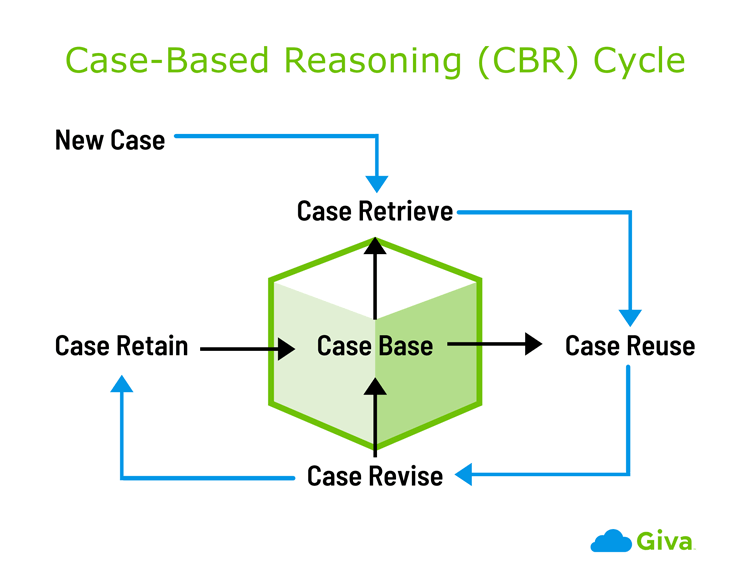
CBR operates as a four-step cycle known as the Four Rs:
-
Retrieve
When a new help desk ticket arrives, the system searches its case library for previously resolved issues that closely match the current problem, ranking candidates by similarity score.
-
Reuse
The most relevant past case, along with its solution, is applied to the new situation. In a help desk context, this means surfacing the resolution steps that fixed a similar ticket.
-
Revise
No two problems are identical, so the retrieved solution is adapted to fit the specifics of the current issue. A support agent or the automated system adjusts the fix as needed and validates that it works.
-
Retain
Once the problem is resolved, the new case and its adapted solution are stored in the case library. Over time, this makes the system progressively better at matching future tickets.
How does a CBR system decide which past case is most similar to the current problem? Most implementations use a similarity function that scores each stored case against the incoming problem by comparing relevant features.
- Ticket category or issue type
- Error code or symptom description
- Affected system or application
- User role or department
A simple approach weights each feature equally, but more sophisticated systems assign higher weights to the features that have historically produced the most accurate matches. This is what distinguishes CBR from a basic keyword search. Two tickets with different wording can still match if their underlying features align.
What are the Advantages of Case-Based Reasoning Systems and Its Limitations?
-
Advantages of CBR
- The AI help desk system is constantly updating its knowledge base with up-to-date customer service issues and questions, making it more efficient in solving problems for customers than human agents can be. Further, the entire model does not need to be updated continuously.
- The AI also learns with every interaction so that it will become even more intelligent over time — something humans cannot do as quickly or efficiently.
- The CBR AI machine learning solution provides a cost-effective customer service option to businesses of any size while improving their bottom line by increasing revenues.
- Machine-Learning software also uses CBR to further the potential of Self-Improving help desk solutions.
- They are even capable of prioritizing cases.
- Since they have historical data on how complicated or lengthy a problem can be, they can quickly manage customer requests. Using the input specifications, they match the problems to their casebase. The AI then uses a combination of machine learning and human input to determine the best course for handling customer issues.
-
Limitations of CBR
- Most AI help desk chatbots use filtered-chat options to understand customer problems.
- In cases of unique concerns, a customer can become quickly frustrated if their need or concern is not an available option. In those cases, it becomes important to merge AI solutions and human agents to ensure that the IT agent is providing more intelligence to the system that it may be missing.
- It is only good as the information it has. If the quality of the data it is using lacks, it can provide irrelevant information. And if the information doesn't exist, it is unable to provide answers.
Case-Based Reasoning Applications Beyond the Help Desk
While CBR is popular in help desks, it is also often used in other industries, such as:
- Healthcare
Example: CBR supports clinical diagnosis by comparing a patient's current symptoms, lab values, and medical history against a library of previously diagnosed and treated cases. This is especially useful for rare diseases, where a physician may have limited personal experience with a condition but the case library contains historical matches from other practitioners. Clinical decision support systems that use CBR can surface similar past cases to guide the diagnosis and reduce the risk of missing an unusual presentation.
- Legal Services
Example: Lawyers and judges rely on case-based reasoning every time they search for precedents relevant to a new matter. Legal research tools that incorporate CBR compare the details of a current case against a library of prior decisions and surface the rulings most likely to be relevant, ranked by similarity. For practitioners with high caseloads, this cuts the time spent on manual precedent research and reduces the risk of missing a directly applicable ruling.
- Education
Example: E-learning platforms and intelligent tutoring systems use CBR to personalize remediation for struggling students. When a student repeatedly makes the same type of error, the system searches its case library for similar past mistakes and retrieves the explanations or exercises that helped comparable students succeed. Over time, the case library grows richer, making the platform progressively better at diagnosing why a specific error type occurs and what intervention actually helps.
These examples illustrate the versatility of CBR across various functional business areas.
Case-Based Reasoning vs. Other AI Approaches
There do exist other similar AI systems, so let's briefly compare a few of them to the CBR approach:
-
Rule-Based Systems Vs. CBR
These work on static "if-then" rules, while CBR adapts dynamically from past cases.
-
Neural Networks vs. CBR
These are powerful for pattern recognition but less transparent in tracing how and why a solution was found or presented. CBR on the other hand uses the cases themselves, which will typically have an audit trail of the resolution process
-
Supervised Learning vs. CBR
These require large labeled datasets, which pair a question with a label and an answer. This ends up requiring huge amounts of pairing to be able to provide comprehensive solutions to problems. However, CBR can work well with smaller, real-world-example case libraries.
The table below summarizes how these approaches compare across the dimensions most relevant to help desk and enterprise AI applications:
Approach |
How It Learns |
Transparency |
Data Requirement |
Adapts Automatically? |
|---|---|---|---|---|
Case-Based Reasoning (CBR) |
From specific resolved cases; updates its library with each new problem solved |
High: you can trace exactly which past case informed the solution |
Works well with smaller, real-world case libraries |
Yes: adds new cases continuously |
Rule-Based Systems |
From static expert-defined if/then rules; does not learn automatically |
High: rules are explicit and auditable |
Requires domain-expert time to define and maintain rules |
No: rules must be updated manually |
Neural Networks |
From large labeled datasets through pattern recognition |
Low: decisions emerge from weighted connections, not traceable steps |
Requires large datasets; computationally intensive |
Partially: retraining required on new data batches |
Supervised Learning |
From labeled training pairs (question + correct answer) |
Medium: some models are interpretable; deep models are opaque |
Requires large labeled datasets; periodic retraining needed |
No: periodic retraining required |
The Future of Case-Based Reasoning
The most significant recent development in CBR is its integration with large language models (LLMs). On its own, an LLM generates answers from statistical patterns in its training data, which means it can produce plausible-sounding but possibly incorrect responses and has no memory of your organization's specific support history. Adding a CBR layer addresses to the LLM solves both problems. The CBR component retrieves the most relevant past cases from your actual knowledge base, and the LLM uses those cases to generate a precise, context-aware response in natural language.
In a help desk setting, this means a customer submits a ticket, the CBR engine identifies the most similar resolved cases from the organization's case library, and the LLM drafts a response that incorporates those solutions in natural language matched to the customer's context. The result draws on real institutional knowledge rather than generic training data, and the source cases are traceable, which matters for audit and quality review.
Researchers have also applied this hybrid approach to safety-critical domains like healthcare and legal analysis, where having an explanation matters as much as accuracy. CBR's strength in structured, traceable experience complements the LLM's natural language abilities, making hybrid systems significantly more useful than either approach alone for enterprise applications.
In the end, AI systems are redefining customer service and the way we interact with our customers. CBR Systems' machine learning help desks are a great example of how these technologies can be a valuable asset to your company's customer satisfaction ratings, revenue streams, operational costs — or all of the above.
Frequently Asked Questions About Case-Based Reasoning
-
What is case-based reasoning with an example?
Case-based reasoning is an AI problem-solving method that solves new problems by finding the most similar resolved case in its library and adapting that solution to the current situation.
A help desk example: a technician receives a ticket about a VPN connection failure. A CBR system searches its library of past resolved tickets, finds three similar VPN issues, retrieves the steps that resolved each one, and presents the most relevant solution to the agent. The technician applies or adapts those steps rather than starting from scratch, cutting resolution time and ensuring consistency across tickets.
-
What are the four steps of the CBR cycle?
The four steps are Retrieve, Reuse, Revise, and Retain, commonly called the Four Rs.
- Retrieve searches the case library for the most similar past problem
- Reuse applies that case's solution to the current situation
- Revise adapts the solution to fit the specific details of the new problem
- Retain stores the newly resolved case in the library so future similar problems can benefit from it
Together, these four steps form a self-reinforcing cycle, where the more problems the system processes, the better its case library becomes.
-
What is the difference between case-based reasoning and rule-based reasoning?
Case-based reasoning solves problems by finding similar past cases and adapting their solutions, whereas rule-based systems solve problems by applying pre-defined "if/then" rules.
The practical difference comes down to adaptability. CBR handles novel situations that fall outside its prior experience by finding the closest available match and adapting it. Rule-based systems can only respond to situations their rules explicitly cover. CBR also requires less upfront knowledge engineering: you build the case library from real resolved problems, rather than having a domain expert define every possible rule in advance.
-
What are the main limitations of case-based reasoning?
CBR is only as good as the cases in its library.
If the case base is small, sparse, or populated with low-quality records, the system will surface poor matches and produce unreliable solutions.
CBR also depends on having reliable similarity metrics. If the system cannot accurately measure how alike two problems are, it retrieves the wrong cases.
For domains where problems are highly unique and rarely repeat, CBR may be less effective than AI approaches that reason from general knowledge rather than historical examples.
Giva Helps Streamline Help Desk Operations with AI Copliots
Giva's AI Copilots help support teams resolve issues quickly. From our Ticket Copilot to our Knowledge Base Copilot, these AI implementations bring the latest technologies to your organization for the best in help desk performance.
To learn more, get a demo to see Giva's solutions in action, or start your own free, 30-day trial today!

Categories: Technology, IT