What Is an IT Self-Service Portal? Features, Benefits Plus How-To's and Best Practices
Every IT team knows the drill. Password resets. Software access requests. VPN questions. Printer troubleshooting. The same low-complexity tickets fill the queue week after week. They are easy to close but they add up fast, and each one pulls a technician away from work that actually needs their attention.
An IT self-service portal solves this from both sides:
- Employees get answers immediately, on their own schedule, without waiting for a reply
- IT staff stop fielding repetitive requests and redirect their time to higher-priority work
This guide covers what an IT self-service portal is, what features it includes, how it fits into your support structure, and how to build one that employees will actually use.

What Is an IT Self-Service Portal?
An IT self-service portal is a web-based platform that lets employees resolve technical issues, request IT services, and find information on their own, without opening a help desk ticket or waiting for an agent. Common resources include:
- Knowledge base
- Service request forms
- Ticket tracking
- Automated tools like password resets
Users can search for solutions, submit and monitor their own support tickets, and request standard IT services at any time, from any device.
In IT Service Management (ITSM) frameworks, the self-service portal is classified as Tier 0 support, the layer that sits before any human involvement. When a user resolves an issue through the portal, no ticket is created and no agent time is consumed. That makes Tier 0 the highest-return investment in terms of reducing overall support workload.
The portal is distinct from a help desk, which involves agents handling requests reactively, and from a broader service desk, which includes a full range of ITSM functions including incident management, change management, and problem management. The self-service portal works alongside both, handling what users can resolve on their own so agents can focus on what they cannot.
In ITSM terms, investing in Tier 0 is part of a shift-left strategy, the deliberate effort to resolve issues at the earliest, cheapest point in the support hierarchy. Every ticket deflected at Tier 0 is a ticket that never consumes agent time at Tier 1 or Tier 2.
Key Features of an IT Self-Service Portal
The features below form the core of a functional IT self-service portal. Not every organization implements all of them on day one, but each one adds measurable value as the portal matures:
-
Knowledge Base
A knowledge base is the foundation of the self-service experience. It holds searchable articles, troubleshooting guides, FAQs, how-to videos, and step-by-step instructions for common IT issues. When a user searches for "how to connect to Wi-Fi" or "set up two-factor authentication," a well-maintained knowledge base returns a usable answer in seconds.
The quality of the knowledge base determines whether users come back or give up and call the help desk instead. Articles need plain language, logical categories, and regular updates as systems change. Stale or overly technical articles are one of the top reasons portals go unused.
-
Service Catalog
The service catalog is the portal's menu of available IT services. Users browse or search for what they need, such as requesting a new software license, submitting a hardware replacement, or asking for access to a shared drive, and submit a request through a structured form. Behind the scenes, the request triggers a preconfigured workflow that routes approvals, notifications, and fulfillment steps automatically.
A well-designed catalog tells users what is available, what approvals are required, and how long fulfillment typically takes, which is essentially a visible Service Level Agreement (SLA) commitment. This reduces follow-up inquiries and makes the process feel predictable.
Employee onboarding is one of the strongest self-service catalog use cases. A single new hire request triggers automated provisioning sequences across teams. IT sets up device access, HR handles enrollment, and day-one readiness becomes a workflow outcome rather than a coordination effort.
-
Ticket Submission and Tracking
For issues that cannot be resolved through the knowledge base, the portal lets users submit a support ticket directly. They can describe the problem, attach a screenshot, set a priority level, and choose the appropriate request category, all without picking up the phone.
Once submitted, they can track the ticket's status and communicate with the assigned technician through the portal.
Visibility matters here. Much of the frustration with IT support comes from not knowing whether a ticket was received or where it stands. A portal that shows real-time status eliminates the "did anyone see my request?" follow-up.
Organizations that add ticket tracking often see a measurable drop in status-check calls and emails, since users no longer need to contact IT just to confirm their request is in the queue.
-
Automated Password Reset
Password resets consistently account for 20–30% of help desk ticket volume in most organizations. Automating this through the portal, with identity verification steps such as Multi-Factor Authentication (MFA), security questions, or integration with Active Directory or other identity management systems, removes those tickets from the queue entirely. Users reset their own passwords in under two minutes, at any hour, with no agent involved.
-
AI Chatbot and Virtual Agent
An AI chatbot acts as the portal's first point of contact. It interprets natural language questions, shows relevant knowledge base articles, guides users through troubleshooting steps, and can initiate automated workflows like password resets or access requests.
Modern ITSM chatbots are built on Natural Language Processing (NLP), and specifically Natural Language Understanding (NLU), to parse unstructured inputs and route users appropriately, without requiring exact keyword matches.
For queries the bot cannot resolve, it escalates to a live agent and passes the conversation context along, so the user never has to repeat themselves. That escalation path is what separates a useful chatbot from a frustrating dead end.
-
Status Dashboard and Announcements
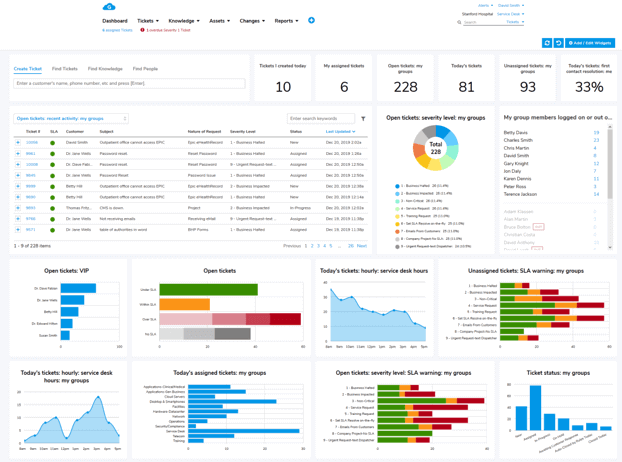
A status dashboard shows the current state of IT systems, including scheduled maintenance windows, active outages, and service degradation notices. When users see that a known issue is already being addressed, they do not open a duplicate ticket. This one feature alone can cut inbound contact volume during incidents significantly.
-
Role-Based Access Controls
Role-based access lets administrators tailor the portal by department, location, or job function:
- A new hire sees onboarding services
- A manager sees approval workflows
- A developer sees environment access requests
This makes the portal feel relevant to each user rather than like a generic IT website with services that do not apply to them.
-
Analytics and Reporting
Portal analytics show which articles are being read, which searches return no results, which services are requested most often, and where users abandon the portal. If a specific search term consistently returns nothing, there is a knowledge base gap. If a service request form has a high abandonment rate, the form is too long or too confusing. Analytics turn the portal into a self-improving system over time.
Benefits of an IT Self-Service Portal
The case for an IT self-service portal is clear on cost and efficiency grounds, but the benefits extend further than the budget line:
-
Reduced Support Costs
Industry benchmarks from HDI and MetricNet show that self-service resolutions cost as little as $0.50 to $2 per resolution, compared to $15 or more for an agent-handled ticket. For an IT team managing thousands of tickets per month, deflecting 30–40% of those through self-service translates to substantial annual savings without any reduction in service quality.
-
Faster Issue Resolution
The difference between a self-service portal and calling the help desk is the wait: A portal returns an answer in seconds. A phone queue or email reply involves waiting for an available agent. For routine issues like password resets, VPN setup, or printer troubleshooting, speed is the primary driver of user satisfaction, and a portal wins on that dimension every time.
This speed also shows up in the metrics. Organizations that invest in self-service typically see meaningful reductions in Average Handle Time (AHT) and improvements in First Contact Resolution (FCR) rates, because the tickets that do reach agents tend to be more complex and more appropriate for agent involvement.
-
24/7 Availability
IT support typically operates within business hours, but employees do not. Remote workers in different time zones, staff working early or late, and travelers all run into IT issues outside the standard support window. A self-service portal is available around the clock, accessible from any device, including mobile devices, at no additional staffing cost.
-
Higher IT Staff Productivity
When routine, low-complexity requests stop arriving in the queue, IT staff can concentrate on work that genuinely requires their skills. That means diagnosing difficult infrastructure problems, supporting application rollouts, handling security incidents, and managing change requests.
The portal does not reduce the value of IT staff, but redirects that value to where it belongs.
-
Better Employee Experience
According to Ivanti's 2024 IT Service Management Trends Report, 45% of employees prefer to fix their own IT problems rather than contacting support. When the portal makes that possible, employee satisfaction with IT goes up. Waiting for a reply to a basic question is a friction point that compounds over time, and removing it has a measurable effect on how employees perceive IT as a function.
-
Scalability
As organizations grow, ticket volume grows with them. A self-service portal absorbs a large portion of that growth without requiring proportional headcount increases.
A company that doubles in size does not need to double its IT support staff if self-service handles the same category of requests at scale.
-
Consistent Support Quality
When the same answer comes from a knowledge base article rather than from whichever agent is available, the answer is consistent every time. This is particularly valuable in compliance-sensitive environments where procedure matters, and in organizations where IT staff turnover makes institutional knowledge fragile.
Common IT Self-Service Portal Use Cases
The following use cases account for the majority of self-service interactions in most organizations. They are also have the highest-return for starting points when building a new portal, since automating them removes the largest slice of repetitive ticket volume. Because of that, they are worth prioritizing in Phase 1 of any portal rollout. Also, they are well-understood by employees, straightforward to automate, and typically account for 60–70% of total ticket volume in organizations that track request categories:
- Password Resets and Account Unlocks: The single highest-volume self-service use case in most IT environments. Users verify identity through MFA or security questions and reset their password in under two minutes, at any time, with no agent involved.
- Software Access Requests: Employees select from a pre-approved software catalog, submit a request, and receive access once approvals are automatically routed and completed. This eliminates the informal "can you install X for me?" email.
- Hardware Requests and Peripheral Issues: Employees submit requests for new equipment, report peripheral problems (monitor, keyboard, mouse, etc.), or initiate hardware replacements through a structured form. The request routes to the correct fulfillment team automatically.
- New Employee Onboarding: A single onboarding service request triggers automated provisioning sequences across IT, HR, and other departments. Device access, application logins, and system permissions are set up through a combined workflow rather than a series of individual tickets.
IT Self-Service Portal vs. Help Desk vs. Service Desk
These three terms describe different layers of IT support, and understanding the distinction helps clarify where a self-service portal fits in the overall support structure:
- The self-service portal operates at Tier 0. It is fully self-directed, involves no human agents, and is available at all times. It covers the requests that users can resolve on their own with the right information or the right automated tool.
- A help desk is Tier 1: reactive, agent-handled, and focused on incident resolution. Agents receive tickets, diagnose issues, and close them. The scope is primarily break-fix, meaning the help desk responds to problems as they are reported. It is not typically concerned with proactive problem management or broader ITSM processes.
- A service desk is a broader function, often aligned with ITIL. It includes the help desk function but adds incident management, service request management, change management, problem management, and knowledge management as organized practices. The service desk is often the owner and operator of the self-service portal, not a competitor to it.
The self-service portal sits at the front of the support hierarchy. It handles what it can. Anything that cannot be resolved through Tier 0 routes to a Tier 1 agent through the help desk. More complex issues escalate from there. The three levels work together, and a well-implemented portal makes every tier more efficient by sending each issue to the right level.
Quick Comparison: Portal, Help Desk, and Service Desk
Attribute |
IT Self-Service Portal |
Help Desk |
Service Desk |
Support Tier |
Tier 0 |
Tier 1 |
Tier 1 and above |
Approach |
Self-directed |
Reactive |
Proactive and strategic |
Human Involvement |
None |
Yes (agents) |
Yes (multiple roles) |
ITSM Alignment |
Partial |
Incident management |
Full ITIL practices |
Change Management |
No |
No |
Yes |
Availability |
24/7 |
Business hours (typically) |
Business hours (typically) |
How to Build an IT Self-Service Portal in 8 Steps
Building a portal is straightforward in concept but requires deliberate work in each phase. Most organizations launch a basic version in two to three months. A full implementation typically takes four to six months, depending on scope and team size.
These eight steps reflect the practical sequence most organizations follow:
-
Define Scope and Audience
Start by deciding what the portal will cover and who it will serve:
- Will it be IT-only, or will other departments like HR or facilities have a presence?
- Which employee groups will have access?
Defining this upfront prevents the portal from expanding in ad-hoc ways that make it confusing to navigate.
Map the most common IT requests your team receives today. These are your starting point for both the service catalog and the knowledge base.
Prioritize by volume. The top 20 request types will account for the majority of your ticket load, and addressing them first delivers the quickest return.
-
Build a Service Catalog
Set up the catalog with the services identified in Step 1.
For each service:
- Write a clear description in plain language
- Specify what information the user needs to provide
- Define any approval steps
- Note the expected fulfillment time
Keep the catalog organized by category so users can browse without already knowing exactly what to search for.
The service catalog is where many portals fail early. If the category names use internal IT terminology that employees do not recognize, users will not find what they need. Test with a few non-IT employees before launching.
-
Populate the Knowledge Base
Write articles for the high-volume issues from your request history:
- Each article should be searchable, clearly titled, and written for someone who knows nothing about the underlying system
- Step-by-step format with screenshots works best for procedural content
- FAQs work well for policy or eligibility questions
- Launch with 30–50 well-written articles covering the most common issues, then expand based on what users search for after go-live
-
Configure Workflows and Automation
Set up the automated workflows that power the service catalog. Each service request type should have a defined path specifying who gets notified, who approves, who fulfills, and what the user receives when the request is complete. Automated password reset and account unlock should be configured and tested before launch, as these are typically the highest-volume self-service actions.
The workflows also need to connect to supporting systems:
- Automated password resets require integration with your identity management system, such as Active Directory or Azure Active Directory
- Onboarding workflows need a data feed from HR to know who is starting and what access they require
-
Set Access Controls and Security
Configure role-based access so each user sees the services and content relevant to their role. Set up Single Sign-On (SSO) and Multi-Factor Authentication (MFA) for the portal login to protect access without adding unnecessary friction for users already authenticated through corporate systems.
-
Pilot Test and Launch
Run a pilot with a small group before the full rollout. Have them try to complete actual tasks, such as resetting a password, submitting a request, and finding an answer to a common question, and watch where they get stuck. Adjust navigation, article clarity, and form fields based on what you observe.
Give the pilot group at least two weeks before reviewing results. A single week is rarely enough time to identify recurring patterns in how users navigate or get stuck. Feedback collected in week two tends to be more useful than day-one reactions.
At launch, communicate what the portal does, where to find it, and what to do when it cannot help. Staff who know the escalation path are less likely to feel abandoned when they reach the limits of self-service.
-
Promote Adoption
A portal that no one knows about will not get used:
- Send targeted communications before and after launch
- Explain the benefit from the employee's perspective (faster answers, 24/7 access) rather than from IT's perspective (fewer tickets for us)
- Post announcements in your intranet, Slack, or Teams, and have managers mention the portal in team meetings
Adoption is a marketing problem as much as a technology problem.
Some organizations use gamification elements, such as usage leaderboards, completion badges for self-resolved tickets, or small incentives for early adopters, to accelerate initial adoption. These are not required, but they can help build momentum in the early weeks when the portal is competing with the habit of calling the help desk.
-
Measure and Iterate
Track the following metrics monthly:
- Ticket deflection rate
- Portal usage broken down by service type
- Knowledge base search success rate
- User satisfaction scores
Drop services or articles that generate no traffic, and expand categories where users are searching but not finding. The portal should improve continuously, not level out after launch.
Best Practices for IT Self-Service Portal Success
The organizations that get the most from their self-service portals share a few consistent habits. Most of them are not technical but organizational:
-
Design for the User, Not for IT
The portal's purpose is to serve employees, not to organize information the way IT organizes it internally. Category names, service descriptions, and article titles should match the vocabulary employees actually use, not ITSM terminology. "Request VPN Access" is clearer than "Remote Network Access Provisioning." This sounds obvious, but most portals get this wrong on the first attempt because IT teams write them for IT teams.
-
Use Plain Language Throughout
Every knowledge base article, every service description, and every form label should be readable by someone who is not technical. Write the way a knowledgeable colleague would explain something to a new employee, using specific, direct language free of jargon. If a term requires a glossary to understand, either define it in context or replace it with a plainer word.
-
Start with Quick Wins and Expand
Begin with the highest-volume, lowest-complexity services. Password resets, software access requests, equipment requests, and network connectivity guides are good starting points.
Add more complex services once the foundation is proven.
Trying to launch with every possible service often results in a portal that does nothing well.
-
Keep the Knowledge Base Current
A knowledge base is only useful if it reflects current systems. Every time a policy changes, a system is upgraded, or a process is updated, the relevant articles need to change with it.
Assign ownership of specific content areas to specific IT staff members so articles do not go stale by default. A quarterly review cycle is a minimum.
-
Build Clear Escalation Paths
Self-service handles what it can. For everything else, the path to human help should be obvious, fast, and frictionless. Users who cannot find a solution should see a clear "still need help?" option that lets them submit a ticket or reach an agent without repeating what they already tried. Hiding the escalation path to inflate self-service metrics is a short-term approach that degrades trust in the portal over time.
-
Assign a Governance Owner
Portals treated as infrastructure, set up once and left alone, lose relevance quickly. Assigning a named owner or a small governance team responsible for the portal's health ensures that content stays current, services get added as IT evolves, and usage data actually drives improvements. Without explicit ownership, the portal drifts.
-
Measure the Right Outcomes
Ticket deflection rate is the headline metric, but it is not the only one that matters. A useful measurement set includes:
- A Customer Satisfaction Score (CSAT) for self-service interactions
A knowledge base article helpfulness ratings - A trend check on whether the tickets reaching agents are genuinely more complex over time
If agents are still fielding the same simple requests after launch, the portal is not working as intended.
- A Customer Satisfaction Score (CSAT) for self-service interactions
Common Mistakes That Undermine IT Self-Service Portals
A significant number of IT self-service portals underperform. Phyllis Drucker, a service management practitioner with more than 20 years of experience, has written that portal initiatives typically function as "technical exercises" rather than efforts to improve employee experience, and the result is low adoption. The patterns below account for most of that gap:
-
Treating It as a One-Time Project
The portal launch is the starting point and not the finish line. Organizations that build a portal, declare it done, and move on find that content goes stale, new services never get added, and usage slowly declines.
A portal requires ongoing ownership, content updates, and periodic redesign as the organization changes. It is a program, not a project.
-
Building Without User Input
IT teams often design portals based on what makes sense to IT, not what makes sense to employees. The result is a portal with confusing navigation, service names no one recognizes, and knowledge articles written for technicians. Involving a sample of actual users in the design and testing phase, through brief focus groups or usability tests, prevents most of these problems before launch.
-
Neglecting Governance
Without a defined owner and a governance process for decisions, the portal tends to grow in disorganized ways. Duplicate services appear, article formats become inconsistent, categories overlap, and no one is responsible for fixing any of it. Governance does not need to be complex, but it does need to answer three questions explicitly:
- Who decides what goes in the portal
- Who maintains the content
- How often the portal is reviewed
- Optimizing for Cost Rather Than Experience
The business case for a self-service portal is often framed entirely around cost savings, and that framing leads to bad decisions. When the goal is to reduce tickets at any cost, organizations end up with a portal that makes self-service difficult enough that users give up, call the help desk anyway, and then develop a negative association with the portal. The cost savings only materialize when users genuinely prefer self-service because it is faster and easier.
-
Letting the Knowledge Base Go Stale
An article that gives a user the wrong answer is worse than no article at all. It wastes their time and sends them to the help desk with extra frustration. Knowledge base content must be reviewed and updated whenever the underlying system or process changes. Organizations that do not build this into their IT change management process find stale articles piling up within months of launch.
AI and the Future of IT Self-Service Portals
The role of AI in IT self-service has moved well beyond keyword-matching chatbots. Modern ITSM platforms now include virtual agents that understand conversational language, remember context from prior interactions, and can initiate multi-step workflows on the user's behalf. Password resets, access provisioning, and software approvals can all be completed through a chat interface without any agent involvement.
The Ivanti ITSM Automation research found that 36% of office workers would now choose a chatbot or automation tool to solve their IT problems, up five points from the prior year. The same report found that 60% of organizations already use automation for identity and access management and 58% for automated password resets, making these the most common self-service automation use cases in production today.
Beyond chatbots, predictive and self-healing systems are starting to appear in more mature ITSM environments. These tools monitor infrastructure continuously, detect anomaly patterns, and in some cases resolve issues before a user notices anything is wrong. When a workstation begins showing signs of a failing drive or an application starts returning errors for a specific group of users, the system can flag it, create a ticket, and in some cases trigger a remediation action automatically. This represents a meaningful shift from Tier 0, which is user-initiated self-service, toward something closer to zero-touch support.
The expansion of self-service beyond IT is also accelerating. Enterprise Service Management (ESM) applies the same portal model to HR, facilities, legal, finance, and other business functions. Employees access a single unified portal for requests across departments. For organizations pursuing ESM, the IT self-service portal often serves as the proof of concept that gets other departments interested in the model.
Frequently Asked Questions About IT Self-Service Portals
-
What is the difference between a self-service portal and a help desk?
A self-service portal is Tier 0 support. The user resolves the issue themselves through knowledge base articles, automated tools, or service catalog requests, with no agent involved.
A help desk is Tier 1 support, where an agent receives a ticket and resolves it. The portal handles what users can do themselves, and the help desk handles what they cannot. Most organizations use both, with the portal reducing the volume of tickets that reach the help desk.
-
What should be included in an IT self-service portal?
At minimum, include a searchable knowledge base, a service catalog with request forms, ticket submission and tracking, and automated password reset. As the portal matures, AI chatbot support, role-based access controls, a status dashboard for IT incidents, and analytics reporting add significant value. The right starting set depends on which issues drive the most ticket volume for your specific organization.
-
How do I get employees to use the self-service portal?
Adoption is primarily a communication and design problem, not a technology problem. Employees use the portal when they know it exists, can find what they are looking for quickly, and trust that the answers are accurate. That requires clear internal communication at launch, plain-language content written for non-technical users, and a fast, obvious escalation path for when the portal cannot help. If the portal is slower or more confusing than calling the help desk, employees will call the help desk.
-
What is the ROI of an IT self-service portal?
The primary driver is cost per ticket. Industry benchmarks place self-service resolutions at $0.50 to $2 each, versus $15 or more for agent-handled tickets. For a team handling 3,000 tickets monthly with a 35% self-service deflection rate, the annual savings can reach six figures.
Research on self-service implementations finds three-year returns of 200 percent or more when adoption levels are high.
Secondary ROI comes from higher IT staff productivity (more time on strategic work), faster resolution times, and improved employee satisfaction scores.
The exact return depends on current ticket volume and how well the portal is adopted.
-
How does a service catalog work in a self-service portal?
The service catalog lists available IT services in organized categories. When a user selects a service and submits a request form, the portal triggers a preconfigured workflow.
- Manager approval is routed automatically if required
- The fulfillment team receives the request with all needed information
- The user gets status updates throughout
The service catalog replaces the informal process of emailing IT with a request and hoping someone picks it up.
-
What is Tier 0 IT support?
Tier 0 is the self-service layer of IT support. It includes the knowledge base, automated tools like password resets, and the service catalog, all of which allow users to resolve issues or fulfill requests without agent involvement. Tier 1 is the help desk (agent-handled, reactive), Tier 2 is specialized technical support, Tier 3 is engineering escalation, and Tier 4 is vendor support.
Tier 0 investments deliver the broadest coverage because they handle the highest volume of requests at the lowest cost per resolution.
Related Giva Resources
- IT Service Desk Software Guide: Features, AI & Best Practices
- 10 Top Knowledge Base Benefits & How to Choose the Best Software
- Knowledge Management Best Practices, Tools & Features
- ITIL Service Request Management Practice
- Benefits of Customer Self-Service Portals
Building an IT Self-Service Portal That Actually Gets Used
An IT self-service portal is not a set-it-and-forget-it feature. The organizations that get real value from theirs, measured in ticket deflection, cost savings, and employee satisfaction, are the ones that treat the portal as an ongoing product. They maintain content, act on analytics, involve users in design, and keep escalation paths clear.
The technology itself is not the hard part. Populating the knowledge base with articles employees will actually find useful, organizing the service catalog in language that makes sense to non-technical staff, and building an internal communication plan that drives adoption are the elements that separate a portal that works from one that collects digital dust.
One observation worth noting. Most of the organizations that struggle with self-service portal adoption have built a portal that serves IT's organizational logic, not the employee's experience. The question to keep asking is not "does the portal contain the right information?" but "can someone who has never used this portal find what they need in under a minute?" Those are different questions with different answers, and the second one is the one that matters.
See What a Self-Service Portal Can Do for Your IT Team
If your IT team is fielding the same requests week after week, a self-service portal is one of the most direct investments you can make in both team efficiency and employee experience. The right platform gives employees 24/7 access to answers, automates routine requests, and frees your IT staff to work on problems that actually need their expertise.
Giva's IT help desk and ITSM software give you what you need, including:
- An intuitive ticketing system
- A fully integrated self-service portal
- A fully integrated knowledge base
- Real-time dashboards and reports
- AI Copilots for ticket summaries, re-writing capabilities, and AI-driven answers from only your knowledge base
It's cloud-based, HIPAA-compliant, and designed to get teams operational quickly.
MetroHealth System, a large health system supporting 7,500 employees across 20 locations, uses Giva's portal to let employees log in, search the knowledge base, and create service requests entirely on their own.
Explore Giva's ITSM Software and Help Desk Software to see how a self-service portal fits into a complete IT support solution.
Get a demo to see Giva's solutions in action, or start your own free, 30-day trial today!



Categories: IT, Help Desk