AI HIPAA Compliance Fully Examined Plus Tools, Platforms and How-To's
 By Ron Avignone
AI is now part of everyday healthcare, from note-taking tools to patient chatbots. But as these systems grow more powerful, so does the question every healthcare leader asks: Is AI HIPAA compliant?
HIPAA-compliant AI refers to artificial intelligence systems built specifically for healthcare that adhere to HIPAA's Privacy, Security, and Breach Notification Rules. This requires data encryption (AES-256), strict access controls, and a signed Business Associate Agreement (BAA).
The short answer then is: AI can be HIPAA compliant, but only when it is designed, configured, and used correctly.
None of the consumer AI tools, like standard ChatGPT, are compliant. However, as this article shows, many enterprise-grade AI platforms can be integrated with the right safeguards, contracts, and security practices.
This guide explains what makes AI HIPAA compliant, which tools qualify, and how healthcare organizations can use AI safely while meeting strict HIPAA-based privacy rules.
Current AI and HIPAA Regulatory Landscape
AI has become a significant part of clinical and healthcare administrative workflows. Medical professionals and support staff often use AI tools to help them summarize medical records, automate documentation, manage schedules, and communicate with patients.
However, many healthcare organizations aren't using it correctly in line with the HIPAA Security Rule, and this can and will cause problems unless this is fixed, and soon!
In January 2025, the Department of Health and Human Services (HHS) proposed major updates to the HIPAA Security Rule. These updates address the increasing use of AI, the increase in ransomware attacks, and emerging cybersecurity threats. The most significant change is the removal of the old "required vs. addressable" distinction.
Now, all safeguards are mandatory for any organization handling electronic Protected Health Information (ePHI). This applies equally to Covered Entities and Business Associates.
These changes reflect an important shift: healthcare organizations can no longer treat AI as a separate or optional add-on. All AI systems that touch PHI must be included in risk analysis, risk management plans, and security programs. Despite this, "Only 18% of healthcare workers knew about formal policies at their healthcare organizations on overseeing generative AI, and just 20% said staff were required to take a structured training course," suggesting an industry-wide lack of preparedness, according to a Wolters Kluwer report.
AI also brings unique risks, such as:
- Large Language Models (LLMs) can memorize or reuse sensitive data if not correctly configured
- Employees can and will use consumer AI tools without approval (to manage heavy workloads more easily), potentially accidentally exposing PHI
Also, the Federal Trade Commission (FTC) has also increased scrutiny of health-related data practices outside of HIPAA.
Going forward, healthcare organizations should expect:
- More direct audits of AI systems
- Detailed federal guidance on AI use
- Real-time compliance monitoring is becoming standard
- Stronger enforcement from both HHS and the FTC
Let's look at this problem more closely and see what healthcare organizations can do to make sure they're using the most HIPAA-compliant AI-powered software possible.
Is AI HIPAA Compliant?
The question "Is AI HIPAA compliant?" doesn't have a simple yes-or-no answer right now. HIPAA compliance wasn't hard-coded into AI tools and apps.
In most cases, compliance depends on how specific AI tools are designed, configured, deployed, and managed within healthcare workflows.
When most people ask whether AI is HIPAA-compliant, they often think specifically about popular tools like ChatGPT or other generative AI platforms they've encountered.
It's important to understand that consumer-facing AI tools such as standard ChatGPT, Google Gemini, Claude, and similar apps are not currently HIPAA-compliant. For this reason, it's important that they should never be used to process unredacted Protected Health Information (PHI).
It's equally important that Covered Entities and Business Associates understand that they, their employees, contractors, suppliers, and anyone remotely connected to PHI do not use AI tools.
One of the problems is that these platforms retain conversation data, use it for model improvement, and don't provide the security controls or legal agreements required for handling PHI.
Another less visible but equally significant challenge is the transparency problem inherent in many AI systems. Because AI algorithms often operate as "black boxes", where they process inputs and generate outputs through logic that is not easily auditable, healthcare organizations may struggle to explain how an AI system used or accessed PHI. HIPAA requirements for documented data flows and audit accountability assume a level of explainability that many AI tools do not normally provide. When evaluating any AI system that touches PHI, organizations must assess not only whether the tool is technically compliant but whether its decision-making process can be documented and defended to patients, auditors, and regulators.
However, this doesn't mean AI is off-limits for healthcare. Many AI technologies can achieve HIPAA compliance when properly implemented.
AI Can Be HIPAA-Compliant
The good news is that AI tools and software can become HIPAA compliant only when certain conditions are met:
-
A signed Business Associate Agreement (BAA)
Any vendor handling PHI must sign a BAA. Without it, using the tool with PHI is a violation. This is the case even if the technology is otherwise secure.
Major cloud providers like Microsoft Azure, Amazon Web Services (AWS), and Google Cloud (GCS) offer HIPAA-eligible AI services and will sign BAAs with healthcare organizations.
If they don't, both yourselves and they are in breach, along with any third-party organizations supporting your organization's use of these cloud services.
-
Minimum Required Technical Safeguards
HIPAA-compliant AI tools need to include the following, as a very minimum:
- Encryption at rest (AES-256) and in transit (TLS 1.2 or higher)
- Multi-factor authentication
- Strong access controls
- Detailed audit logs
- Secure data storage
- Isolation of customer data
These are not optional features.
-
Zero Data Retention
Many compliant AI tools use "zero-retention" endpoints. This means:
- No prompts are saved
- No outputs are stored
- No data is used for model training
Standard API endpoints that retain data for model training or service improvement are unsuitable for PHI processing.
HIPAA-compliant configurations typically use zero-retention endpoints. This means that the AI provider processes requests without storing conversation content, prompts, or outputs. This prevents PHI from being reused or exposed.
-
AI-Secure Operational Practices
Even if the technology is secure, healthcare organizations need to still do the following (as a minimum):
- Conduct AI-specific risk assessments
- Train staff on proper AI use
- Monitor for shadow AI
- Document all AI data flows
- Maintain an AI breach response plan
The compliance status of AI also depends on specific features and use cases.
For example, while text-based interactions with specific AI platforms may be HIPAA-eligible, image-generation or audio-processing capabilities might not be covered under the same compliance framework.
Organizations must verify which specific capabilities are included in their vendor's BAA. HIPAA compliance is ongoing, not a one-time configuration.
HIPAA Eligible Does Not Mean HIPAA Compliant
Many cloud AI services are "HIPAA eligible," meaning they can meet HIPAA requirements. This is positive, but you must be very careful about how they are configured and used, so that they become fully HIPAA compliant.
Healthcare organizations need to review every AI system individually to make sure it meets all requirements. This is ongoing, and equally important for any Business Associates that handle healthcare data, especially PHI.
For healthcare providers, this means you cannot simply adopt any AI tool and assume it's compliant. Each AI system requires the following:
- Careful evaluation against HIPAA requirements
- Secure contractual arrangements through BAAs
- Appropriate technical configuration
- Ongoing oversight to maintain compliance throughout the tool's lifecycle
Now, let's look at the various AI tools that meet HIPAA compliance requirements, once configured the right ways.
HIPAA-Compliant AI Tools, Platforms, and Software for Healthcare
Healthcare organizations have growing options for AI tools that meet HIPAA compliance requirements. Below are solutions specifically designed or configured for secure handling of PHI, organized by category and use case.
Enterprise AI Platforms
-
Hathr.AI
Built on Anthropic's Claude and hosted exclusively on AWS GovCloud with FedRAMP High certification, Hathr.AI offers private AI chat and document processing specifically designed for healthcare professionals. The platform maintains strict data isolation, with no mixing of client data.
- Best For: Clinical documentation, patient record summarization, medical text analysis, and secure document generation
- Pricing: Starting at $45/month
- Key Features: Handles documents over 500,000 words, complete data privacy, NIST 800-171 certified, HIPAA-compliant APIs for integration
-
BastionGPT
A private, HIPAA-compliant alternative to ChatGPT that uses specially trained versions of leading AI models, including GPT-4, Claude, and Gemini, specifically for healthcare and mental health professionals.
- Best For: Clinical notes, medical scribing, session transcription, and documentation review
- Pricing: Multiple tiers with all plans including BAA
- Key Features: Transcribes up to four speakers, reviews documentation for errors, handles sensitive health topics without content blocking, no chat history shared with model providers
-
CompliantChatGPT
An AI medical copilot platform built specifically for healthcare workflows, offering secure conversational AI for clinical tasks while maintaining strict PHI safeguards.
- Best For: Analyzing labs, drafting SOAP notes, treatment planning, session summarizing
- Pricing: Contact for enterprise pricing
- Key Features: Built-in PHI protection, regular compliance audits, integration with EHR systems, prompt engineering guidance for clinical accuracy
Cloud Platform AI Services
-
Microsoft Azure OpenAI Service
Access to OpenAI models through Microsoft's enterprise cloud infrastructure with built-in HIPAA compliance framework. Microsoft provides standard BAAs through its Data Protection Addendum.
- Best For: Organizations with existing Microsoft infrastructure, custom AI application development, enterprise-scale deployments
- Pricing: Pay-as-you-go based on usage (token-based pricing)
- Key Features: Zero data retention options, comprehensive audit logging, enterprise access controls, integration with Microsoft healthcare tools, text-based processing covered under BAA
-
Amazon Web Services (AWS) AI Services for Healthcare
AWS offers multiple HIPAA-eligible AI services, including Amazon Bedrock for foundation models and Comprehend Medical for extracting structured data from unstructured medical text.
- Best For: Organizations with AWS infrastructure, custom healthcare applications, and clinical data extraction
- Pricing: Variable based on specific services used
- Key Features: BAA available for eligible customers, extraction of medical entities from clinical notes, FHIR-based data integration, scalable infrastructure
-
Google Cloud Healthcare AI
Google Cloud offers HIPAA-compliant AI tools, including Med-PaLM for medical question-answering and healthcare-specific data analytics capabilities.
- Best For: Large-scale data analytics, research applications, organizations using Google Cloud Platform
- Pricing: Enterprise pricing varies by deployment
- Key Features: FHIR interoperability, advanced analytics, medical Natural Language Processing (NLP) capabilities, research-grade AI models
Clinical Documentation and Scribing
-
Suki AI
Voice-driven clinical documentation assistant that provides real-time transcription and coding support specifically designed for physician workflows.
- Best For: Real-time clinical documentation, ambient scribing, and reducing physician administrative burden
- Pricing: Contact sales for customized pricing
- Key Features: Real-time transcription during patient encounters, automatic medical coding suggestions, EHR integration, voice-activated commands
-
DeepScribe
Speech-to-text tool for automated clinical documentation with deep integration into EHR systems.
- Best For: Automated note-taking, reducing documentation time, ambient listening
- Pricing: Per-provider subscription model
- Key Features: Ambient clinical documentation, automatic SOAP note generation, EHR integration, specialty-specific templates
-
Eleos Health
AI platform built specifically for behavioral health and therapy documentation, automating session note-taking while maintaining strict HIPAA compliance.
- Best For: Therapy note-taking, behavioral health documentation, reducing clinician administrative burden
- Pricing: Contact for pricing
- Key Features: Ambient session documentation, HIPAA-compliant data handling, supports multiple therapy modalities, reduces time spent on clinical notes
Patient Communication and Engagement
-
Emitrr
All-in-one HIPAA-compliant AI communication platform offering SMS, VoIP, chatbots, appointment reminders, and patient engagement tools with over 1,000 integrations.
- Best For: Small to mid-size practices, patient communication automation, and appointment management
- Pricing: Custom pricing based on call volume
- Key Features: HIPAA-secure messaging, AI chatbots, automated appointment reminders, two-way texting, VoIP capabilities, and EHR integrations
-
Dialzara
AI phone answering solution designed specifically for healthcare providers, dramatically improving call answer rates while maintaining HIPAA compliance.
- Best For: Front desk automation, after-hours call management, and reducing missed patient calls
- Pricing: Custom pricing based on call volume
- Key Features: Medical terminology understanding, appointment scheduling, and healthcare-specific workflows
-
Weave
Communication platform offering HIPAA-compliant texting, phone calls, video conferencing, appointment reminders, and patient engagement features.
- Best For: Multi-location practices, comprehensive patient communication
- Pricing: Starts around $399/month per location
- Key Features: Unified communications platform, online scheduling, payment processing, reviews management
-
Luma Health
Patient success platform focused on communication between providers and patients, with streamlined appointment scheduling and follow-up capabilities.
- Best For: Patient outreach, reducing no-shows, care coordination
- Pricing: Contact for pricing
- Key Features: Automated appointment reminders, waitlist management, patient self-scheduling, referral management
Specialized Healthcare Tools
-
Merative
Merative offers a suite of AI-enhanced healthcare products and actively integrates AI and Machine Learning (ML) across its platform. The products provide clinical decision support and predictive analytics with HIPAA-ready configurations for enterprise healthcare organizations.
- Best For: Clinical decision support, population health analytics, research applications
- Pricing: Enterprise pricing
- Key Features: Evidence-based clinical insights, drug interaction checking, genomic analysis, and imaging analytics
-
John Snow Labs Healthcare NLP
Commercially supported open-source NLP tools specifically built for HIPAA/GDPR-compliant on-premises or private cloud deployment, with particular strength in clinical text analysis.
- Best For: Organizations requiring on-premises deployment, clinical text mining, and entity extraction
- Pricing: Enterprise licensing and pricing.
- Key Features: On-premises deployment, clinical entity extraction, medical coding assistance, de-identification capabilities
Giva: Your HIPAA-Ready AI Support Ticketing Solution
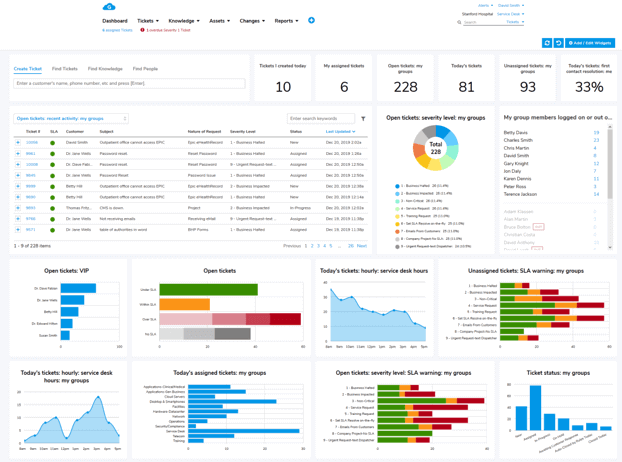
Giva combines secure AI-powered tools specifically designed for healthcare providers. AI Copilots help streamline your operations while maintaining security and compliance. Giva is built from the ground up with healthcare security requirements in mind.
Why choose Giva:
- Full HIPAA compliance: Business Associate Agreements included with all plans, comprehensive encryption, detailed audit logging, and regular security assessments.
- Robust security: Enterprise-grade security infrastructure specifically designed for protected health information.
- Dedicated support: Healthcare help desk support compliance experts available to guide implementation and safeguard ongoing compliance.
Ready to modernize your patient communication while maintaining complete HIPAA compliance? Make sure your healthcare organization benefits from Giva's HIPAA-Compliant Cloud Help Desk Software.
Giving you the highest security and compliance of Protected Health Information (PHI), including Electronic Health and Medical Records (EHR/EMR)
Giva provides the tools, expertise, and support you need to harness AI's potential while maintaining complete HIPAA compliance. Our platform combines powerful AI capabilities with enterprise-grade security designed specifically for healthcare organizations.
Contact Giva today to:
- Get a personalized demo of our HIPAA-compliant customer support platform with AI capabilities
- Speak with our compliance experts about your specific requirements
- Learn how other healthcare organizations are successfully deploying AI while maintaining compliance
Now, let's look at how to make sure you're maintaining HIPAA compliance when using an AI tool, application, or other piece of software.
How to Maintain HIPAA Compliance When Using AI
Deploying AI tools in healthcare settings requires more than selecting a compliant vendor. Organizations must implement comprehensive safeguards throughout the AI lifecycle to maintain continuous compliance.
Here are essential best practices for ensuring your AI deployments meet HIPAA requirements.
-
Conduct Comprehensive AI-Specific Risk Assessments
Traditional IT risk assessments don't adequately address AI-specific risks. Healthcare organizations must conduct separate, thorough risk analyses for each AI system that processes PHI.
AI systems must be included in HIPAA risk analysis. Organizations should:
- Map all PHI data flows
- Document how the AI uses, stores, or deletes data
- Evaluate model behavior and retention
- Repeat assessments yearly or after significant changes
This documentation is essential for audits.
-
Implement Strict Access Controls and Authentication
Access to AI systems processing PHI must follow the principle of least privilege. Grant employees access only to the AI capabilities they need for their job functions, and only to the minimum PHI necessary to perform those functions.
AI systems must use:
- Multi-factor authentication
- Role-Based Access Control (RBAC)
- Least-privilege permissions
- Automatic session timeouts
- Continuous access monitoring
Audit logs must show who accessed PHI, when, and for what purpose.
-
Implement Robust Vendor Management and BAA Coverage
Never use an AI tool with PHI until you have a signed Business Associate Agreement in place. This isn't merely a formality but a fundamental HIPAA requirement. The BAA legally obligates your vendor to protect PHI and specifies their responsibilities in the event of a breach.
Vet AI vendors thoroughly before signing contracts. Request documentation of their security certifications, such as SOC 2 Type II, HITRUST, or ISO 27001. Before using an AI tool with PHI:
- Make sure a BAA is signed
- Confirm which features are covered
- Check vendor certifications (SOC 2, HITRUST, ISO)
- Track BAA renewals annually
- Review subcontractors used by the vendor
The stakes of ignoring this can be significant. Under the HIPAA Breach Notification Rule, if PHI is disclosed to a third-party AI vendor without a signed BAA in place, the incident is classified as a notifiable breach, regardless of whether any actual misuse of data occurred. Also, if a vendor's AI system re-identifies data that was transmitted as de-identified, that incident also triggers breach notification.
The bottom line: If the BAA doesn't cover an AI feature, it shouldn't be used with PHI.
-
Minimize PHI Exposure Through De-identification and Data Minimization
The best way to reduce HIPAA compliance risk with AI is to minimize the amount of PHI the system processes. Before inputting data into an AI system, ask whether the whole dataset is necessary or if adequately de-identified information would suffice.
HIPAA recognizes two secure de-identification methods: Safe Harbor and Expert Determination:
- Safe Harbor requires the removal of 18 specific identifiers, including names, dates, geographic information, and various ID numbers.
- Expert Determination relies on statistical analysis by qualified experts to determine that the risk of re-identification is very small. When de-identified data meets these standards, it's no longer considered PHI and falls outside HIPAA's regulatory scope.
Organizations should also:
- Remove unnecessary identifiers before AI processing
- Limit the data the AI can access ("minimum necessary")
- Use synthetic data for testing or training
Less PHI means less risk.
However, it is important to recognize that de-identification does not eliminate compliance risk entirely. Research has demonstrated that datasets stripped of the 18 Safe Harbor identifiers can still be re-identified through linkage with external data sources or AI-based inference techniques. For AI systems that use de-identified data for input or output, a formal re-identification risk assessment is the appropriate standard.
-
Establish Comprehensive Monitoring, Auditing, and Incident Response
Continuous monitoring forms the foundation of ongoing HIPAA compliance. Implement automated systems that track AI tool usage in real time and generate alerts for suspicious activities, like unusual access patterns, bulk data exports, or attempts to access unauthorized information.
Maintain detailed audit logs that capture all interactions with PHI by the AI system. These logs should include user identification, timestamps, actions performed, data accessed, and system responses.
During a HIPAA audit or after a security incident, these logs provide important evidence of compliance and help reconstruct events.
Healthcare organizations should:
- Monitor AI activity in real time
- Flag unusual behavior or access patterns
- Conduct quarterly audits of access logs
- Patch and update AI systems regularly
- Keep audit logs for at least six years
- Maintain an AI-specific incident response plan
New HIPAA proposals require regular vulnerability scanning and annual penetration testing.
Finally, an interesting angle on this is having AI systems actually be part of the monitoring processes. NLP tools can scan emails, electronic health records, and other text data to automatically flag potential PHI exposures or policy violations before they escalate. AI-powered platforms can also generate detailed audit trails documenting who accessed PHI, when, and for what purpose, which is information HIPAA auditors might expect to be able to see.
-
Combat Shadow AI and Unauthorized Tool Usage
One of the most significant AI compliance risks comes from "shadow AI", which means employees using unsanctioned AI tools with PHI.
A well-intentioned staff member might copy patient information into ChatGPT to save time writing a letter, not realizing they've just committed a HIPAA violation.
Unapproved AI use is a leading source of breaches. Organizations need to be careful to do the following:
- Block consumer AI tools on work devices (either through VPNs or domain-level blocking)
- Use DLP tools to prevent PHI sharing
- Monitor network traffic for unauthorized AI use
- Educate staff on AI risks
- Provide approved alternatives to meet workflow needs
Training and communication are essential for preventing accidental violations.
Below are ways you can stay up-to-date on AI and HIPAA compliance:
How to Stay Updated on AI and HIPAA Compliance
The regulatory landscape governing AI in healthcare continues evolving rapidly. Staying informed about changes to HIPAA requirements, new HHS guidance, and emerging best practices is essential to maintaining compliance. Here are authoritative sources and strategies for keeping current.
-
Official Government Resources
HHS Office for Civil Rights (OCR)
OCR enforces HIPAA regulations and publishes official guidance, breach reports, and enforcement actions. Check their website regularly for proposed rule changes, final rules, and guidance documents specifically addressing AI and new technologies. Subscribe to their email updates to receive notifications of significant changes.
HHS Health Sector Cybersecurity Coordination Center (HC3)
HC3 provides cybersecurity threat briefings, best practices, and intelligence specifically for the healthcare sector. Their alerts often address emerging risks related to AI and other new technologies.
National Institute of Standards and Technology (NIST)
NIST's AI Risk Management Framework provides complementary guidance to HIPAA for organizations deploying AI in healthcare. The framework helps make sure AI systems are trustworthy and ethical while maintaining security.
-
Industry Publications and News Sources
The leading independent source for HIPAA news, updates, and compliance guidance. Their coverage of AI and HIPAA issues provides practical insights into regulatory developments and enforcement trends. Subscribe to their newsletter for regular updates delivered to your inbox.
Providing comprehensive coverage of health information technology, including extensive reporting on AI adoption, privacy concerns, and compliance requirements. Their articles often feature case studies and expert perspectives on managing AI compliance.
Broader healthcare industry news that includes regulatory coverage, technology trends, and compliance issues. Useful for understanding the business context of AI adoption and compliance requirements.
-
Professional Organizations and Associations
American Health Information Management Association (AHIMA)
AHIMA provides education, resources, and advocacy for health information professionals. Their guidance on AI, privacy, and data governance offers practical frameworks for implementing compliant AI systems.
Healthcare Information and Management Systems Society (HIMSS)
HIMSS offers education, events, and resources focused on health information technology. Their annual conference and publications address cutting-edge topics including AI compliance, cybersecurity, and privacy.
American Medical Informatics Association (AMIA)
AMIA focuses on healthcare informatics and provides thought leadership on AI implementation, including ethical considerations and regulatory compliance.
-
Legal and Compliance Resources
American Bar Association Health Law Section
Provides legal perspectives on healthcare compliance issues, including AI-related regulatory challenges. Their publications and events address emerging legal questions at the intersection of AI and healthcare law.
International Association of Privacy Professionals (IAPP)
While not exclusively focused on healthcare, IAPP offers valuable resources on privacy compliance, including AI-related issues that extend beyond HIPAA to frameworks such as GDPR and state privacy laws.
AI HIPAA Compliance Conclusion
AI can safely and effectively support healthcare, but only when it is used responsibly. No AI model, tool, or software is automatically HIPAA compliant. But AI HIPAA compliance can be achieved when organizations choose the right tools, sign BAAs, configure systems carefully, and maintain strong security practices.
One important principle to keep in mind: HIPAA compliance is a shared responsibility. A vendor's BAA ensures that their system meets compliance requirements, but healthcare organizations remain fully responsible for how their staff uses the tool to handle PHI. Compliant technology is only one part of the equation.
The future of healthcare will rely heavily on AI, and organizations that invest early in compliant, secure solutions will be best positioned to provide high-quality, efficient care.
Giva and other HIPAA-compliant AI platforms enable organizations to adopt modern tools without compromising PHI. With the right safeguards in place, AI can improve workflows, reduce administrative burden, and enhance patient experiences while maintaining full compliance.
HIPAA Compliance: Additional Resources
- Is Google Workspace HIPAA Compliant? Gmail, Meet, Drive and Other G Suite Apps
- Top HIPAA-compliant EMR software solutions
- 5 Top HIPAA-Compliant Document Management Software Solutions
- Giva's HIPAA-compliant software series
- HIPAA Resource Center<
- Understanding the Health Insurance Portability and Accountability Act (HIPAA)
Need HIPAA-compliant healthcare help desk, customer service or ITSM software? Trust Giva's HIPAA-Compliant Cloud Help Desk Software.
Giving you the highest security and compliance of Protected Health Information (PHI), including Electronic Health and Medical Records (EHR/EMR).
Get a demo to see Giva's solutions in action, or start your own free, 30-day trial today!

Categories: HIPAA Compliance, Technology