Change Management Roles and Responsibilities: A Complete Guide
Change management is the structured process of guiding people, teams, and organizations from their current way of working to a new one. It focuses on the human side of change, such as reducing resistance, building adoption, and making sure improvements actually stick long after a project goes live. In IT, that process is formalized through defined roles and responsibilities. Knowing who owns what is the difference between a change that is effected cleanly versus one that creates chaos. Our expert in the following has a way of making that clarity concrete...
The ITIL Guru sat at his desk, looking over the latest additions in the Continuous Improvement Register (CIR). As a review board member, he liked what he saw. More and more IT staff contribute improvement ideas, making him feel good about the progress. The phone rang.
"ITIL Guru. How may I assist you today?"
"This is Michael. The CIO requested that I come to her office tomorrow. She wants me to take over the role of Change Manager. Her text does not appear clear about the new Change Enablement practice. Can you help me to make a good impression?"
"Michael, I am always happy to help explain ITIL.

Purpose of the Change Management (Enablement) Practice
"The purpose of the change practice has never deviated. It has always been to maximize the number of successful service and product changes by ensuring a risk assessment, authorizing changes to proceed, and managing the change schedule.1
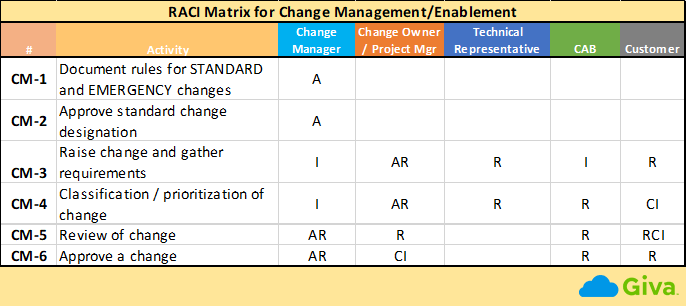
"The numbers show why understanding its roles matters. A WTW survey of 720 global organizations found that only one-third of respondents had effectively managed the risks associated with major work changes over the prior three years. "Moreover, as you recall, in ITIL version 3, the practice (or process) name was Change Management. In January 2019, Axelos released ITIL 4. At this time, Axelos changed the practice name to Change Control. And then, in January 2020, Axelos again changed the name to Change Enablement. I do not see any ambivalence here, and I am happy to adopt Change Enablement as continuous improvement. Change Management never managed changes. That was left to Project Management. However, for the purpose of this explanation, we will continue to include the more common name of Change Management. "Thank you for clearing up the name change. I want to make sure we follow ITIL's best practices in everything. Is Change Enablement responsible for business changes as well?" "No. There is another practice for that. ITIL calls that practice Organizational Change Management. 'The purpose of Organizational Change Management is to ensure we implement changes in the organization smoothly and successfully, and that we manage the human aspects of the change.'2 The main roles in Change Management are: Change Manager is the operational heart of the Change Enablement practice. They own the process end-to-end: evaluating and categorizing incoming change requests, chairing CAB meetings, maintaining the change schedule, and running Post-Implementation Reviews. The Change Manager is ultimately accountable for whether changes move through the system efficiently and without disruption to IT services. The Change Manager's responsibilities include: Change Management Analyst handles the detailed assessment and documentation work that makes sound change decisions possible. Working closely with the Change Manager, the Analyst evaluates the risk and impact of each incoming change request, keeps records current, and ensures the right information reaches the CAB before every meeting. The Change Management Analyst's responsibilities include: The CAB is a cross-functional group that evaluates, reviews, and advises on Normal Changes. One important distinction worth knowing is that CAB stands for Change Advisory Board, not Change Approval Board. The CAB advises the Change Manager, who holds the final authority to approve or reject a change. CAB membership typically includes IT managers, technical leads, product owners, and business representatives, so the evaluation covers both technical risk and business impact. The CAB's responsibilities include: The Change Sponsor is typically a senior executive or department leader who owns the business case for the change. They are the most visible face of the initiative, and the person employees look to for signals about whether leadership is genuinely committed to seeing it through. The Change Sponsor's responsibilities include: Change Agents are the day-to-day supporters of the change initiative. They are typically frontline managers, team leads, or department representatives who work directly with the people most affected by a transition. In ITIL terms, Change Agents often overlap with the stakeholder groups represented at CAB meetings. But the Change Agent role goes further than reviewing and approving change requests: they are actively helping people adapt once those changes go live. Think of them as the human network that runs alongside the formal approval process. Their responsibilities include: The Project Manager owns the technical delivery of the initiative: the timeline, milestones, budget, and scope of what is being built and deployed. In ITIL terms, once the CAB authorizes a Normal Change, the Project Management practice takes over execution. The key distinction from the Change Manager is that the Project Manager answers "Is the work done on time and within budget?" while the Change Manager answers "Will the people affected actually adopt it?" Both questions have to be answered yes for a Normal Change to succeed. The Project Manager's responsibilities in the context of Change Management include: Here's a quick comparison: Change Manager Project Manager Primary Focus People and adoption Delivery and scope Success Metric Adoption rate and behavior change On-time, on-budget delivery Engaged Through Post-Implementation Review (PIR) Project go-live / handoff HR teams are often overlooked in ITIL-focused change management conversations, but they are essential partners in any change that significantly affects how people do their jobs. In ITIL-specific IT change management, HR is less directly involved in the Change Enablement approval process. But they become a critical partner whenever a Normal Change has material impact on staff roles or ways of working. Change Enablement manages the change to the service, while HR manages the change to the people who deliver the service. In organizational change management, HR's responsibilities typically include: "The RACI acronym stands for Responsible, Accountable, Consulted, and Informed. Use these to understand the various roles and responsibilities in effective Change Management/Enablement:" RACI: A = Accountable, R = Responsible, C = Consulted, I = Informed For more, see our article answering How Does the Responsibility Matrix (RACI) Work in ITIL?.
The Change Manager's roles are: "What you must know is there are three Change Types and three Change Authorities." Change Type Change Authority Standard Change Change Manager Normal Change Change Advisory Board (CAB) Emergency Change Emergency Change Advisory Board (ECAB) "There are only three types of changes. That is all you need!" Characteristics: "A Standard Change is my favorite. The change authority for Standard Changes is the Change Manager. The Change Manager determines what criteria they require to make a change a Standard Change. A best practice is to set an IT goal of eighty percent of all changes are standard changes. When meeting the CIO, ask her to make this the IT goal and make it 80% for every IT functional team." The advantages of Standard Changes: Examples of a Standard Change: "Emergency Changes are changes implemented as soon as possible.4" Characteristics of Emergency Changes: "The IT goal for Emergency Changes should be to a reduction in the frequency over time. With the direction of the CIO, each IT functional team should set a plan to reduce Emergency Changes." "With Standard Changes automated through Change Enablement because they are pre-approved, and Emergency Changes fast-tracked past the detailed scrutiny, Change Enablement can concentrate on Normal Changes. "The Change Advisory Board (CAB) is the change authority for all Normal Changes. The degree of scrutiny depends on the scope, risk, and priority. The Change Manager often chairs the CAB. "Once authorized and scheduled, the Project Management practice executes all Normal Changes." "As you can see, Michael, Change Management/Enablement efficiency is critical to keeping IT in alignment with business demands and opportunities. ITIL's term for this is Governance. Change is how the company continues to make continuous improvement happen. The more efficiently change occurs, the faster the organization improves. I wish you well with the new position. I am sure you will have more questions. I am always here for you." Footnotes:Change Management Roles and Responsibilities Defined
Change Manager
Change Management Analyst
Change Advisory Board (CAB)
Change Sponsor
Change Agents
Project Manager
Human Resources (HR)
How to Use the RACI Matrix Model for Effective Change Management Roles and Responsibilities
The Starting Point: The Change Manager Role in Change Management
Three Change Types are the Key to Change Management Efficiency
Standard Change
Why are Standard Changes the key to successful Change Management?
Emergency Change: Cange enablement's answer to a SWOT team
Normal Change: Change Management/Enablement Approved for Execution by the Project Management Practice
1. ITIL Foundation ITIL 4 Edition, AXELOS GLOBAL BEST PRACTICE, 2019, p. 118
2. Ibid, p. 89
3. Ibid, p. 119
4. Ibid, p. 119
5. Ibid, p. 119

Categories: IT, Help Desk