Is Outlook HIPAA Compliant? How to Keep Email Communication Secure
 By Ron Avignone
Many organizations have questions about software and HIPAA compliance, especially when it comes to everyday tools like Microsoft Outlook. Is Outlook HIPAA compliant? It's an important question for any business that works with Protected Health Information (PHI).
To help answer that question, we reviewed Microsoft Outlook's HIPAA compliance requirements so you don't have to. Whether this is something you've already considered or are just starting to think about, this article breaks down what you need to know in a clear and easy-to-understand way.
Is Outlook HIPAA Compliant?
No, Outlook is not HIPAA-compliant by default. However, Outlook can be used in a HIPAA-compliant way.
There are three critical conditions you must guarantee to utilize Outlook in compliance with HIPAA.
- Outlook must be used as part of a qualifying Microsoft Office 365 Enterprise plan.
- A signed Business Associate Agreement with Microsoft is required before sending or storing any electronic Protected Health Information (ePHI) through Outlook.
- Security features such as encryption, access controls, audit logging, and data loss prevention must be correctly configured and supported by internal policies and user training.
Note that Outlook.com (the free consumer version) is not HIPAA compliant at all and should never be used to send ePHI.
Now that we have a high-level understanding of the big three, let's get more into the details.
How To Ensure HIPAA Compliance When Using Outlook
-
You Must Be Using A Microsoft 365 Enterprise Plan, not Outlook.com
Outlook.com is a free, web-based email platform. While similar to Office 365's Outlook product , it is not the same. Microsoft's HIPAA commitments do not cover consumer Outlook.com. Therefore, it should not be used to send ePHI.
On the other hand, Microsoft offers a variety of Microsoft 365 Enterprise subscription plans that include the Outlook application and can be used in compliance with HIPAA:
- Plans that support HIPAA compliance include Microsoft 365 Business Premium, E3, and E5
- Organizations on lower-tier plans, such as Microsoft 365 Business Basic or Business Standard, may need to purchase add-ons or upgrade to access the security and compliance features required to meet HIPAA's technical safeguards.
For example, if an organization such as a hospital subscribes to a plan that does not support HIPAA compliance, the hospital will need to purchase add-ons to make Microsoft Outlook HIPAA-compliant.
-
You Must Have A Business Associate Agreement With Microsoft
HIPAA regulations require that covered entities (e.g., hospitals, doctors' offices) enter into agreements with business associates to ensure the security of ePHI. This is called a Business Associate Agreement (BAA).
To support its customers with HIPAA compliance, Microsoft enters into BAAs. However, having a BAA does not guarantee compliance with HIPAA rules. Microsoft's own documentation makes this explicit: "By offering a Business Associate Agreement, Microsoft helps support your HIPAA compliance. However, using Microsoft services doesn't on its own achieve HIPAA compliance." In other words, the BAA covers Microsoft's obligations and not your organization's.
"Among other things, a Business Associate Agreement establishes the permitted and required uses and disclosures of PHI by the business associate, based on the relationship between the parties and the activities or services being performed by the business associate."
Microsoft's Business Associate Agreement covers Microsoft's role in safeguarding ePHI within its cloud infrastructure, including services such as Outlook and Exchange Online.
However, the Microsoft BAA does not:
- Automatically configure Outlook securely
- Prevent users from sending PHI incorrectly
- Replace your internal HIPAA policies and training
- Eliminate the need for risk assessments
To be clear, each organization is responsible for ensuring that it operates a compliance program and has internal processes aligned with HIPAA. Here's a HIPAA compliance checklist to help get your organization up to speed.
-
Your System Must Possess Certain HIPAA Compliant Security Features
-
Enterprise-Level Encryption
The HIPAA security rule requires organizations to ensure the confidentiality, integrity, and availability of all electronic Protected Health Information ("ePHI") created, received, maintained, or transmitted. Further, "The purpose of the requirement is to ensure ePHI is unreadable, undecipherable, and unusable to any person or software program that has not been granted access rights."
To meet this standard, Microsoft offers enterprise-level encryption by encrypting data both at rest in Microsoft's datacenters and in transit between clients and servers. And by offering additional message-level encryption options for email and files.
- Data at rest (e.g., in Microsoft Outlook) is protected with BitLocker encryption and per-file Advanced Encryption Standard (AES) in Azure Storage.
- Data in transit is protected with Transport Layer Security. Additional options for Secure/Multipurpose Internet Mail Extensions (S/MIME) require digital signatures to verify the sender's identity in an email message.
When encryption is correctly configured and a BAA is in place, Microsoft 365's encryption capabilities can be used as part of a HIPAA-compliant environment. However, organizations must still conduct risk assessments, implement policies, enforce access controls, and monitor.
-
Microsoft Exchange Online Protection (EOP)
EOP is a cloud-based email filtering service. EOP protects your organization against spam and malware. It also includes features to safeguard your organization from messaging policy violations committed on behalf of employees.
EOP can simplify the management of your messaging environment. Microsoft EOP may also relieve many of the obstacles of maintaining on-premises hardware and software.
-
Data Loss Prevention (DLP)
DLP policies are rules and processes that define how an organization identifies, monitors, and protects sensitive data. DLP policies help prevent accidental or malicious leaks, loss, or unauthorized access to ePHI.
They are defined as relatively "simple packages that contain sets of conditions, which are made up of transport rules, actions, and exceptions that you create." Once you create a DLP policy, you activate it to filter email messages. On the other hand, you choose not to activate it. This allows you to test your policies without affecting mail flow.
-
Ability To Wipe Data On Mobile Devices
HIPAA's Security Rule expects covered entities to protect ePHI on mobile devices and address the risk of loss or theft. Remote wipe helps meet this expectation by quickly removing PHI from compromised phones or tablets.
Using Microsoft Intune, admins can either factory-reset a managed device or selectively remove only Microsoft 365 organization data (e.g., mail, calendar, files, and policies). All while leaving a user's personal data intact.
In addition, there's Microsoft 365 Basic Mobility and Security, which is a subset of Microsoft Intune. It's a built-in mobile device management capability included with certain Microsoft 365 subscriptions. It provides core features such as enforcing basic security policies and remotely wiping (or selectively wiping) organization data from mobile devices connected to other Microsoft 365 apps, like Outlook.
-
Access Controls
Microsoft Entra ID provides several access control features that, when properly configured and combined with a BAA and internal policies, support HIPAA's technical safeguard requirements.
- Identify and sign-in controls: unique user IDs, role-based access control, and multi-factor authentication.
- Session and device controls: screen locks, restricted access from unmanaged or non-compliant devices, session timeouts, and sign-in frequency settings.
- Authorization and data-scoped controls: role-based and group-based permissions, sensitivity labels, and sharing controls restrict external sharing.
-
Audit Logging
Audit logging in Microsoft 365 is a core part of meeting HIPAA's audit controls requirement because it records who accessed systems and data that may contain ePHI. Audit logs are like a digital paper trail, tracking what employees did and when they did it.
However, advanced audit features, including the Unified Audit Log, are not available on all Microsoft 365 plans. Organizations should confirm that their subscription tier includes the audit logging capabilities required for HIPAA compliance before assuming this requirement is covered.
The Microsoft 365 Unified Audit Log captures a wide range of user and admin actions. Auditable actions include:
- File access and sharing
- Mailbox access
- Configuration changes
Microsoft Entra ID sign-in and audit logs record authentication attempts, changes to identities and policies, and other directory-level events. This helps show who accessed PHI-related resources and from where.
-
Outlook vs Outlook.com vs Exchange Online
Before continuing, let's clear up and summarize the different Outlook products for HIPAA compliance:
Microsoft Product |
HIPAA Compliant? |
Why / Why Not |
Outlook.com (Free) |
No |
Consumer service; no BAA; not designed for regulated data |
Outlook (Microsoft 365 Enterprise) |
Yes, if configured |
Covered under Microsoft's BAA when safeguards are enabled |
Exchange Online |
Yes, if configured |
Core email backend with encryption, logging, and DLP |
Microsoft 365 Business (Limited Plans) |
Depends |
Some plans require add-ons or upgrades for compliance |
Important: Using the Outlook app alone does not make email HIPAA compliant. Compliance depends on the Microsoft 365 environment behind it.
Common Ways Organizations Accidentally Violate HIPAA Using Outlook
Even with a Microsoft 365 Enterprise plan, HIPAA violations can occur if Outlook is misused. Common examples include:
- Sending PHI through unencrypted email
- Emailing PHI to the wrong recipient
- Allowing shared mailboxes without proper access controls
- Using personal or unmanaged mobile devices
- Storing sensitive patient information in long email threads instead of secure systems
These risks are why many healthcare organizations limit PHI in email and use secure, HIPAA-compliant platforms for case management and service requests.
Microsoft Outlook HIPAA Compliance And Email Communication Best Practices
Here are five practical Microsoft Outlook HIPAA compliance and email communication best practices.
-
Use the Right Microsoft 365 Enterprise Plan and BAA
Use Outlook only as part of a Microsoft 365 plan that is eligible for a Business Associate Agreement (BAA), such as Enterprise plans. Remember: Outlook.com for consumers is not HIPAA compliant.
Then, ensure your organization has a fully executed BAA with Microsoft before sending any PHI via Outlook.
-
Enforce Encryption For Emails With PHI
Configure Microsoft 365 to encrypt email in transit using Transport Layer Security (TLS) and to use Office Message Encryption or S/MIME for messages containing PHI or other sensitive data.
To go one step further, you can implement policy-based encryption (for example, via DLP rules) so emails are encrypted automatically when any of the 18 PHI identifiers are detected. This removes the human factor of relying on users to remember to turn it on.
-
Implement Strong Access Controls and MFA
Require Multi-Factor Authentication (MFA) for all accounts with Outlook access. In addition, enforce strong passwords and conditional access policies to reduce the risk of account compromise.
Furthermore, you can limit Outlook and mailbox access to only the minimum number of workforce members. As part of your HIPAA compliance procedures, you can regularly review group memberships and admin roles to ensure least-privilege access to ePHI.
-
Use DLP, Address Checks, and Logging To Reduce Mistakes
Configure Data Loss Prevention (DLP) policies in Microsoft 365 to detect PHI patterns and either block, encrypt, or require approval before messages leave your organization.
In addition, turn on and monitor audit logging for Outlook and Microsoft 365. Audit logging will allow you to review who accessed ePHI, track external sends, and support HIPAA investigations if an incident occurs.
-
Train Staff and Integrate With a HIPAA-Compliant Service Platform
Remember, HIPAA-compliant business protocols are only as good as the people enforcing them. So, provide regular training so staff understand how to recognize ePHI, when to use encryption, how to verify recipients, and how to report misdirected or suspicious emails, as encouraged by HIPAA standards.
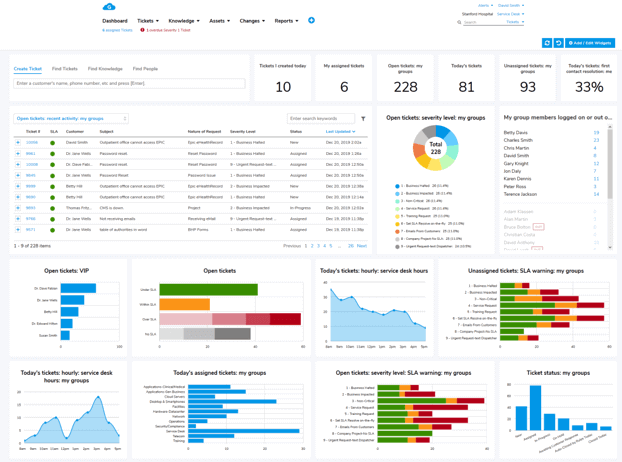
Last but not least, we recommend pairing Outlook with a HIPAA-compliant service management platform like Giva's AI-powered, HIPAA-compliant help desk and customer service applications.
Giva's powerful software helps you centralize ePHI-related requests, enforce workflows, and keep sensitive details in secure tickets instead of free-form email threads. Giva's applications are HIPAA compliant and specifically designed to reduce compliance risk and improve auditability.
When to Consider a Dedicated HIPAA-Compliant Email Platform
For organizations where email is a primary channel for communicating protected health information, dedicated HIPAA-compliant email services may be worth evaluating alongside Microsoft 365. Platforms designed specifically for healthcare include end-to-end encryption and HIPAA-specific safeguards configured by default, reducing the setup burden on IT teams and minimizing the risk of misconfiguration.
That said, Microsoft 365 with Outlook remains a fully viable path to HIPAA-compliant email communication when properly licensed, configured, and governed. The right choice depends on your organization's size, IT capacity, and the volume of PHI moving through emails.
Many healthcare organizations pair a compliant Microsoft 365 Outlook setup with a purpose-built HIPAA-compliant service management platform like Giva to help keep sensitive case details in structured, auditable tickets rather than free-form email threads.
See how Giva might help your support teams by scheduling a demo to see Giva's solutions in actions, or starting your own free, 30-day trial today.
Outlook Is Not HIPAA Compliant "On Delivery," But It Can Be Made So
Outlook, on its own, does not satisfy HIPAA requirements, but it can support compliant communication when it is implemented and governed correctly. To stay within HIPAA's guardrails, organizations must run Outlook in an appropriate Microsoft 365 enterprise environment. In addition, they must have a signed Business Associate Agreement with Microsoft.
Perhaps most importantly, they must rigorously carry out HIPAA compliance best practices. The best HIPAA-compliant workflow includes encryption, granular access controls, audit logging, and data loss prevention.

Categories: HIPAA Compliance, Technology