How to Prove and Communicate That IT Is Contributing to Business Value
 By Ron Avignone
The IT team finished the quarter with a 99.7% uptime record, resolved 847 service requests, and completed a system migration that had been on the finance department's wish list for three years. The CTO summarized all of it at the leadership meeting.
And then someone asked when IT would be getting its budget cut.
It's a familiar scenario for anyone who's worked in IT long enough. The work gets done, systems run, and somehow none of it registers as strategic contribution, just overhead instead. More stats won't help — it's a narrative issue.
We address that in this article, which covers:
- Why IT value tends to stay invisible
- How to translate operational work into business-language outcomes
- How to tailor that story to different stakeholders
- How to make communicating IT value a year-round habit rather than a budget-season pitch

Key Takeaways
- Operational metrics don't self-translate: Uptime percentages and ticket counts only mean something to business stakeholders when converted into outcomes: hours of productivity protected, costs avoided, revenue at risk quantified.
- Different stakeholders need different frames: CFOs respond to cost avoidance and risk reduction, CEOs respond to growth capability, and department heads respond to their own team's specific problems resolved.
- Proving IT value is an ongoing practice: Teams that communicate IT contributions throughout the year build stronger stakeholder relationships than teams that make the case only at annual budget reviews.
Why IT Value Goes Unnoticed
Before you can fix the problem, it helps to understand why it exists. There are three structural reasons IT gets labeled a cost center rather than a strategic contributor, and none of them are about the quality of its work:
-
IT Is Infrastructure, Not a Product
IT creates value the same way a building's electrical system does. You don't notice it when it's working, and you can't ignore it when it's not. Most business stakeholders interact with the outputs of IT (applications, systems, data) without thinking about the work that keeps them running. IT systems just end up being taken for granted.
The problem is that systems that are invisible when working are fine for a power grid but make communication very difficult for a team that needs budget. In 2016, a single power module failure in Delta Air Lines' Atlanta data center caused a system outage that cancelled more than 2,000 flights over three days and cost the airline $150 million. That's what IT's operational value looks like when it suddenly becomes visible. And the goal is to make that value visible before something breaks, not after.
-
Technical Language Does Not Cross the Gap
IT teams naturally report in IT terms, and those terms don't translate directly into business language. A 99.8% uptime figure sounds good, but most executives don't know whether that's excellent, ordinary, or somewhere in between. Metrics like Mean Time to Resolve (MTTR) and First Contact Resolution (FCR) rate are meaningful within IT but invisible to the people who control IT's budget.
-
Value Is Diffuse, Not Concentrated
A product launch has a clear moment of delivery. IT's contribution is spread across every department, every day, running in the background while software updates roll out, outages get averted, and workflows improve piece by piece. Nothing announces itself. But diffuse doesn't mean small. It means you have to aggregate it deliberately and then communicate it clearly.
4 Types of IT Business Value
IT value can be categorized in at least four distinct ways, and naming them clearly is the first step toward measuring and communicating each one:
- Operational Value: IT keeps the business running. This is measured in system availability, issue resolution speed, and Service Level Agreement (SLA) compliance. It's the foundation everything else depends on.
- Productivity Value: IT recovers time for employees. When a ticket gets resolved in 30 minutes instead of half a day, or an automated workflow replaces a manual one, employees get that time back. This shows up in tickets resolved per day, hours of downtime avoided, and new employee onboarding speed.
- Financial Value: IT avoids costs and protects revenue. Prevented outages, optimized software licensing, reduced breach exposure, and infrastructure consolidation all belong here. The Return on Investment (ROI) for these activities is often more concrete than it looks.
- Strategic Value: IT enables new business capabilities. Examples like the infrastructure that made a new product possible, the system integration that opened a new market, the data platform that gave the sales team visibility they'd never had before, are IT contributions, even when they get credited to the business unit that launched them.
IT Value Types at a Glance
Type of IT Value |
What IT Does |
How to Measure It |
|---|---|---|
Operational Value |
Keeps systems available and responsive |
Uptime %, SLA compliance rate, MTTR |
Productivity Value |
Reduces time employees lose to technical issues |
Hours of downtime avoided, FCR rate, tickets resolved per agent per day |
Financial Value |
Avoids costs and protects revenue |
Cost of prevented outages, licensing savings, avoided breach costs |
Strategic Value |
Enables new business capabilities and growth |
New capabilities delivered, time-to-market for IT-enabled initiatives |
How to Use Metrics That Tell a Business Story
The IT metrics you already collect are useful. The question is whether you're translating them into a form that means something to people outside IT.
-
Start with What Executives Already Watch
The easiest path into an executive conversation is to start with the metrics they already care about and work backward to show where IT touches each one.
Customer satisfaction, for example, is directly affected by system reliability. When the customer-facing platform goes down during peak hours, that's a customer satisfaction event, not just an IT incident.
When IT prevents that outage, it's contributing to customer retention, whether anyone made the connection or not.
-
The Translation Formula
The goal isn't to replace IT metrics but to translate them. Here's how common IT measurements map to business outcomes:
IT Metric
Business Translation
How to Calculate the Impact
System uptime (e.g., 99.9%)
Revenue and productivity protected during operating hours
Operating hours at risk x employees affected x avg hourly compensation, plus estimated revenue at risk
First Contact Resolution (FCR) rate
Employee hours recovered per month
FCR-resolved tickets x avg time difference between escalated and direct resolution
Mean Time to Resolve (MTTR)
Hours of business disruption avoided
(Old MTTR - New MTTR) x avg employees affected per incident x incidents per period
Ticket deflection rate
Cost savings from self-service handling
Deflected tickets x avg cost per Tier 1 agent-handled ticket
Here's what this looks like in practice. An IT manager at a mid-size professional services firm started including a "time recovered" figure in her monthly summary after realizing her business stakeholders didn't know what First Contact Resolution (FCR) meant. She calculated that her team's 78% FCR rate, compared to a typical baseline of 70%, translated to roughly 90 fewer escalated tickets per month, or about 45 hours of employee time not lost to follow-up. Her department head, who had been skimming the IT report for a year, started reading it consistently after that change.
One honest note: The hardest number to pin down is the revenue impact of system downtime, because it depends entirely on how revenue-critical the affected system is. A two-hour outage on an internal collaboration tool is a different cost than a two-hour outage on an e-commerce checkout flow. There's no universal formula. You have to apply judgment to your own environment, and that's worth acknowledging when you present the numbers.
-
What Good Executive Reporting Looks Like
An IT value report for executives doesn't need to be long. The most effective format includes:
- 3 to 5 business-outcome metrics (not raw IT figures)
- One concrete example of a problem prevented or a capability delivered
- A brief update on progress against IT goals that connect to specific business priorities
What it shouldn't include is a list of tickets closed, raw uptime percentages without context, or jargon that requires an IT background to interpret.
How to Communicate IT Value to Different Stakeholders
Not every executive hears value the same way. The CFO who controls your budget isn't asking the same question as the VP of Sales whose team depends on your Customer Relationship Management (CRM) system.
Here are some things to consider for each type of person:
-
CFOs: Lead with Cost and Risk
CFOs live in the language of cost avoidance and risk reduction, and the narrative should focus that way.
The most direct frame is to calculate what a single hour of downtime would cost the business in lost revenue, lost productivity, and recovery effort. For organizations with revenue-critical systems, that number is often larger than most people outside IT expect. Present it alongside IT's uptime record, and the narrative shifts from "we kept things running" to "we protected the business from a significant loss last quarter."
Cost avoidance is often the most straightforward value story to tell with a CFO, because the math is clean. Downtime prevented x estimated hourly cost = value protected.
-
CEOs and Senior Leadership: Lead with Business Outcomes
What did IT make possible that wouldn't have happened otherwise? That's the question CEOs are actually asking, even when the conversation is framed around cost.
These are IT contributions in this light:
- The product that needed a new data integration before it could launch
- The customer onboarding workflow IT automated to reduce churn
- The analytics platform that gave the sales team pipeline visibility for the first time
They tend to get credited to the business unit that announced them unless IT makes the connection explicit and early.
-
Department Heads: Lead with Their Team's Pain Points
This is often the most effective conversation, and the most underused one. Department heads care primarily about their own team's time and productivity. They don't need a value framework. They need a specific before-and-after.
"Your team was averaging 45 minutes a week on password resets before we rolled out self-service. We're now under 5 minutes for the same task." That kind of statement doesn't require a dashboard or a cost model. It requires knowing which problem you solved and communicating it directly to the person it affected.
How to Build Your IT Value Narrative
The most important shift here is about when you communicate:
-
The Value Calendar: Making Communication a Habit
Most IT teams make their strongest case for value during the budget cycle. By then, the perception is already set. You're not shaping a narrative at that point but defending a position.
A value calendar flips that. It's a planned schedule of moments throughout the year when IT communicates its contributions proactively, such as:
- A monthly operational summary keeps department stakeholders current on key metrics and recent wins.
- A quarterly contribution to the business review connects IT's progress to strategic priorities.
-
An annual IT value report aggregates the full picture:
- Uptime record for the year
- Major projects delivered
- Improvements to user satisfaction scores
- Cost savings achieved
Done consistently, it means the budget conversation is a confirmation of something leadership already knows.
The cadence doesn't have to be complex: Monthly for operational highlights, quarterly for strategic progress, annually for the full picture. What matters is that it happens on a schedule, not reactively.
-
Run Stories vs. Change Stories
There are two types of IT value stories, and most IT teams only tell one of them:
Run stories are about continuity:
- Systems stayed up
- Tickets got resolved
- Employees got help
Change stories are about delivery:
- A new capability added
- A process improved
- A problem eliminated
Run stories tend to be told only at the worst moment, like during an outage, as a defense.
Change stories get lost entirely, credited to whatever business unit made the announcement.
Both belong in IT's narrative, and most IT teams leave the change stories completely untold.
-
Define Value Before You Start
One of the most practical things you can do is define what success looks like before a project begins, in business terms, and then measure it at 60 or 90 days.
As an example, before deploying an IT self-service portal, document the baseline, such as how many tickets of the portal-eligible type come in each month, at roughly what handling time per ticket?
Set a check-in point. At that point, the improvement story is already built. You just have to measure and report it.
This also makes stakeholder conversations easier. You can say "here's what we planned to achieve" alongside "here's what we actually delivered," which is a much stronger position than presenting an improvement nobody expected.
6 Common Mistakes IT Teams Make When Trying to Prove Value
Most IT teams want to communicate their value better. These are the mistakes that get in the way:
- Measuring outputs instead of outcomes: Tickets closed is an output. Employee hours recovered is an outcome. Reporting activity without connecting it to impact leaves the audience to make the connection on their own, and most won't.
- Only speaking up when things go wrong: Reactive communication reinforces the firefighter perception instead of replacing it. If business stakeholders only hear from IT during outages, that's the frame they'll carry into budget conversations.
- Using technical language with non-technical audiences: SLA compliance percentages mean nothing to a CFO who has never heard the term. Every external IT communication should be readable by someone with no IT background.
- Waiting until budget season to make the case: The perception forms all year. Trying to reshape it in a single budget presentation almost never works, because the audience already has a mental model that's been building for months.
- Treating value communication as a report instead of a relationship: A PDF sent once a year isn't a narrative. It's a data dump. IT value is better communicated through ongoing touchpoints with the stakeholders who make decisions.
- Skipping the before/after baseline: A snapshot of current performance is hard to interpret without context. An improvement story needs a starting point, and most teams don't document one before a project begins.
Frequently Asked Questions About Proving IT Business Value
-
What metrics should IT use to show business value?
The most effective IT metrics for business audiences are outcome-based rather than activity-based.
Instead of reporting raw ticket volumes or uptime percentages in isolation, translate them. Three common calculations:
- System uptime x hours of operation x employees affected = productivity protected
- First Contact Resolution (FCR) rate improvement x average resolution time difference = hours recovered per month
- Mean Time to Resolve (MTTR) reduction x incidents per period = hours of business disruption avoided
The specific metrics that matter most depend on your business. A financial services firm might weight system availability and compliance more heavily than a professional services firm, which might prioritize employee productivity metrics. Start with the outcomes your executives already watch and work backward to the IT figures that drive them.
-
How do I justify IT spending to the CFO?
CFOs respond best to cost avoidance and risk quantification.
Frame IT spending in terms of what it prevents. If your organization has even one revenue-critical system, a single hour of downtime is a meaningful cost. The most credible figure to present is one calculated from your own organization's revenue, headcount, and operations.
Security investment follows the same logic. IBM's 2025 Cost of a Data Breach Report puts the global average at $4.44 million per incident, a figure that well-exceeds virtually any preventive security investment.
Make the math explicit, and the "IT is just overhead" argument becomes much harder to sustain.
-
How often should IT report its value to business leadership?
Most IT teams are well served by a three-level cadence: monthly, quarterly, and annually.
For example:
- A brief monthly summary to key department stakeholders
- A quarterly contribution to the business review
- An annual IT value report that aggregates the year's wins, improvements, and investments
None of these need to be long. The monthly summary might be half a page. Consistency matters more than volume.
-
What is the difference between IT metrics and IT KPIs?
IT metrics are operational measurements; IT Key Performance Indicators (KPIs) are the subset that track progress toward a defined business goal.
Ticket volume is a metric. It tells you how much work came in. An IT KPI might be "First Contact Resolution (FCR) rate above 80%," which tells you how effectively that work is being handled relative to a target that connects to employee productivity.
Metrics describe what happened. KPIs measure whether you're achieving what you set out to achieve.
For business stakeholders, KPIs are almost always more useful, because they have a defined target that makes performance interpretable.
-
How does ITSM software help IT prove its value?
ITSM platforms centralize the data IT needs to build its value story, without requiring manual assembly from multiple sources.
A well-configured IT Service Management (ITSM) platform tracks resolution times, SLA compliance, ticket volume trends, user satisfaction scores, and escalation rates in one place. That data is the foundation of the translation work described throughout this guide: turning FCR rate into hours recovered, turning MTTR into disruption avoided. Without it, most teams spend as much time assembling the data as interpreting it, which is why the reporting habit tends not to stick.
For teams working within an ITIL (IT Infrastructure Library) framework, this data is already built into the practice structure. IT incident management records feed directly into MTTR calculations. Service request data feeds FCR rate. The connection between ITIL practice compliance and value story is more direct than most teams realize.
-
How do IT teams prove the value of AI and automation investments?
Apply the same baseline-measure-translate approach that works for any IT investment. Document the current state before the tool is deployed, then measure what changed three to six months later.
IT investments in AI and automation tend to get measured at the wrong level. Adoption figures (the percentage of employees using the tool) are not outcomes. The question that matters is which specific workflow changed and by how much. A finance team using an AI-assisted reporting tool that previously took 8 hours per month and now takes 2 hours has a clear, translatable result. The equivalent adoption-framing ("80% of the team is using the tool") does not.
The measurement challenge with AI is real. McKinsey's 2025 State of AI research found that just 39 percent of organizations attribute any enterprise-level financial impact to their AI use. IT teams that fail to document baselines before deployment will not be able to answer the ROI question when leadership starts asking. The same before/after discipline that works for any IT initiative works here. It just needs to happen before the tool goes in.
Related Giva Resources
- Top 15 Benefits of ITSM
- How to Build a Business Case for Replacing Your ITSM Software
- 35 Unique Help Desk Metrics for the Best Agent Performance
- Help Desk Return on Investment
- Top 10 ITSM Best Practices
Proving IT Business Value Is a Communication Practice, Not Just a Measurement Problem
IT already creates operational, productivity, financial, and strategic value every single day. The challenge of IT-business alignment is rarely about capability gaps. It's about the habit of communicating that capability in terms the business can hear.
The organizations where IT has strong credibility aren't necessarily doing more impressive work. They've built the practice of narrating it consistently, translating it into business language, and timing that narrative for when stakeholders are paying attention. None of what this guide covers is technically difficult. It just has to happen regularly.
Pick one thing from this guide and apply it this quarter. A monthly summary to one key department head. A before/after metric on one initiative that's already under way. Two touchpoints on the calendar for the next six months. Any of those is a real start.
Take the First Step Toward a Measurable IT Value Story
Building a consistent IT value narrative starts with having the right data. Giva's ITSM and IT help desk software gives teams the infrastructure they need to track and report the metrics that matter. Key reporting capabilities include:
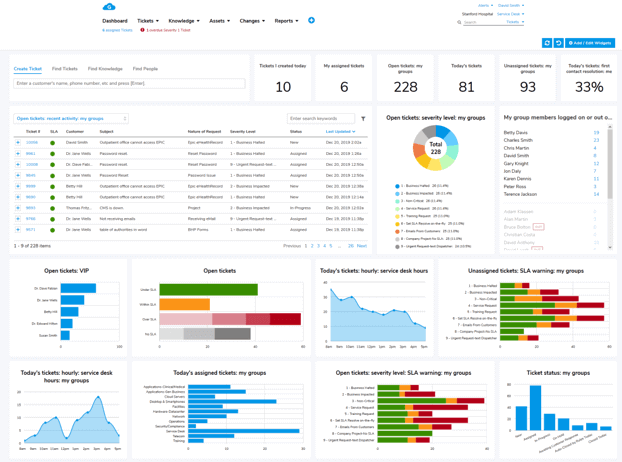
- Centralized dashboards for service desk performance
- Built-in SLA tracking and compliance reporting
- User satisfaction scoring
- Trend reporting across ticket volume and resolution times
Whether you're running an IT service desk, supporting an employee-facing operation, or both, Giva makes it easy to track the metrics that matter and communicate them in a format your stakeholders can act on.
To learn more, get a demo to see Giva's solutions in action, or start your own free, 30-day trial today!



Categories: IT