Customer Churn Rate: Formula, Causes and How to Reduce It
 By Ron Avignone
Customer churn rate is one of the most closely watched metrics in any subscription or service-based business. Even small increases in churn can turn into trends, eroding revenue over time. Most teams get caught focusing on acquiring new customers but less on retention.
Churn, however, is rarely just about losing customers. When the customer churn rate starts to rise, it usually points to deeper issues within the business. This can include inconsistencies in the customer experience and gaps in customer expectations.
To reduce churn, a business first needs to understand what customer churn rate means and how to measure it.
What Is Customer Churn Rate?
Put simply, customer churn rate is the percentage of customers a business loses over a given period, and is the direct inverse of customer retention rate and one of the clearest indicators of how well your product, service, and overall customer experience are delivering value. It is usually measured monthly, but can also be tracked quarterly or annually depending on the business model and reporting needs. For example, quarterly churn compares customers lost during Q1 to the total number of customers at the start of Q1. It is a simple calculation, though more on that later.
It's important to know that a "churned customer" is not always the same across businesses. Here are a few examples for reference:
- Subscription-based businesses: A customer cancels their subscription or does not renew at the end of the subscription term. For example, an Amazon Prime or Netflix account
- SaaS churn rate context: Account cancellation or downgrade in services. For example, a business realizes it is paying for services it doesn't use and needs to scale
- E-commerce / non-subscription: A repeat customer stops making purchases over a defined period
The effects are exactly what you would expect. Churn reduces the size of the existing customer base. It also forces businesses to spend more on customer acquisition to replace lost revenue.
Did you know? The term "customer churn rate" is often used interchangeably with customer attrition, attrition rate, and customer turnover.
Churn Rate vs. Retention Rate
Customer churn rate and customer retention rates are related, but they measure different things. Churn looks at the percentage of customers a business loses, while retention looks at the percentage of customers that stay.
For example, if a business has a churn rate of 10% in a given month, its customer retention rate would be 90% for that same period. Together, these metrics give a clearer picture of how a business maintains its existing customer base.
A high churn rate signals weak retention. A strong retention rate means customers are more loyal. Tracking both is easy to do together and helps businesses understand customer behavior and find areas to improve.
Types of Customer Churn
You might be surprised to find that not all churn is the same. Different types of churn can help businesses understand why a customer leaves:
-
Voluntary Churn
A customer chooses to leave your business on their own. For example, a customer cancels their cell phone service with Provider A and switches to Provider B. They might switch for a better price or more features. The core issue is that they no longer see value in the product or service.
-
Involuntary Churn
In this case, a customer does not intend to leave, but inaction causes a temporary or permanent lapse in service. Common examples include outdated billing information, failed payments, or expired credit cards. This type of churn is often preventable with the right systems in place. For example, automated reminders can alert customers to update payment details. They can also help fix failed transactions before service is interrupted.
-
Revenue Churn
Revenue churn focuses on lost revenue rather than just lost customers. When customers cancel or downgrade their services, it reduces overall revenue. In some cases, a business may lose only a few customers but still see a significant drop in revenue. This is why it is important to look beyond customer count and understand the financial impact of churn.
-
SaaS / B2B
In SaaS and B2B environments, churn often involves larger accounts. When these customers cancel or even downgrade service, the financial impact can be significant. This is different from businesses that serve individual customers. In those cases, each account represents a smaller portion of total revenue.
How to Calculate Customer Churn Rate
Calculating customer churn rate is much simpler than it sounds. As we discussed earlier, it compares customers lost during a period to the number of customers at the start of that period.
The Customer Churn Rate Formula
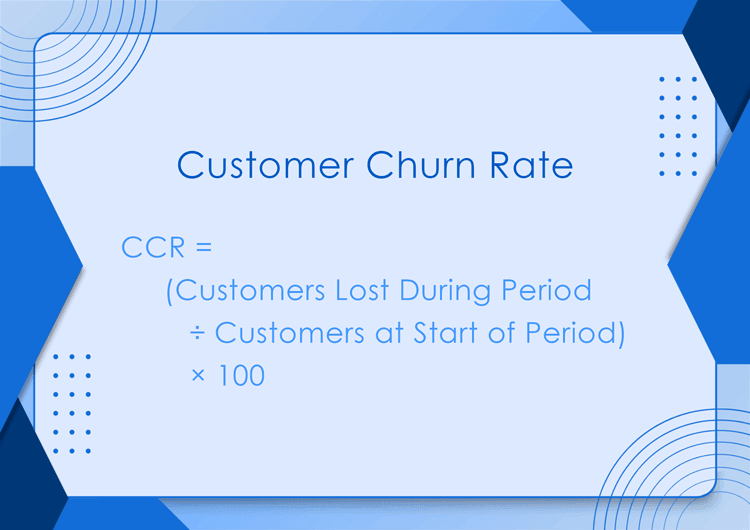
Customer Churn Rate = (Customers Lost During Period ÷ Customers at Start of Period) x 100
For example, if a business starts the month with 1,000 customers and loses 50 by the end of the month, the churn rate would be 5%.
This formula gives businesses a simple way to track churn metrics over time and identify patterns in customer behavior. Most businesses calculate churn on a monthly basis, though quarterly and annual reporting is also common.
Monthly vs. Annual Churn Rate (And the Common Calculation Mistake)
One of the biggest mistakes businesses make is assuming annual churn can be calculated by simply multiplying monthly churn by 12. While this seems logical, it actually overstates annual churn because it ignores compounding.
For example, a monthly churn rate of 5% does not equal a 60% annual churn rate.
The more accurate formula is:
Annual Churn Rate = 1 - (1 - Monthly Churn Rate) ^12
This formula accounts for the compounding effect that happens over time. In reality, a 5% monthly churn rate results in an annual churn rate of roughly 46%, not 60%.
Customer Churn vs. Revenue Churn
Customer churn and revenue churn measure different types of business impact. Customer churn focuses on the number of customers lost, while revenue churn focuses on the amount of recurring revenue lost from cancellations, downgrades, or reduced spending.
This distinction is especially important in SaaS businesses where a small number of enterprise customers may represent a large portion of total revenue.
For example, losing one large enterprise customer may create more financial impact than losing dozens of smaller accounts.
Revenue churn is often broken into two categories:
- Gross revenue churn: Lost recurring revenue without factoring in upgrades or expansion revenue
- Net revenue churn: Revenue lost after accounting for upgrades, cross-sells, and expansion revenue
Some SaaS companies can even achieve negative churn when expansion revenue from existing customers exceeds revenue lost from cancellations.
What is Logo Churn?
Logo churn refers to the percentage of customers lost during a given period, regardless of account size or revenue value. The term "logo" simply refers to individual customer accounts.
A business may have low logo churn but still experience high revenue churn if larger customers leave. This is why many SaaS businesses track both metrics together.
What Is a Good Customer Churn Rate?
There is no universal "good" customer churn rate. That said, lower is always better. Benchmarks can vary by industry, business model, customer type, and more.
Industry Differences
Some industries experience higher customer turnover, lower brand loyalty, and shorter customer relationships. Examples include:
- Streaming services (Netflix, Paramount Plus, etc.)
- Retail subscriptions (Amazon, grocery delivery, etc.)
- Mobile carriers (T-Mobile, AT&T, Verizon, etc.)
Industries that offer enterprise SaaS, B2B software, and financial services often see lower churn rates. This is due to longer-term contracts, higher switching costs, and stronger, more personal, customer relationships.
For SaaS and subscription businesses, a monthly churn rate between 1% and 5% is generally considered healthy, with best-in-class companies targeting closer to 1% to 2% per month. According to Recurly's churn benchmarks, the overall average monthly churn rate is 3.27% (voluntary: 2.41%, involuntary: 0.86%). B2B Software and Professional Services companies average 3.8% monthly, while DTC-oriented businesses (digital media, consumer goods, education) average 6.5% monthly.
It is also important to consider company size and growth stage. Early-stage businesses often see higher churn. This usually happens while they improve their products, onboarding, and customer experience. More established companies often have better retention systems in place.
A high customer churn rate is not always a sign that a business is failing. However, consistently high churn can be a sign of issues with customer experience, pricing, or customer service.
Below are some general churn benchmarks by industry:
Industry |
Typical Churn Trend |
Notes |
|---|---|---|
SaaS / B2B Software |
Lower |
Longer contracts and higher switching costs |
Telecom / Mobile Carriers |
Higher |
Competitive pricing and frequent provider changes |
Streaming Services |
Higher |
Customers can cancel and rejoin easily |
Retail Subscriptions |
Moderate to High |
Lower brand loyalty and heavy price comparison shopping |
Financial Services |
Lower |
Long-term customer relationships are more common |
Consumer Apps |
Higher |
Low switching barriers and strong competition |
Healthcare SaaS |
Lower |
Businesses often rely on long-term software solutions |
eCommerce Subscriptions |
Moderate to High |
Repeat purchase behavior can fluctuate over time |
It is also important to look at churn trends over time rather than focusing on a single month or quarter. Even businesses with a healthy churn rate can experience periods of increased customer attrition.
At the end of the day, the goal is not a perfect 0% churn rate. Some level of churn is normal in almost every industry. The focus should be on improving customer retention rates over time.
What Causes Customer Churn?
Customer churn rarely happens because of one single issue. In most cases, customers leave after a series of poor experiences. The good news is that many of these problems are measurable and preventable:
-
Poor Customer Service
Poor customer service is one of the most common causes of churn. Long response times, tickets that sit for days, and inconsistent support among agents can damage customer relationships faster than they were built. The good news is that customer service is one of the easiest churn drivers to improve. Businesses can introduce new training and scale staff to respond faster and provide better resolutions. These are the types of changes that have a direct impact on customer retention.
-
Weak Onboarding Process
First impressions matter. If new users struggle during the onboarding process, they are far less likely to continue using the product or service long-term. This is especially common in SaaS churn rate environments where feature adoption is critical early on. Businesses want their employees to be up and running as quickly as possible. Your product is meant to break down roadblocks, not create new ones.
-
Lack of Product Value
Customers need to see ongoing value in what they are paying for. When product usage starts to decline, churn risk often increases as well. In some cases, this signals a deeper product-market fit issue, where the product may not be solving the right problems for the customers it is attracting. Customers expect products and services to improve over time. Feedback collection and implementation is critical here.
-
Price Increases
Let's face it, no one reacts with joy to the news of a price increase. They are a leading cause of customer attrition. This is especially true in consumer-based industries. Customers are often willing to pay more if they believe the service, support, and overall customer experience justify the cost. This also applies to products or services with evolving and improving offerings.
-
Poor Communication
Customers want to feel heard. They notice when businesses stop listening to feedback or communicating regularly. Over time, this can weaken customer relationships and increase churn. The bottom line is simple. Why ask for feedback if you do not plan to use it?
Simple actions like follow-up emails, surveys, and product update notifications can help businesses stay connected with customers. These touchpoints can also help identify frustrations before customers decide to leave.
-
Billing and Payment Issues
Some churn has nothing to do with the product itself. Outdated billing information, expired credit cards, and failed payments are all common causes of involuntary churn. Automated reminders and in-account notifications can help reduce these avoidable losses.
-
Strong Competition
Some industries experience higher churn because customers have more choices available. Competitors may offer lower pricing, better features, or a simpler user experience. Businesses that fail to evolve with customer expectations can fall behind.
Overall, understanding the root causes of churn is one of the most important parts of improving customer retention rates.
How to Reduce Customer Churn
Reducing churn begins with understanding why your customers are leaving. As we have highlighted so far, you might be surprised to learn that most churn can be reduced through simple changes within your business. Areas like customer service staffing, simplifying product onboarding, and better proactive engagement can be difference makers. Churn reduction is an ongoing effort.
How to Reduce Voluntary Churn
-
Improve Customer Service
Customer service interactions can make or break your level of churn. Sometimes even more so than the quality of your product. Customers expect to reach live agents with minimal hold times, and they expect fair resolutions. Even when they may not be in the right!
As a business, it is important to understand whether the cost of resolution is better long-term than the cost of customer attrition. For example, a $5 monthly bill credit to a mobile phone customer is often worth more than losing them to a competitor.
Think of the customer experience as one of, if not your most important product offerings.
-
Strengthen the Onboarding Process
Depending on your product offering, getting customers up and running is critical. This is especially true for businesses that provide software solutions to large enterprises. They cannot afford to spend hours training teams and getting employees up to speed.
Customers expect providers to handle the heavy lifting here with ease. Training materials like setup guides, videos, and onboarding emails should be clear and focused on early success.
-
Use Customer Feedback
Asking for customer feedback is the easy part. Putting it into action is where things often go wrong. It is important to follow up with customers after purchases and customer service interactions to understand what worked well and what didn't.
This is commonly done through email, though personal phone calls can also be a nice touch if capacity allows. Closing feedback loops by implementing customer recommendations shows that you take feedback seriously. That is good for retention and future participation in customer feedback surveys.
-
Increase Proactive Engagement
Do not only contact customers when problems happen. Occasional check-in emails, product updates, and usage tips are often appreciated in moderation. Proactive engagement like this also keeps your business top of mind for future purchases.
-
Track Product Usage
If you notice reduced logins or lower usage, it could be a sign of an upcoming cancellation. Businesses should identify disengaged customers early. Then, attempt to guide them back to the product or platform before they fully disconnect.
You do not want to come across as a "Big Brother" type figure in this situation, so it is important to promote usage without being intrusive. The goal is to encourage stronger customer health over time.
-
Reward Loyalty
Nowadays, loyalty programs are almost a requirement. Businesses that do not offer them in some form are already at a disadvantage. Often, loyalty incentives are what keep customers coming back instead of moving to competitors.
Offering ongoing discounts and early access to new features can be strong incentives for customers to stay long-term. Loyalty programs are not just for major brands. Smaller businesses can benefit from them as well.
How to Reduce Involuntary Churn
Involuntary churn often happens without the customer intending for it to happen. Most of the time, the customer still wants the product or service, but payment or account issues get in the way.
One of the easiest ways to reduce involuntary churn is through automated billing reminders. Customers change credit cards, forget renewal dates, or fail to update outdated billing information all the time. Simple reminder emails or text notifications can prevent many of these avoidable cancellations. Best of all, most of these reminders can be automated.
Offering flexible payment options can also help. Payment flexibility matters. Some customers prefer paying over time, monthly, quarterly or even annually. The easier it is for customers to manage payment terms for what works best for their situation, the more likely they are to stay long-term.
Finally, account management should be simple and easy to navigate. It should be easy for customers to update payment details, renew subscriptions, or manage billing settings. As a business, you want your money, so make it easy for your customers to pay you!
How Different Teams Help Reduce Customer Churn
Customer churn reduction is not only the responsibility of customer support teams. Multiple departments influence customer retention:
- Customer Success Teams: Monitor customer health and proactive engagement
- Support Teams: Resolve issues quickly and improve customer experience
- Product Teams: Improve usability and feature adoption
- Sales Teams: Set accurate customer expectations during onboarding
- Billing Teams: Reduce involuntary churn from payment issues
Businesses often see stronger retention when these teams work together.
Early Warning Signs to Detect and Predict Customer Churn
Businesses should not wait until customers cancel before paying attention to churn risk. In many cases, there are warning signs long before a customer actually leaves. Tracking customer behavior and engagement trends early can help businesses take action before churn happens:
-
Reduced Product Usage
As discussed earlier, one of the biggest warning signs is a drop in product usage. Fewer logins, lower activity levels, or reduced feature adoption can all signal that a customer is becoming disengaged. If customers stop using the product regularly, there is usually a reason why.
-
Lower Customer Satisfaction Scores
Customer Satisfaction Score (CSAT) and Net Promoter Score (NPS) are both measurements that help businesses understand how customers actually feel about their experience. Naturally, lower scores are often a sign that customers are becoming frustrated with the product or customer service.
Learn more: CSAT vs. NPS vs. CES: How to Calculate Plus the Pros and Cons of Each
-
Negative Customer Feedback
Customer feedback can reveal problems before churn starts to increase. When the same complaints continue showing up in surveys or support tickets, it's usually a sign that something is not being fixed properly.
-
Reduced Engagement
Customers who stop opening emails, ignore product updates, or interact less with your business may be losing interest. Small engagement changes can become bigger customer retention problems over time. For example, businesses can re-engage customers with product tutorials, or reminders about features they aren't fully using.
-
Increased Support Issues
An increase in support tickets or unresolved issues can be an early warning sign of churn. Customers are far less likely to stay if problems continue without clear communication or resolutions.
-
Downgrades or Reduced Spending
Customers do not always cancel immediately. In some cases, they reduce spending, downgrade services, or remove add-ons before leaving completely. These changes can help businesses identify churn risk earlier.
At the end of the day, predicting churn is about paying attention to patterns. Businesses that monitor usage data, and customer feedback are often in a much better position to reduce churn before it happens.
-
Using AI and Predictive Analytics to Reduce Churn
Many businesses now use AI and predictive analytics to identify churn risk earlier. These systems analyze customer behavior patterns such as:
- Reduced product usage
- Support ticket frequency
- Declining customer satisfaction scores
- Lower engagement with emails or product updates
- Billing issues or failed payments
AI-driven customer health scoring can help businesses prioritize outreach before customers fully disengage. This allows customer success teams to focus on accounts showing early warning signs.
FAQs About Customer Churn Rate
-
What is a good customer churn rate?
There is no universal answer to this question because churn benchmarks vary by industry. Generally speaking, lower is always better. Businesses with strong customer retention rates often see lower churn over time.
-
What is considered a high churn rate?
A high churn rate depends heavily on the industry and business model. Generally, churn becomes concerning when it consistently increases over time or exceeds industry averages.
-
Why is customer churn important?
Customer churn directly impacts revenue growth, profitability, and customer acquisition costs. High churn forces businesses to replace lost customers more frequently.
-
Is the customer churn rate the same as attrition rate?
Yes. Customer churn rate and attrition rate are often used interchangeably. The term "attrition rate" is often used in HR and employee retention discussions. "Customer churn" is more common in business and SaaS environments.
-
What is negative churn?
Negative churn happens when a business earns more from existing customers than it loses from cancellations or downgrades. This is common in SaaS businesses that offer upgrades, add-ons, or expanded services.
-
How often should businesses calculate churn rate?
Most businesses calculate churn on a monthly basis because it helps identify problems quickly. Quarterly and annual reports help businesses see bigger trends over time.
-
Can a business have a 0% churn rate?
Realistically, probably not. Some level of churn is normal in almost every industry. Customer needs change, competitors evolve, and pricing structures shift over time. The goal is not perfection. The goal is continuous improvement in customer retention and customer experience.
-
How can small businesses reduce churn?
Small businesses can reduce churn by improving customer communication, simplifying onboarding, collecting feedback, and offering loyalty incentives.
-
Why is churn higher in some industries?
Industries with lower switching costs, stronger competition, and shorter-term customer relationships often experience higher churn rates.
Customer Churn Is More Than Just a Number
Customer churn rate is often treated like just another business metric. In reality, it is one of the clearest signs of how customers feel about their experience with a company.
When churn starts to increase, there is usually a reason behind it. Poor customer service, weak onboarding, and poor communication can all push customers away over time, intentionally or even unintentionally! The same is true when products stop improving or providing value. The good news is that many of these problems are both measurable and fixable.
Businesses that listen to customer feedback and monitor engagement trends are often better at improving retention over time.
Ultimately, reducing churn is not about achieving perfection. It is about building trust, creating stronger customer relationships, and giving customers a reason to stay.
Related Resources
- The 10 Most Important Customer Experience Statistics for 2026 with How To's and Examples
- 24 Proven Ways to Increase Customer Engagement with Examples and Statistics
- Customer Satisfaction Metrics: Top Measurements Plus How-To's
- Customer Satisfaction Survey Best Practices and Top Questions Based on Real-Life Examples
- CSAT vs. NPS vs. CES: How to Calculate Plus the Pros and Cons of Each
Reduce Customer Churn Through Better Service Management
Poor customer service and slow response times consistently rank among the most common and most preventable causes of customer churn. The teams that reduce churn most effectively are the ones that can track service quality, respond to issues quickly, and identify at-risk customers before problems compound.
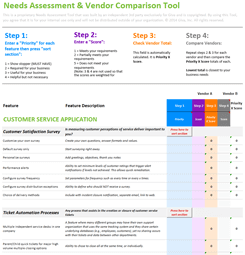
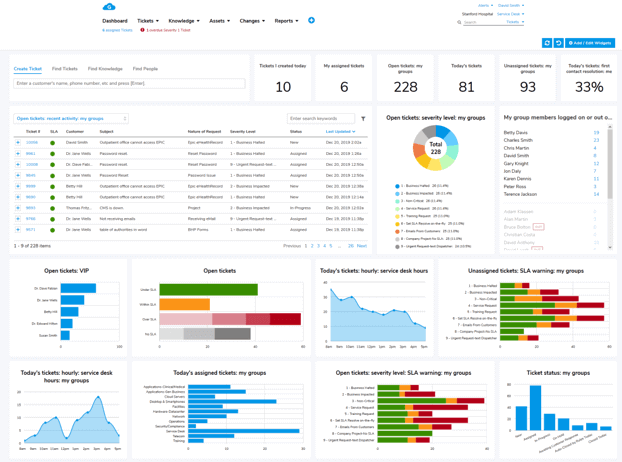
Giva's cloud-based customer service software is designed to give service teams exactly that visibility. Built-in CSAT measurement, SLA tracking, and real-time performance dashboards help managers monitor the service metrics that directly influence customer retention, so they can act before churn becomes a trend.
Get a demo to see Giva's solutions in action, or start your own free, 30-day trial today!



Categories: Customer Service