Help Desk Management Fully Examined Including the Top 12 Best Practices
 By Ron Avignone
Help desk management has become a strategic priority for organizations of every size.
Whether your help desk is internal, employee-facing, or external, helping customers, it plays a mission-critical role in keeping your organization functioning.
In this guide, we cover what it takes to run a well-managed help desk in operationally challenging times. We've included core best practices, the software that makes help desks scalable, and the Key Performance Indicators (KPIs) you should work towards.
Every IT help desk should be aiming for less downtime, fewer delays, lower costs, and a consistently positive experience for everyone who reaches out for help.

Key Takeaways: Summary Table
For those in a hurry, we've compiled the following quick reference summary table:
# |
Takeaway |
Why it matters |
1 |
Structure your ticket routing from the start |
Clear categorization, priority levels, and automation rules prevent tickets from getting lost and keep resolution times down |
2 |
Build a centralized, maintained knowledge base |
Agents resolve issues faster and users can self-serve, reducing ticket volume for routine requests |
3 |
Document standard operating procedures |
Consistency across your team improves outcomes, speeds up onboarding, and makes process gaps easier to spot |
4 |
Automate repetitive tasks |
Workflow automation reduces manual effort, lowers error rates, and frees agents for complex, high-value work |
5 |
Train your team continuously |
Tools and expectations evolve, and ongoing training keeps technical skills and communication quality sharp |
6 |
Support users across all channels |
Omnichannel support and a self-service portal meet users where they are and reduce pressure on your support team |
7 |
Enforce SLAs with real processes |
SLA tracking only works when it's built into workflows, not reviewed after the fact |
8 |
Use a service catalog to manage expectations |
Clear service definitions reduce vague requests and help teams plan capacity more effectively |
9 |
Let data drive improvement |
Regular review of key metrics turns performance patterns into actionable process changes |
10 |
Treat security as an operational priority |
Sensitive data flows through every ticket; protocols, access controls, and audits are non-negotiable |
What Is Help Desk Management?
Help desk management is the practice of using software, primarily ticketing systems, to centralize, prioritize, and resolve user requests submitted via email, phone, chat, or self-service portal. It involves the automation, workflows, and team coordination needed to handle those requests efficiently and consistently.
A well-run help desk management program typically includes:
- Ticket intake and routing processes
- Defined support tiers and escalation paths
- Knowledge base management
- SLA monitoring and performance reporting
- Agent training and workforce planning
- Security and compliance controls
In many organizations, help desk management also overlaps with broader IT Service Management (ITSM) frameworks such as ITIL. These provide structured approaches for handling incidents, service requests, and problem management.
In the end, the goal of help desk management is to resolve issues quickly while maintaining a high-quality user experience.
Key Components of Help Desk Management
A well-run help desk management system is built on five main components:
- Ticketing system: The central mechanism for logging, tracking, and resolving every support request from submission to closure.
- Automation and rules: Automatic routing, escalation, and notification logic that assigns tickets to the right agents and keeps workflows moving without manual intervention.
- Reporting and analytics: Real-time monitoring of KPIs such as ticket volume, SLA compliance rates, and agent performance to support data-driven management decisions.
- Self-service knowledge base: A searchable resource that lets users resolve routine issues independently, reducing incoming ticket volume before requests ever reach an agent.
- Omnichannel support: A unified inbox that consolidates queries from email, phone, chat, and web portals so agents can manage all channels in one place, with full context on each user.
Why It Is Important to Improve and Maintain High Help Desk Management Standards
A poorly run help desk is more expensive than most organizations realize. High ticket volumes with no clear ownership, missed SLA deadlines, and support agents stuck on repetitive tasks aren't just inconveniences. They translate into lost productivity, damaged customer relationships, and costs that grow over time.
A well-managed help desk delivers real business results:
- Faster issue resolution reduces downtime for employees and friction for customers, directly protecting revenue.
- Lower operational costs come from automation and self-service tools that reduce incoming ticket volume.
- Higher user satisfaction builds loyalty. Customers who get fast, accurate help are more likely to stay.
- Better visibility lets leadership spot patterns, justify resources, and make smarter decisions about staffing and tools.
Organizations that invest in help desk performance don't just answer tickets faster. They build a support infrastructure that scales with growth and holds up under pressure.
12 Best Practices for Help Desk Management
Below are 12 best practices that IT help desk leaders and help desk managers need to think about and implement to maintain high standards, hit KPIs, and SLA targets:
-
Define Clear IT Support Ticket Routing and Priority Levels
IT support tiers or levels are categorized from 0 to 4 (five in total), each with a specific operational IT support function to fulfill.
IT support tickets should be automatically routed to the right priority level, and if there's been a mistake, re-routed to make sure the right support is provided at the right time.
The goal of tiered support is to ensure efficient and effective resolution of IT issues. This is done by assigning tasks to the right team members with the most appropriate skills, knowledge, and tools to solve the problem.
- Tier 0 (Self-Serve): At this stage, IT users/customers use self-service portals, knowledge bases, and help desk software to find answers to their problems. If they can't, then their issue becomes a support ticket, where they can get help from IT teams at Tier 1 up to Tier 4
- Tier 1 (Basic Support): Handles simple troubleshooting tasks that users can't find/manage via Tier 0 (self-serve). The primary focus is on basic problem resolution, such as password resets, software installation assistance, printer problems, and general IT help desk support.
- Tier 2 (Intermediate Support): Issues that cannot be resolved by Tier 1 are escalated to Tier 2. This is usually done thanks to automated (AI-based) or human escalation within help desk software. Tier 2 involves more specialized knowledge and technical expertise. These issues may include network connectivity, complex software problems (SaaS, PaaS, IaaS), and even detailed hardware troubleshooting.
- Tier 3 (Advanced Support): The highest level of technical support that's either in-house or provided by an IT agency, dealing with the most complex and critical issues. Specialists in this tier often work closely with software developers and engineers to resolve bugs, system failures, and other advanced problems. Tier 4 engineers also perform in-depth analysis and strategic planning to prevent future issues.
- Tier 4 (External Support): This is when internal IT team members can't solve the problem, so it needs to go to the vendor, even if that vendor is Microsoft or Google. However, it's usually a more obscure SaaS or hardware vendor than that, and if they can't fix the problem, it usually can't be fixed.
With structured IT support tiers, organizations can streamline their support processes.
With the help of software, routine issues are handled efficiently while complex problems receive the attention of highly skilled technicians.
-
Build and Maintain a Centralized Knowledge Base (KB)
A searchable, AI-powered knowledge base is one of the highest-leverage investments a help desk team can make.
When help desk agents at every level have quick access to up-to-date knowledge base articles, they spend less time researching and more time resolving. That's also why AI-Powered Knowledge Copilots are such an important ally too, saving time when agents are trying to find the answers to customer problems.
At the same time, an external, customer-centric knowledge base is a huge time and cost-saving solution. When end users can find answers on their own, tickets don't get created in the first place.
To make this a worthwhile investment, organizations need to create a centralized knowledge base that is genuinely useful, not just a collection of outdated documents. A KB needs to have:
- An assigned clear ownership for knowledge management
- Regular review cycles set up for existing content (and easy ways to update them, using ticket-based knowledge)
- An easy way to turn resolved tickets into new articles as a standard practice
A self-service portal that surfaces resources to end users reduces ticket volume for routine requests and frees up support staff for more complex issues.
-
Standardize Processes with Documented, Readily Updated SOPs
Inconsistency is the opposite of everything an IT help desk should be doing. When agents handle similar requests in different ways, you get unpredictable outcomes, customer confusion, and missed KPIs and SLAs.
Standard Operating Procedures (SOPs) give your team a repeatable baseline for how to handle common issues. SOPs are meant to cover everything from first response through to resolution and follow-up.
Robust SOPs cover the full ticket lifecycle:
- How requests are acknowledged
- What information is gathered
- How escalation works
- When follow-up reminders should go out
SOPs should also address approval workflows, asset tracking, and incident response for more complex requests.
Well-documented procedures make onboarding faster, improve consistency across shifts, and make it much easier to spot where things are breaking down, giving you a clear standard to measure against.
-
Use IT Workflow Automation and AI Tools to Reduce Manual Effort
IT help desks handle large volumes of repetitive, predictable tasks.
Sending acknowledgement emails, assigning tickets by category, escalating unresolved issues after a set time can all be handled through automated workflows and now, AI copilots, rather than being done manually.
Workflow automation and AI tools don't just save time, they reduce the cognitive load on support agents and lower the risk of human error.
Make sure that nothing slips through the cracks during busy periods. Key automation capabilities to look for include:
- Automation rules for ticket routing and priority assignment
- Canned responses for common queries
- Automated escalation triggers based on ticket age or SLA status
- Follow-up reminders sent automatically when tickets go quiet
The goal isn't to replace human judgment but to reserve human attention for the work that actually requires it. When agents aren't buried in manual tasks, they can focus on complex issues and the kind of personalized support that builds real loyalty.
-
Invest in Ongoing Training for IT Staff
Technology only delivers results when the people using it are able to use it effectively, and that includes the software, and any hardware, an IT team is using.
Help desk training should be continuous and not just something that happens during onboarding. Tools evolve (like the introduction of AI), customer expectations shift, and the range of issues your team encounters changes over time.
Effective ongoing training covers two sides:
- The technical side (hard skills): How to use your help desk software, navigate the knowledge base, and handle escalations for more complex software problems
- The human side (soft skills): Customer service, communication skills, de-escalation techniques, and how to deliver personalized support even when ticket volumes are high
Regular feedback loops help, too. Ticket audits, agent performance reviews, and user satisfaction surveys all highlight gaps and shape what your next round of training should focus on.
-
Offer Omnichannel, AI Chatbots, and Self-Service Support
Customers expect to reach support through whatever channel works best for them, such as email, chat, phone, a self-service portal, or even social media. Omnichannel support means meeting users where they are and keeping the experience consistent across all touchpoints.
Self-service options are especially important for managing ticket volume.
A well-designed self-service portal with intuitive navigation and a searchable knowledge base can resolve a significant share of requests before they ever reach an agent. Users often prefer self-service for routine issues simply because it's faster.
For organizations with global or multilingual user bases, multi-language support is increasingly essential. It's part of meeting customer expectations at scale and ensuring that the quality of support doesn't vary based on where someone is located.
-
Align IT Help Desk Support Operations with SLAs
Service Level Agreements (SLAs) define the commitments your help desk makes to users, starting with but not limited to the following key performance areas:
- Response times
- Resolution times
- Escalation timelines
A clear system for tracking and enforcing these commitments should be in place for it to be effective and successful.
SLA management should be built into your help desk workflows from the start:
- Configure your platform to surface open tickets approaching their deadlines
- Automate escalation when thresholds are crossed
- Report on SLA compliance at regular intervals, so that trends are visible to managers and stakeholders
When an SLA breach occurs, it should trigger more than a quick fix. It should prompt a review of whether the underlying process needs to change. Clear ownership and defined escalation paths give your team the structure to follow through on those commitments consistently.
-
Use a Service Catalog to Set Clear Customer Expectations
An ITIL service catalog defines what your help desk offers, how requests should be submitted, and what users can expect in return. For IT and internal support teams especially, a well-structured catalog is one of the most effective tools for managing employee requests and reducing ambiguity.
When users know exactly which services are available, how to request them, and what the turnaround will be, they're less likely to submit vague tickets or repeatedly follow up on in-progress work. A clearly defined catalog also makes it easier for support teams to plan capacity, since they can anticipate the mix of requests they'll receive.
Service catalogs work best when they're integrated directly into the self-service portal, so users can browse and submit requests in one place without friction. Combine that with the relevant AI-based help to make workflows even easier for everyone.
-
Use Data and Customer Satisfaction Scores to Drive Continuous Improvement
A help desk that doesn't measure itself can't improve systematically. The key performance indicators that matter most, such as ticket volume, resolution time, first-contact resolution rate, agent productivity, user satisfaction, and SLA compliance, show where things are working and where improvements are needed.
But data is only useful when it's actioned. Build a regular help desk performance review cycle. Use this to identify trends, and turn them into process changes.
If one category of tickets consistently takes longer to resolve, that's a signal to:
- Look at the knowledge base (is it something that can be supported with self-serve tools and resources, and are they up-to-date?
- Check the escalation path (is it going to agents at the right level?)
- Check the level of expertise on the team handling the issue
A culture of continuous improvement, backed by real data, is what separates help desks that stagnate from those that keep on improving and getting better.
-
Prioritize Data Security and Compliance
IT support interactions often involve sensitive information like user credentials, system access, and personal data. Help desk teams are a common target for social engineering, cyberattacks, and unauthorized access attempts, which makes data security an operational priority.
Clear protocols should be embedded in your standard operating procedures:
- Identity verification steps before sharing account access
- Role-based access controls within your help desk software
- Regular security audits and access reviews
- Audit trails for all ticket actions involving sensitive data
For organizations operating across multiple regions, compliance requirements add another layer of complexity. Your tools and processes need to account for this from the start, not as an afterthought.
-
Use AI to Streamline Help Desk Processes
Artificial Intelligence (AI) is now a key component of modern help desk management. Rather than replacing human agents, AI typically acts as a productivity layer that reduces repetitive work and allows support teams to focus on complex technical issues.
AI tools can assist support teams by:
- Automatically categorizing and routing incoming tickets
- Suggesting knowledge base articles during ticket resolution
- Powering self-service chatbots that answer routine questions
- Predicting SLA breaches before they occur
- Identifying recurring problems through ticket pattern analysis
-
Implement Strategies to Reduce Costs
Organizations commonly reduce help desk expenses through:
- Self-service adoption: Knowledge bases and self-service portals allow users to resolve routine issues independently.
- Automation: Workflow automation eliminates repetitive administrative tasks such as ticket routing and escalation monitoring.
- Knowledge reuse: Converting solved tickets into knowledge articles prevents the same issue from being solved repeatedly.
- Root-cause analysis: Identifying the underlying causes of recurring tickets helps eliminate entire categories of support requests.
Over time, these strategies can significantly reduce cost per ticket while improving user satisfaction.
Typical User Roles in Help Desk Management
A well-structured help desk operation typically includes four distinct roles:
- The Help Desk Manager, who leads the team, sets strategy, and monitors overall performance
- Help Desk Agents, who handle day-to-day ticket resolution and direct user interactions
- The Help Desk Admin, who manages the platform configuration, user permissions, and underlying IT infrastructure
- The Knowledge Manager, who maintains and updates the knowledge base to ensure agents and end users have access to accurate, current information
In smaller organizations, one person may fill several of these roles simultaneously.
Key Responsibilities of the Help Desk Manager
While support agents handle day-to-day troubleshooting, help desk managers are responsible for ensuring the entire support operation runs smoothly.
Typical responsibilities include:
- Team leadership and staffing: Recruit, train, and schedule support agents to maintain coverage across all support channels.
- Process management: Design workflows for ticket routing, escalation, and resolution to keep operations efficient.
- Performance monitoring: Track metrics such as first-contact resolution, ticket backlog, SLA compliance, and customer satisfaction scores.
- Knowledge management: Make sure the knowledge base is kept accurate and useful.
- Continuous improvement: Analyze trends in support tickets to identify recurring problems and improve processes, documentation, or system configurations.
In mature organizations, help desk managers also collaborate closely with IT leadership, cybersecurity teams, and application owners to prevent issues before they occur.
Understanding the Help Desk Ticket Lifecycle
Every support request moves through a defined lifecycle from submission to resolution. Understanding this lifecycle helps managers identify bottlenecks and improve efficiency.
A typical ticket lifecycle includes:
- Ticket creation: A user submits a request through email, portal, chat, or phone.
- Classification and prioritization: The system categorizes the ticket and assigns priority based on urgency and impact.
- Assignment: Tickets are routed to the appropriate support tier or agent.
- Investigation and troubleshooting: The assigned agent analyzes the issue and works toward resolution.
- Escalation (if needed): Complex issues may move to higher-tier support teams.
- Resolution and documentation: Once solved, the ticket is closed and the solution may be added to the knowledge base.
Optimizing each stage of the ticket lifecycle helps reduce resolution times and improve customer satisfaction.
Common Help Desk Management Challenges
Even well-run help desks face recurring operational challenges. Recognizing these challenges early allows organizations to implement better workflows, automation tools, and training programs.
Some of the most common include:
- High ticket volumes: Growing organizations often see ticket demand rise faster than support capacity.
- Knowledge gaps: When documentation is incomplete or outdated, agents spend more time researching solutions.
- Inconsistent processes: Without standardized workflows, similar issues may be handled differently by different agents.
- Agent burnout: Support teams often deal with repetitive requests and high workloads, which can impact morale and performance.
- Security risks: Help desks frequently handle account access and sensitive data, making them a target for social engineering attacks.
How to Measure IT Help Desk Performance
Tracking the right metrics turns gut feelings into actionable intelligence. The most important performance indicators for help desk teams include:
- First-Contact Resolution (FCR) rate: Tickets resolved without escalation or follow-up
- Average Ticket Resolution (ATR) time: From open to closed
- Average Handling Time (AHT): Total time an agent spends on a ticket including active handling and wrap-up work
- SLA compliance rate: What share of tickets meet committed timelines
- Ticket volume by category: Useful for spotting demand patterns and knowledge gaps
- Agent productivity: Tickets handled per agent, balanced with quality indicators
- Customer Satisfaction Score (CSAT): Direct feedback on the support experience, typically collected via post-resolution surveys
- Cost per ticket: A measure of operational efficiency over time
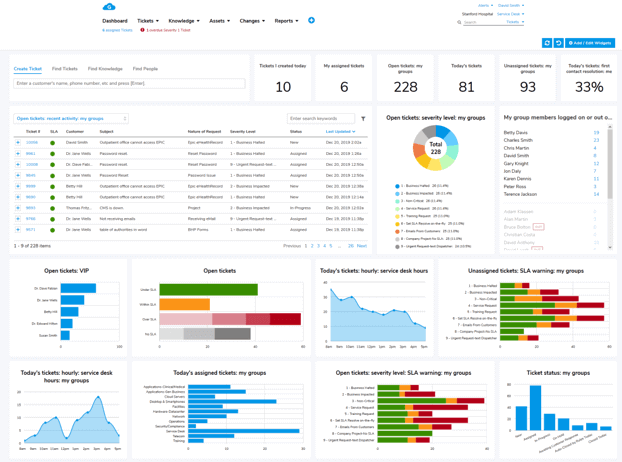
Giva's reporting and analytics tools surface these metrics in real time, giving managers the visibility to act quickly rather than react after the fact. For a deeper look at which metrics matter most and how to use them, explore Giva's resources on help desk metrics and performance reporting.
A real-time dashboard that puts all of these indicators in one view rather than requiring manual report pulls is one of the clearest signs of a mature, well-run help desk operation.
How the Right IT Help Desk Software Optimizes Productivity and Efficiency
Best practices only scale when they're supported by the right technology. Help desk management software is the operational backbone of a modern support team.
It's where tickets are created, routed, tracked, resolved, and analyzed. This software is crucial because its quality and features directly affect agent productivity, user satisfaction, and your team's ability to hit KPIs and SLAs.
What to Look for in Help Desk Management Software
- Automation capabilities: Robust workflow automation, smart ticket routing rules, and automated escalation and follow-up are essential. The more routine tasks you can automate, the more your team can focus on high-value work.
- Self-service and knowledge management: A built-in self-service portal, centralized knowledge base, and seamless knowledge base integration with your ticketing workflow are critical for reducing volume and empowering users to help themselves.
- Omnichannel support: Your platform should support all the communication channels your users rely on, email, web forms, chat, phone, and social media, with a unified view of each user's history across channels. No customer should have to explain their issue over and over again, especially if there's not been a satisfactory resolution yet.
- SLA tracking and reporting: Real-time SLA tracking, configurable alerts for approaching breaches, and clear performance dashboards are non-negotiable for teams with defined service commitments.
- Integration capabilities: Whether you need to connect to CRM systems, project management tools, collaboration tools, or asset tracking platforms, your help desk software should work with the systems your team already uses.
- Cloud-based and mobile-ready: A cloud-based or web-based help desk eliminates infrastructure overhead and lets support staff work from anywhere. Mobile device support ensures agents stay responsive even when away from their desks.
- Security and compliance: Role-based access, audit trails, and data security features are essential for teams handling sensitive employee or customer information.
Streamlined Help Desk Management for Streamlined Support
Running a well-managed help desk is an ongoing commitment to process, people, and technology, and the results compound over time.
IT teams that invest in clear ticket routing, solid knowledge management, workflow automation, regular training, and the right help desk management software consistently outperform those that don't. The results show up as faster resolution times, better SLA compliance, higher user satisfaction, and lower operational costs.
The best-performing help desk teams share one trait: they treat support as a strategic function, not just a cost center. They measure what matters, act on what they learn, and keep raising the bar.
Whether you're formalizing a help desk operation for the first time or looking to improve an existing one, the practices in this guide give you a concrete place to start.
Related Resources
- ITIL Resources: Get helpful ITIL resources with insights from our industry experts & best practices
- Help desk solutions for small, mid-sized, and enterprise organizations
- Self-service portal and AI-powered knowledge base solutions
- What SLA Metrics Are Worth Watching? 8 Key Metrics for Measuring Service Level Agreement Performance
Why Giva Stands Out as High-Performance Help Desk Management Software
Giva is a cloud-based help desk solution built for organizations that need enterprise-grade help desk capabilities without the enterprise-level complexity. It's designed for IT teams that need automation tools, self-service resources, SLA tracking, and real-time reporting. All of this is packaged in an interface that's clean enough that new support staff can get up to speed quickly.
Giva supports knowledge base integration, custom integrations, and live performance dashboards. With Giva, there's no infrastructure to manage and no lengthy implementation to navigate.
If your team is ready to move from reactive support to a proactive, data-driven operation, explore what Giva can do for your help desk.
Get a demo to see Giva's solutions in action, or start your own free, 30-day trial today!


Categories: Help Desk