How to Coach Help Desk Agents on Ticket Quality Without Micromanaging
Help desk managers often find themselves in a tricky situation: If they review every ticket their agents work on, resentment can grow, and they risk burnout. On the other hand, if they never review tickets, their team's service quality plummets. In this scenario, it's easy to wonder, "How do I coach IT help desk agents on ticket quality without micromanaging them?"
The answer is help desk ticket quality coaching.
In this article, we'll define ticket quality coaching. Then, we'll take a deeper look into the components of high-quality coaching: structure, cadence, and follow-through. The goal will be to highlight how to run the coaching conversation. All the while, we'll make it clear how to avoid crossing the line into micromanagement territory.

Key Takeaways
- Most managers land on 5-10 tickets per agent, per week: That's the common sample-size convention for ticket quality coaching, or a 1-5% sample of total volume, refined through a few coaching cycles rather than picked from a fixed formula.
- Coaching cadence should follow tenure, not a fixed calendar: New agents get a coaching touchpoint most weeks, while veteran agents on a steady queue can move to a biweekly or monthly cadence, as long as the conversation still happens on schedule rather than only when something goes wrong.
-
What actually separates coaching from micromanaging? It comes down to three things:
- What gets reviewed (a sample of finished work vs. every ticket in progress)
- When feedback happens (on a set cadence vs. in real time)
- Who decides the next step (the agent, with guidance, vs. the manager, by directive)
- Ticket quality comes down to six traits: Accuracy, resolution clarity, completeness, efficiency, customer centeredness, and actionability are the standard to coach toward, not a single pass/fail check.
- The Situation-Behavior-Impact (SBI) framework works on written tickets, not just calls: SBI feedback, built originally for voice-call coaching, applies just as well to a resolution note or a missing knowledge base citation.
What Is Ticket Quality Coaching?
Ticket quality coaching provides structured, targeted feedback on support tickets to help agents improve resolution quality and the customer experience.
The goal of ticket quality coaching is to use a sample of an agent's work to guide long-term, sustainable development. It's not to correct every ticket in real time. That would be micromanaging.
Let's discuss that distinction.
Coaching vs. Micromanaging: Where the Line Actually Is
Coaching and micromanaging are two distinct things. Unfortunately, the line dividing the two can be easily stepped over if you're not careful.
The main differences between coaching and micromanaging are:
- What components of the agent's work get reviewed
- When the manager decides to provide feedback
- Who decides the next steps
Effective ticket quality coaching uses a sample of finished work to review. On the other hand, micromanaging feedback involves reviewing every ticket in progress.
Feedback should be given, and coaching should occur after the fact. Ideally, on a set schedule or cadence. Micromanagers provide feedback in the moment, in real time.
Lastly, help desk ticket-quality coaching allows the agent to define next steps with the manager's guidance. On the other hand, micromanaging involves a top-down definition of a path forward
Coaching and Micromanaging Comparison
Ticket Quality Coaching |
Micromanaging |
|
|---|---|---|
What: |
Outcomes, quality, and customer experience |
Minor style choices and trivial details |
When: |
Regular, intentional review points in order to build confidence over time |
Constant oversight to catch mistakes, disrupting normal work |
Who: |
Agent defines an improvement plan using clear guidance from the coaching they received |
Manager defines an "improvement plan" in compliance with their preferred process |
What Makes a Quality Ticket? 6 Components to Coach
Quality tickets resolve issues accurately, efficiently, and transparently. The result is a positive customer experience that builds confidence in your product or service.
Let's look at the components of a high-quality ticket so you know what your coaching goals should be:
- Accuracy: Quality tickets need to be accurate. This means they highlight the right problem, provide a correct diagnosis, and solution. They do not rely on assumptions or introduce errors.
- Resolution Clarity: Good tickets are easy for another team member to understand without needing more context. Clarity relies on plain language, organized notes, and a clear summary of what happened and what was done about it.
- Completeness: The ticket includes all the necessary information to move the case forward without additional back-and-forth. This includes key details, relevant customer history, and next steps. It also includes basic housekeeping items that are easy to skip under time pressure, such as correct category or issue-type coding, an updated asset or configuration record, or confirmation that the end user actually received clear closing instructions.
- Efficiency: Quality tickets avoid unnecessary friction. This means no redundant questions, duplicate work, or transfers to other agents.
- Customer Centeredness: Customer service professionals empathetically consider the customer's perspective. The tone of the ticket should be respectful and helpful. As a result, the customer's experience builds trust.
- Actionability: Quality tickets clearly outline the next steps and action items. If the ticket must be escalated, the recipient will have all the necessary info and know exactly what to do to resolve the issue.
Dimension |
What It Measures |
Example |
|---|---|---|
Accuracy |
Are the issue and proposed resolution correctly documented? |
The agent confirms the customer's problem before documenting the fix. |
Resolution Clarity |
Is the ticket documentation easy to understand? |
The ticket states the issue, action taken, and current status in separate, readable sections. |
Completeness |
Is all the required context present within the ticket? |
The ticket includes timestamps, error messages, and the customer's attempted workaround. |
Efficiency |
Did the interaction avoid unnecessary friction? |
The agent uses existing data instead of asking repeated questions. |
Customer Centeredness |
Did the ticket address the customer's experience empathetically? |
Included notes describe the customer's goal, not just internal actions to be taken. |
Actionability |
Can the next steps be taken? Or can the next person take action immediately? |
The ticket includes an escalation request and supporting evidence. |
How to Sample Ticket Quality Without Reviewing Everything
Thus far, we've made it clear that effective ticket quality coaching does not rely on micromanaging every ticket that hits the help desk. This strategy is ineffective for the help desk team member and ultimately detrimental to the manager also.
Instead, ticket coaching relies on pulling a sample of tickets to review with each individual agent. The goal is to review support tickets and provide help desk teams with targeted feedback to improve accuracy, resolution clarity, completeness, efficiency, customer centeredness, and actionability.
These six components are what move the metrics that actually matter to the business. Accurate, complete tickets close on the first contact instead of bouncing back, which is why coaching gains usually show up first in your First Contact Resolution (FCR) rate and your ticket reopen rate. Customer centeredness and clarity tend to show up just a bit later in Customer Satisfaction Score (CSAT). If a ticket quality score never moves any of those three numbers, that's a sign the framework is measuring the wrong things, not that coaching doesn't work.
How Many Tickets to Review
When it comes to ticket quality coaching, there is no perfect sample size. In our experience, most help desk managers arrive at the ideal sample size after calibrating it to what makes the most sense for their team. Typically, what gets reviewed and how you coach ultimately depends on ticket volume and ticket complexity.
That being said, a common convention is roughly 5-10 tickets per agent per week. Or a 1-5% sample extrapolated to the full ticket population. But again, the exact sample size, and whether you need more or less, will become clearer after a few coaching cycles.
Where AI-Assisted Quality Assurance (QA) Fits
AI-assisted QA is increasingly used to score a much larger share of tickets, sometimes all of them. This shifts the help desk manager's focus toward calibration, exception handling, and spot-checking rather than primary evaluation.
In ticket quality coaching, managers can use AI to surface patterns and consistency issues at scale. Once they've done that, they're more easily able to reserve their human judgment for edge cases, disputed scores, and coaching conversations that require more context.
The same visibility that helps a manager spot patterns also helps an agent spot their own. When agents can see their own quality trend between coaching sessions, they can self-correct in the days between reviews instead of waiting to hear it from a manager. It can keep coaching from feeling like a surprise, where the agent already has a rough sense of what the conversation is going to cover.
The Help Desk Ticket Quality Coaching Conversation: Structure, Cadence, and Follow-Through
Now it's time for the actual subject of this article: the coaching conversation.
In this section, we'll offer guidance on structuring your ticket-quality coaching. Some managers lean on general-purpose coaching models like GROW (Goal, Reality, Options, Way Forward) for this. We use a framework built specifically for ticket work instead: Situation-Behavior-Impact (SBI). Then we'll discuss cadence. Your coaching cadence is all about how often the actual coaching conversation happens.
But it doesn't stop there. Ticket quality coaching requires follow-through. So we'll highlight how to ensure your coaching remains sustainable in the long run.
Adapting Situation-Behavior-Impact (SBI) Feedback to Ticket Work
Traditionally, the SBI framework is built around voice calls. In a call center setting, managers use the SBI framework to coach agents on how to provide better help. They do so by structuring their feedback based on the situation, the agent's behavior, and the behavior's impact.
- Situation: Names the specific moment or interaction
- Behavior: Describes the observable action that was taken
- Impact: Explains the effect the behavior had on the work or customer
However, SBI feedback can also be adapted to help desks and ticket work. For example, you can apply the SBI framework to a resolution note, missing troubleshooting detail, or omitted Knowledge Base (KB) citation. If the same gap keeps showing up across multiple agents, where everyone forgets to cite the KB, or everyone is writing the same vague closing notes, that's less a coaching problem and more a tooling one. The fix is often a better knowledge base article or a canned-response template for that specific issue, so the correct answer is one click away instead of something every agent has to remember to type from scratch.
Here's an example of SBI-style feedback from a help desk manager based on a closing ticket note their agent logged into the system.
The agent's note simply reads, "Resolved by resetting the user's profile cache."
The manager's SBI feedback is as follows:
- Situation: "In the ticket update you posted after the customer reported repeated login failures. This is incomplete because there is no summary of what occurred before. It's missing context, like timestamps."
- Behavior: "The resolution note says 'Resolved by resetting the user's profile cache.' Moving forward, we also need to document what was checked and what changed, and include a KB citation."
- Impact: "The next agent may be unable to verify the fix or reproduce it consistently. This is a problem because it slows handoff and makes the resolution harder to trust. Next time, the closing note should include next steps or escalation."
In this example, the manager's situational feedback highlights the note's lack of context. They provide an example of additional context to include next time.
The manager's behavioral feedback indicates that the agent's response lacks clarity. Then they provide examples of content the agent should include next time to create a more complete ticket.
Lastly, the manager's impact feedback points out that the ticket note lacks actionability. In addition to feedback, they go one step further by explaining why it's a problem and offering guidance for next time.
Setting a Cadence Tied to Coaching
Ticket coaching is an ongoing practice. It's not a one-and-done situation. The cadence or volume of coaching reviews you carry out should be based on the sampling cycle. But remember, it doesn't have to be a 1:1 schedule.
Let us explain what we mean.
You can pull ticket samples weekly, but you don't need a weekly coaching cadence. Instead, your cadence should be informed by your agents' tenure or experience.
For example, new agents get a coaching touchpoint during most weeks. On the other hand, your veteran agents are on a steady biweekly or monthly coaching cadence.
The biggest takeaway here is this: a coaching cadence schedule ensures a conversation still happens on a fixed schedule, not only when something goes wrong.
Calibration as Prevention: Reviewing Tickets Together
During coaching meetings, the strategy is to review tickets together. By reviewing tickets together, coaches and agents can calibrate expectations. Calibration helps prevent drift, benefiting both the agent and the coach.
For the agent, drift prevention is about catching a bad habit before it can become the agent's default. For coaches, drift prevention keeps them from scoring tickets based on preference, habit, or individual style. Instead, both the coach and the agent stick to the agreed-upon criteria, with the same quality scorecard applied the same way every time, to maintain consistency.
One strategy for reviewing tickets together is to pick one strong and one weak ticket. You can walk through the two tickets together, with the agent identifying what worked and what they would change. The coach can then deliver their SBI-style feedback.
Avoiding the Help Desk Micromanaging Trap
A consistent cadence is important for ticket quality coaching. But you risk sliding into micromanagement if you don't stick to the SBI framework and review tickets as a team.
For example, micromanaging coaches can become obsessed with enforcing Average Handle Time (AHT) in real time. However, the coaching-oriented alternative is to track AHT over time during regularly scheduled coaching reviews.
Another example of micromanagement is over-the-shoulder ticket auditing. The coaching-oriented alternative is structured, scheduled ticket reviews. That keeps the focus on learning and consistency, not surveillance.
Screen recording or keystroke-level monitoring tools applied to ticket work are another micromanagement trap. Instead, a coaching-oriented alternative is a post-work ticket review. Or, even better, a coaching session in which you review the ticket together using a clear scope. This keeps the process non-intrusive while still finding patterns to improve ticket quality.
When Speed Metrics Undercut Quality Coaching
Above, we discussed how enforcing AHT in real time is a form of micromanagement. Enforcing speed metrics like AHT can also undercut quality. Rewarding fast resolution and volume creates pressure that leads to sloppy tickets. Ironically, this outcome invites the very oversight the manager is trying to avoid.
You want to avoid leading with metrics like AHT. Instead, it's best practice to combine quality coaching alongside speed metrics.
But the tricky part is that there is no universal speed-to-quality weighting ratio that works for every help desk team. Your speed-to-quality feedback will depend on the mix of ticket complexity your team handles.
FAQs About Help Desk Ticket Quality Coaching
-
What leadership style avoids micromanaging?
A coaching or servant-leadership style avoids micromanaging by setting clear expectations, then giving people the autonomy to do the work their own way. The manager stays available for support and feedback, but focuses on outcomes, trust, and development rather than controlling every step.
-
Should ticket quality scores affect performance reviews or compensation?
The answer is two-fold: it's yes for a pattern but no for a single bad ticket. Ticket quality scores are best used as one input in performance reviews or compensation decisions. They're most effective when they show a sustained trend, are tied to a clear scope, and are combined with other evidence like productivity, customer impact, and peer or manager feedback
-
What's a good ticket quality score to aim for?
There's no universal benchmark for a good ticket quality score because scoring methods and standards vary by organization. The best target is the team's own baseline from the first few calibration cycles. In other words, compare the team against itself before comparing it to any outside number.
Related Giva Resources
- 35 Unique Help Desk Metrics for the Best Agent Performance
- 7 IT Help Desk Reports Every Manager Should Review Weekly
- Help Desk Management: The Complete Guide for IT and Support Teams
- Call Center Quality Assurance: Frameworks & Best Practices
Ticket Coaching Improves Help Desk Operations and Provides Exceptional Customer Service
Ticket quality coaching is about shifting the focus from measuring metrics to treating the coaching conversation as the goal. When you accomplish that, metric measurement becomes just a single input in a much more robust coaching conversation.
Robust ticket quality coaching also includes feedback on ticket accuracy, clarity, completeness, efficiency, customer centeredness, and actionability. All of which is delivered via the Situation-Behavior-Impact framework during regularly scheduled coaching reviews. With a consistent, scheduled coaching cadence, you can achieve better ticket quality without ever micromanaging or reviewing every ticket. The end result? Exceptional customer service.
Bring Visibility to Every Ticket Quality Coaching Conversation with Giva
Coaching ticket quality only works if a manager can see trends without living inside every ticket. That's the gap between managers who end up micromanaging out of necessity and managers who can coach with confidence: visibility into the data that matters, without having to dig for it.
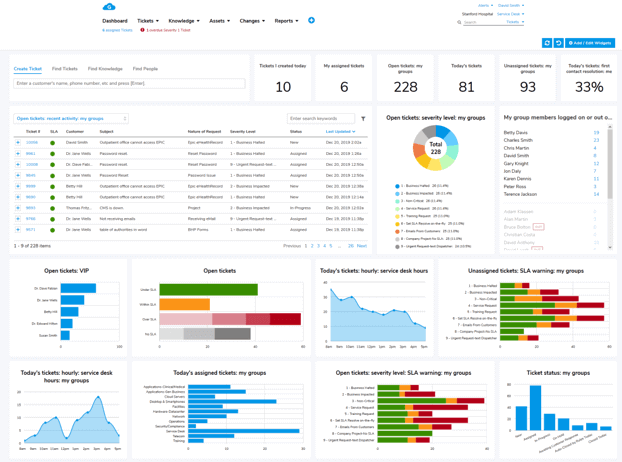
Giva's help desk software is built with that visibility in mind. Built-in reporting surfaces the exact signals this guide is built around, such as reopen rates, SLA compliance, and agent-level performance trends, so a coaching conversation can start from real data instead of a manager's memory of one bad ticket. Giva's reporting analytics lets you pull an agent's trend line in a few clicks instead of exporting a spreadsheet every week.
Whether you're building a ticket quality strategy for the first time or trying to make an existing QA process feel less like surveillance, having the right data on hand is what makes coaching conversations shorter, more specific, and more useful to the agent on the other side of them.
Get a demo to see Giva's solutions in action, or start your own free, 30-day trial today!



Categories: Help Desk