ITSM Automation Fully Examined Plus 10 Use Cases and How-To's
 By Ron Avignone
Most IT teams run some version of the same routine. A ticket comes in for a password reset, an analyst handles it, and the next one follows. Password resets, software installs, access requests, and status notifications are predictable, high-volume tasks that use up IT bandwidth without requiring any real expertise. IT Service Management (ITSM) automation is how you change that.
ITSM automation covers far more than the help desk. Where service desk automation focuses on the user-facing support layer, ITSM automation spans every major IT service management process, including change management, problem management, asset lifecycle management, and workforce onboarding and offboarding, in addition to the high-volume support operations where most programs begin.
In this article, we cover what ITSM automation is, how it works, the main types and use cases, how to implement it step by step, and the pitfalls most organizations encounter along the way.
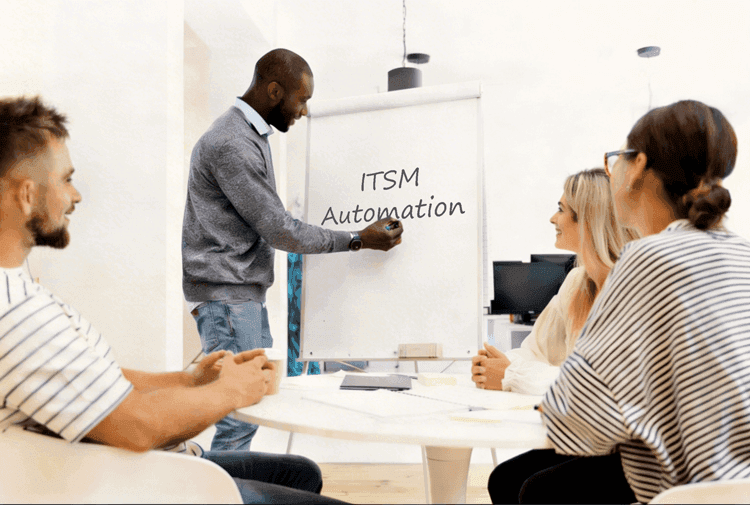
What Is ITSM Automation?
ITSM automation is the use of technology to handle IT service management tasks and workflows without manual intervention. It connects rules, triggers, and AI capabilities to your service management platform so that routine requests are processed, incidents are classified and routed, users are notified, and compliance controls are enforced automatically. The result is a shift from reactive break-fix operations to proactive, consistent service delivery.
The term covers a wide range:
- At one end, simple conditional rules send an email when a ticket reaches a certain priority.
- At the other, AI systems interpret natural language, predict incidents before users report them, and resolve issues without human involvement.
Most organizations operate somewhere between those two points and expand their automation as confidence and maturity grow.
How ITSM Automation Works
When a request enters the system, automation acts at intake. Without a human dispatcher making those decisions, the platform:
- Reads the content
- Performs ticket categorization and priority assignment based on defined criteria
- Routes the ticket to the correct queue
For simple requests, a workflow can handle the entire resolution end-to-end:
- A password reset request is verified
- The credential is reset
- The user is notified
- The ticket is closed
For complex issues, automation ensures the right team receives the ticket with the right context attached, cutting the back-and-forth that wastes time before work actually starts.
Throughout the ticket lifecycle, automation handles actions such as the following:
- Status updates
- Service Level Agreement (SLA) countdown tracking
- Escalation triggers when deadlines approach
- Post-resolution notifications
Every action generates data, which accumulates into patterns that guide further process improvement.
Traditional Automation vs. AI-Powered ITSM Automation
Traditional rule-based automation follows explicit logic. If the ticket contains "network" in the description, it routes to the network team. It is predictable, auditable, and straightforward to configure. It works well for high-volume, structured inputs where the conditions are consistent.
AI-powered automation, however, interprets intent rather than keywords. Natural Language Processing (NLP) understands what a request means even when the wording varies:
- Machine learning models improve classification accuracy as they see more data
- Agentic AI systems carry out multi-step resolution sequences autonomously
The potential is significantly greater, but so is the implementation complexity.
Both types have a place in a mature ITSM environment. Rule-based automation is the right foundation, and AI capabilities build on top of it.
Dimension |
Traditional / Rule-Based |
AI-Powered |
How It Works |
Follows predefined rules and scripts |
Interprets intent, learns from data and outcomes |
Input Types Handled |
Structured, predictable inputs |
Variable and natural language inputs |
Best-Fit Use Cases |
High-volume, consistent tasks |
Complex or variable tasks requiring judgment |
Adaptability |
Manual rule updates required when conditions change |
Learns and improves from outcomes over time |
Implementation |
Low complexity, quick to deploy |
Higher investment, significantly higher ceiling |
5 Common Types of ITSM Automation
-
Rule-Based Automation
This is the most fundamental form of ITSM automation, and the right starting point for most organizations. Conditional logic triggers actions when defined criteria are met:
- A critical-priority ticket pages the on-call engineer
- A ticket unresolved past its SLA target triggers an escalation email
- A new hardware request creates a linked purchasing approval task
Rule-based automation is deterministic and easy to audit. Because every outcome traces back to a clearly defined rule, troubleshooting and governance are straightforward.
-
Workflow Orchestration
Workflow orchestration coordinates sequences of steps across multiple systems and teams. For example, a new employee onboarding workflow might:
- Create an Active Directory account
- Assign software licenses
- Provision hardware
- Send a welcome message in sequence
And each step depends on the previous one completing successfully.
Orchestration handles the complexity that single-step rules cannot manage alone.
-
Robotic Process Automation (RPA)
RPA uses software bots to replicate the actions a person takes in a user interface, such as clicking through screens, copying data between systems, and filling out forms. It is particularly useful where direct API integration is not available, such as legacy systems that predate modern integration standards.
The limitation of RPA is sensitivity to UI changes. If a screen layout changes, the bot breaks and needs to be rebuilt. RPA is a practical bridge for legacy environments, but it is not a long-term substitute for native integrations where those are available.
-
AI and Machine Learning Automation
AI-powered automation interprets natural language, learns from historical resolution data, and applies contextual judgment that static rules cannot replicate. NLP understands what a user's request means rather than just what keywords it contains.
Machine learning models improve classification accuracy over time as they process more tickets, and anomaly detection algorithms flag unusual patterns before they escalate into incidents.
Agentic AI takes automation a step further. Where earlier types classify or trigger a single action, an agentic AI system works through a multi-step problem on its own, making decisions at each stage without waiting for human input. A practical example:
- Detecting an anomaly
- Checking the change schedule
- Triggering a remediation
- Closing the ticket.
This agentic AI tier requires more data maturity and infrastructure investment to deploy effectively, but it handles the variability and edge cases that earlier tiers cannot.
-
Event-Driven Automation
Event-driven automation triggers workflows in response to system events rather than waiting for a user to submit a ticket.
When a monitoring tool detects a threshold breach, CPU spike, or service failure, the event fires an ITSM workflow automatically, classifying the incident, routing it to the right team, and in many cases initiating auto-remediation scripts.
Unlike rule-based automation, which responds to conditions inside the ITSM platform, event-driven automation listens to signals from external monitoring systems and infrastructure tools, connecting your monitoring and alerting tools directly to service management workflows.
All five types have a place in a mature ITSM environment. Rule-based and event-driven automation form the foundation. Workflow orchestration, RPA, and AI capabilities build on top of them.
10 Key ITSM Automation Use Cases
ITSM automation applies across the full span of IT service management, from day-to-day help desk operations to higher-order processes like change governance, problem elimination, and asset lifecycle management.
These use cases illustrate that:
-
Incident Management
When an alert fires or a user submits a ticket, automation:
- Classifies the incident by severity
- Routes it to the right team
- Triggers predefined response procedures
For critical incidents, it can page the on-call engineer, notify affected stakeholders, and create a shared response channel simultaneously.
Auto-remediation scripts handle known patterns automatically, like restarting a service, clearing a full log file, or releasing a memory lock, often before users notice the issue.
A financial services team, for instance, might configure automation to detect transaction processing alerts and trigger a restart workflow before any manual review takes place. The result is fewer incidents reaching the help desk queue and faster Mean Time to Resolution (MTTR) for the ones that do.
-
Service Request Fulfillment
Service catalog requests, such as software installs, hardware provisioning, and access grants, follow predictable approval chains. Automation routes each request through the right approval steps, tracks SLA compliance, and triggers fulfillment actions once approved. For pre-approved request types, the entire process from submission to fulfillment can complete without agent involvement.
-
Change Management
Change management carries inherent risk because failed changes cause outages. Automation handles the administrative side, routing requests through the Change Advisory Board (CAB), tracking approvals, and sending notifications.
AI-powered tools add risk analysis, examining historical success and failure patterns along with dependency maps to flag high-risk changes before they reach the CAB:
- Low-risk changes can be auto-approved
- High-risk ones are escalated with AI-generated risk context included in the review package, giving the CAB more relevant information and less administrative overhead
-
Problem Management
Problem management focuses on finding and eliminating the root causes of recurring incidents, rather than just resolving each one in isolation. Automation helps by correlating incident patterns across time, revealing clusters that point to an underlying issue, and triggering root cause analysis workflows.
When a known problem is resolved, AI can auto-draft new knowledge articles from the resolution steps and update the knowledge base automatically, so future incidents in the same category get faster resolution.
-
Asset Management
Automated asset discovery keeps the Configuration Management Database (CMDB) current without manual inventory cycles. Automation tracks hardware and software through their lifecycle, flags assets approaching end-of-life, and alerts when software licenses are underused or over-deployed. When an employee offboards, asset retrieval and license reclamation workflows can trigger automatically from the HR system event.
-
Employee Onboarding and Offboarding
IT onboarding requires coordinated steps across multiple systems.
For example, a single HR event, such as a new hire being confirmed, triggers a coordinated automated sequence:
- Creating the Active Directory account
- Assigning software licenses and provisioning hardware
- Setting up email and communication tools
- Granting access based on job role and sending login instructions
Offboarding runs the same logic in reverse, revoking access across systems, reclaiming licenses, and initiating device return workflows, all triggered by the exit date in the HR system. Manual offboarding processes frequently leave access gaps that persist for days or weeks after an employee leaves.
-
Self-Service and Knowledge Base
A well-configured self-service portal lets users resolve common issues without contacting the help desk. Automation keeps the knowledge base current by flagging gaps when the same question generates multiple tickets and suggesting article updates when a resolution adds new information.
AI-powered virtual assistants answer natural language questions from the knowledge base, handle routine requests like password resets, and escalate to a live agent when the situation requires judgment.
The quality of self-service depends heavily on the quality of the knowledge base behind it.
-
SLA Management and Escalation
SLAs define response and resolution time commitments. Automation tracks time-to-response and time-to-resolution in real time, sends reminders as deadlines approach, and escalates automatically when an SLA breach is imminent. This removes the need for someone to watch ticket queues manually for approaching deadlines and ensures consistent SLA enforcement across all teams.
-
Password Reset and Access Management
Password resets and access requests are high-volume, low-complexity tasks that automation handles end-to-end: identity verification, credential reset or access provisioning, and ticket closure with a full audit trail. For a broader look at service desk–specific automations, see our guide to Service Desk Automation.
-
Patch Management and Security Monitoring
Keeping systems patched and secure requires systematic scanning and update deployment across potentially thousands of endpoints. Automation handles patch discovery, testing, deployment scheduling, and compliance reporting.
Security monitoring tools feed events into the ITSM platform automatically, and high-severity alerts trigger incident response workflows without waiting for an analyst to review a dashboard.
Benefits of IT Service Management Automation
-
Faster Incident Resolution
When routing, classification, and initial response steps happen automatically, time-to-resolution shrinks. Analysts spend time on complex problems instead of triaging routine tickets. For simple issues, the entire resolution cycle can run without human involvement.
The same logic extends across all ITSM workflows, where automated change processing, problem analysis, and service request fulfillment each help reduce the manual handoffs that add delay without adding value.
-
Lower Operational Costs
Automating routine tasks reduces the volume of tickets requiring agent handling. Self-service portals lower cost per ticket further by resolving issues without any IT involvement.
Over time, the same team manages significantly more IT service management volume, like ticket resolution, change processing, access provisioning, and asset tracking, without proportional headcount increases.
-
Fewer Human Errors
Manual processes introduce variation. Different agents handle the same request type differently, documentation gets skipped, and approvals can be bypassed under pressure. Automated workflows follow the same logic every time. The approval chain for a change runs identically regardless of when it is submitted or who is on shift.
-
Better Experience for IT Staff and End Users
When analysts spend less time on repetitive tickets, they have more capacity for work that requires judgment and expertise. For end users, automated status updates and self-service options mean faster answers without waiting for an available agent. According to the HCLSoftware/ITSM.tools State of AI in ITSM 2025 report, improving end-user experience is the top expected benefit of AI and automation adoption, cited by 65% of ITSM professionals surveyed.
-
Scalability Without Growing Headcount
As organizations grow, ticket volumes grow with them. Automation absorbs higher volumes without proportionally increasing staff. Teams with mature automation programs routinely handle significantly more tickets while keeping headcount stable, because volume increases flow through automated workflows rather than to agents.
-
Improved Compliance and Audit Readiness
Automated workflows capture a complete record of every action, including who approved what, when, and what changed.
In regulated industries like healthcare or financial services, where compliance with standards like HIPAA, SOC 2, or GDPR requires documented evidence of process adherence, this audit trail is required as part of the compliance infrastructure.
-
Data-Driven Continuous Improvement
Every automated action generates data. Over time, patterns emerge that make process improvement visible and actionable:
- Which issue types take the longest to resolve
- Which services generate the highest ticket volume
- Which change categories have the highest failure rates
This replaces guesswork and periodic manager intuition with a continuous, data-backed view of where your ITSM processes need attention.
How to Implement ITSM Automation Step by Step
-
Step 1: Assess Your Current Processes
A realistic picture of where your team's time goes is the foundation for identifying where automation delivers the most value:
- Map your existing workflows before automating anything
- Pull ticket data to understand volume by category, average resolution time, and re-open rates
- Note which tasks are genuinely repetitive and which require human judgment
-
Step 2: Identify and Prioritize Automation Opportunities
The best starting points are high-volume, low-complexity tasks with clear, predictable outcomes. Password resets, ticket routing, and status notifications are classic first automations. Prioritize based on ticket volume and time consumed per ticket, and save judgment-heavy workflows for after you have proved the approach on simpler ones.
-
Step 3: Map Your Workflows Before Building
Document each workflow in detail, including every step, decision point, rule, and dependency. Then confirm that the following supporting configuration already exists in your platform:
- Categories and service types
- Routing rules and assignment criteria
- SLA definitions
- Approval chains
If those elements are missing or incorrect, fix them first. Automating a poorly defined process makes the wrong outcome happen faster.
-
Step 4: Choose the Right Platform
Look for a platform with a no-code or low-code workflow designer that lets IT staff build and maintain automations without developer involvement.
Check its integration capabilities with the systems your workflows need to touch, including Active Directory, HR systems, monitoring tools, and cloud infrastructure.
AI features like natural language ticket classification and virtual agents can be layered on top once the foundational workflows are stable.
-
Step 5: Build, Test, and Roll Out Gradually
Start with one or two high-impact, low-risk workflows. Test thoroughly in a staging environment before going live. Once live, monitor closely against clear baseline metrics:
- Resolution time
- First-contact resolution rate
- User satisfaction scores
Phased rollout makes problems easier to isolate and keeps disruption manageable.
-
Step 6: Monitor, Measure, and Refine
Automation is not a set-and-forget deployment. Workflows break as inputs change:
- New request types appear that existing rules do not handle
- Systems get updated in ways that affect routing or integration
- Organizational structures shift, changing who owns what process
Build regular review cycles into your program. Use ticket data and user feedback to find where automations are failing or creating friction, and update them accordingly.
This iterative review cycle aligns with the Continual Service Improvement (CSI) practice in ITIL-aligned frameworks. Treating automation as a living program rather than a fixed deployment is what keeps it effective as organizational needs and technology evolve.
Common ITSM Automation Issues to Avoid
-
Automating a Broken Process
Automation amplifies whatever process it runs on. A manual process with unclear decision points becomes an automated process with unclear decision points that runs faster and affects more tickets. Before automating, confirm the underlying process is sound. If ticket routing logic is inconsistent or approval chains are ambiguous, standardize those first.
The same principle applies to data quality. Automated classification running on poorly structured, inconsistently tagged ticket data amplifies those inconsistencies at scale.
-
Trying to Automate Everything at Once
Organizations that attempt large-scale automation programs all at once tend to encounter more failures and take longer to realize value. Multiple simultaneous deployments are harder to troubleshoot, and teams get frustrated when several new workflows are unstable at the same time. A phased approach, starting with two or three high-volume workflows and proving value before expanding, builds organizational confidence alongside technical maturity.
-
Underestimating Change Management
Automation shifts responsibilities. When agents no longer manually categorize tickets, they need to understand what the system is doing and when to override it. When users can self-serve, they need to know the portal exists and trust it to give accurate answers.
Teams that involve staff early in workflow design, treating them as contributors rather than subjects of the rollout, see faster adoption and fewer workarounds.
-
Neglecting the Knowledge Base
Self-service portals and virtual agents are only as useful as the information behind them. A chatbot that gives inaccurate answers or a knowledge base full of outdated articles erodes user confidence quickly. Knowledge base maintenance is an ongoing responsibility, not a one-time setup task. Budget time and ownership for it alongside the automation build itself.
-
Skipping Governance and Audit Trails
Automation without governance creates compliance risk. Every automated workflow should have a defined owner, clear exception handling, and a documented audit trail. In regulated environments, the ability to show that a process ran correctly, and to investigate when it did not, is a compliance requirement. Adding governance after the fact is harder than building it in from the start.
Frequently Asked Questions About ITSM Automation
-
What is the difference between ITSM automation and IT automation?
- IT automation is a broad category covering any use of technology to execute IT tasks without manual intervention, including infrastructure provisioning, configuration management, patch deployment, and DevOps pipelines. It spans a wider range of tools and systems.
- ITSM automation focuses specifically on service management workflows, covering how IT teams receive, process, and fulfill service requests, incidents, changes, and problems. It typically operates within a service management platform and follows ITIL-aligned practices.
The two overlap in practice, particularly where infrastructure automation, such as auto-provisioning, feeds into service request fulfillment workflows.
-
What ITSM processes should you automate first?
Start with high-volume, low-complexity tasks that have a predictable outcome. Password resets and account unlocks are the classic starting point. They are among the most common help desk tickets at most organizations, require no judgment to resolve, and deliver immediate measurable impact on workload.
Ticket routing and classification are strong second choices because they affect every ticket in the system.
After those are stable and working well, expand to service request fulfillment, SLA tracking, and change approval notifications.
-
How long does ITSM automation take to implement?
Simple automations, such as ticket routing rules, email notifications, and basic escalation triggers, can be configured in days. More complex workflows, including multi-system onboarding orchestration or AI-powered ticket classification, typically take weeks to months to design, build, test, and roll out.
Most organizations see measurable return on investment within 6 to 18 months of beginning a structured automation program, though early quick wins on simple workflows are usually visible much sooner.
-
What ROI should you expect from ITSM automation?
ROI from ITSM automation is typically measured through:
- Cost per ticket reduction
- Increase in first-contact resolution rate
- Reduction in Mean Time to Resolution (MTTR)
- Decrease in the percentage of tickets reaching human agents
- Automation coverage rate, which tracks what percentage of inbound requests are resolved without any human touch
- Self-service adoption rates
- SLA compliance improvements
Most organizations with simple automation use cases achieve positive ROI within the first year of deployment. Broader programs that include AI capabilities and multi-system orchestration take longer to deliver their full return but have a significantly higher potential.
Related Giva Resources
- IT Process Automation: Benefits + Best-Practice How-Tos
- 16 ITSM Trends for 2026: How to Build Smarter & Safer Service
- Top 10 ITSM Best Practices + Action Items
- ITSM Frameworks: Major Types + How and When to Choose Them
ITSM Automation: The Path to a More Productive IT Team
When routine tasks run automatically, skilled IT professionals have time for the work that actually requires their expertise. That shift does not require a large-scale transformation on day one. Automation compounds value incrementally, with each workflow that goes live reducing manual load and generating data that guides the next improvement.
The global ITSM market reflects this investment. MarketsandMarkets projects growth from $10.5 billion in 2023 to $22.1 billion by 2028, driven primarily by automation and AI adoption.
Most teams approach ITSM automation as a technology project. They deploy the tool, configure the rules, announce the launch, and move on.
The organizations that sustain meaningful improvement treat it differently. They run it as a continuous program, with defined ownership, regular review cycles, and a feedback loop between ticket data and workflow updates.
The technology is the straightforward part. The discipline of maintaining it over time is what separates automation programs that stay effective from ones that gradually become inflexible.
Giva Can Help Streamline Your IT Service Management
Bring a higher level of efficiency to your service desk operations with our IT Service Management software and automation features:
- Use macros, auto-close rules workflow, and scheduled tasks to quickly create, update, and close incidents
- Summarize tickets or suggest and rewrite agent responses with Giva's AI Copilot capabilities
- Automate email-to-ticket conversion workflows
- Empower users with Giva's self-service portal
- Team efficiency, improvement and productivity reports
- Capture feedback on a continuous basis to measure customer pulse with customer satisfaction surveys
Let Giva be your ITSM support partner!
Get a demo to see Giva's solutions in action, or start your own free, 30-day trial today!


Categories: IT, Help Desk