HR Service Management Complete Guide: Types, Tiers and How-To's
 By Ron Avignone
Ask HR teams what slows them down most, and the answer is usually some version of the same thing: too much time spent answering the same questions over and over, responding to requests that arrive through email, Slack, and informal hallway conversations, and chasing down approvals across departments that each have their own informal process.
Employees, for their part, aren't sure who to contact for what, and the experience of getting even routine HR help (updating a direct deposit, understanding a leave policy, or getting a new laptop on day one) can feel like a lot more effort than it should be. HR service management exists to fix exactly that.
Below, we cover what HR Service Management is, how it differs from related concepts like HR operations and IT service management, and which delivery model fits different types of organizations. You'll also find the key components every HRSM system needs, a practical six-step implementation roadmap, the KPIs that actually tell you whether the model is working, and what AI is starting to change about all of it.

Key Takeaways
- HRSM applies IT Service Management principles to HR: It replaces ad hoc HR processes with defined request flows, SLAs, and self-service, treating employee support as a repeatable, measurable service.
- Tier 0 self-service handles the majority of volume: Well-implemented Tier 0 commonly resolves 60-75% of HR requests before they reach a human, making the tiered model the most widely adopted HRSM structure.
- The service catalog is the make-or-break step: Rushing to platform configuration without a finished catalog almost always produces a post-launch rewrite of whatever design decisions got skipped.
- Four delivery models fit different organizations: Traditional, shared services, self-service, and tiered each suit different organizational sizes and structures. Most mid-to-large organizations build toward the tiered model.
- AI is moving toward agentic workflows: HRSM automation is maturing from rule-based routing toward multi-step agentic processes, though sensitive matters like employee relations, accommodations, and performance concerns still require human judgment.
What Is HR Service Management?
HR Service Management (HRSM) is the practice of applying structured service management principles to HR, treating employee support as a repeatable, measurable service with defined request flows, clear ownership, and trackable outcomes.
The practical result is that employees submit requests through a defined channel, those requests are routed to the right person or team, progress is visible to everyone involved, and resolution happens within a timeframe the organization has actually agreed to uphold.
Simple requests are resolved at self-service while complex ones escalate automatically to the right specialist, and the whole system generates data you can use.
HR Service Management vs. HR Service Delivery
These two terms get used interchangeably, but they describe different things:
- HR Service Delivery refers to the outward-facing channels employees use to access support, including the self-service portal, the HR contact center, and direct engagement with an HR business partner.
- HR Service Management is the governing framework that determines how those channels are designed, what commitments back them, and how their performance is measured and improved.
How HRSM Relates to ITSM and Enterprise Service Management
HR Service Management borrows its operating logic from IT Service Management (ITSM), which is the discipline IT departments use to manage the delivery of IT services through structured processes, defined request types, and formal SLAs. The insight behind HRSM is that the same model that makes IT support scalable and measurable can work just as well for HR.
Enterprise Service Management (ESM) is the broader category. It applies ITSM principles across every business function, not just IT. HR is typically one of the first departments to adopt ESM alongside IT, partly because HR handles high volumes of routine, repeatable requests that are well-suited to structured workflows and self-service deflection. If your organization uses a shared service management platform, HR may already be one of several departments running on it.
For many organizations, this also shapes the platform evaluation question. Under an ESM umbrella, HR and IT share the same case management engine, the same SLA framework, and the same self-service portal technology while keeping their separate queues and ownership structures. The practical implication is that the HR question often isn't "what platform does HR need?" but "can the platform IT is already running support HR as well?"
HR Service Management vs. HR Operations
HR Operations is the organizational function that manages the day-to-day activities supporting the employee lifecycle:
- Payroll
- Compliance
- Benefits administration
- Onboarding
- Recordkeeping
- Everything else that keeps HR running
HR Service Management is a methodology, not a department. It's the framework HR Operations teams can adopt to deliver those same activities in a more structured, consistent, and measurable way.
The distinction matters because HRSM is sometimes presented as something that replaces HR Operations. It doesn't. What it does is give HR Operations a better operating model, one where requests are tracked instead of lost, SLAs exist instead of informal norms, and self-service handles routine volume so HR staff can spend more time on work that genuinely requires human judgment.
Here's how the two compare:
|
HR Operations |
HR Service Management |
|---|---|---|
What it is |
The organizational function managing the employee lifecycle |
A methodology for how HR services are structured and delivered |
Scope |
Payroll, compliance, benefits, hiring, onboarding, offboarding |
Request intake, routing, SLAs, self-service, reporting, continuous improvement |
Focus |
Getting HR work done |
How HR work is defined, tracked, and measured |
Output |
Completed HR transactions and programs |
Consistent, measurable service delivery at scale |
Relationship |
The function doing the work |
The framework that makes the work scalable |
4 Types of HR Service Delivery Models
There's no single right way to structure HR service delivery. The right model depends on your organization's size, geographic footprint, workforce mix, and how centralized your HR function already is. Most organizations land on one of four approaches:
-
Traditional Model
In the traditional model, HR generalists, who perform multiple HR roles, handle all services for a given business unit or location. Employees know their HR contact personally, and most requests move through informal channels.
The model works well for small organizations where HR handles a manageable volume and employees value personal relationships, but it struggles at scale. When an organization grows or goes remote, different generalists develop different norms and the same question can get different answers depending on who you ask.
-
Shared Services Model
The shared services model consolidates HR functions into a centralized team that serves the entire organization rather than individual business units. Its roots trace back to Dave Ulrich's influential three-part HR framework from the 1990s, which divided HR into three complementary functions:
- A shared services center handling routine administrative work
- Centers of Excellence (CoEs) providing specialist expertise in areas like benefits and compensation
- HR business partners embedded in business units to handle strategic and relationship-focused work
Most organizations running mature HRSM today are operating some version of this structure.
Specialists handle their area of expertise, generalists manage the broader intake, and the team operates under formal SLAs that define response and resolution timeframes.
The efficiency gains at mid-to-large scale are real, but only with governance in place. Without clear SLAs, defined escalation paths, and ongoing performance measurement, a shared services center can feel slower and more bureaucratic than the generalist model it replaced.
-
Self-Service Model
In a self-service model, employees access HR services directly through a portal or app, without HR staff involvement for routine requests. They can check payslips, update personal details, request leave, access benefits summaries, and find policy answers without waiting for anyone to respond to an email.
Most platforms extend self-service to managers as well (sometimes called manager self-service), giving them additional capabilities like approving team time-off requests, submitting headcount requests, or accessing team performance data.
The model's success depends less on the technology than on the editorial discipline required to keep content current. A portal with outdated policies or broken request forms erodes trust quickly, and employees route around it rather than report the problem. Teams that treat knowledge base maintenance as an ongoing program rather than a one-time setup task see substantially better Tier 0 deflection rates over time.
-
Tiered Model
The tiered model combines shared services and self-service into a structured, multi-level system that routes requests to the appropriate tier based on complexity. It's the most widely adopted approach for mid-to-large organizations because it optimizes for efficiency at the bottom while preserving specialist capacity for work that genuinely requires it. Most organizations investing in a formal HRSM platform are building toward this structure, even if they start with simpler components.
Comparing the Four HR Service Delivery Models
Model |
Best Fit |
Primary Benefit |
Main Limitation |
Typical Tech Required |
|---|---|---|---|---|
Traditional |
Small organizations (under 200 employees) |
High-touch, personal HR relationships |
Doesn't scale; inconsistent across teams |
Basic HRIS; email |
Shared Services |
Mid-to-large organizations with centralized HR |
Efficiency, specialization, SLA accountability |
Requires strong governance to avoid bottlenecks |
Service management platform, HRIS integration |
Self-Service |
Organizations with high-volume routine requests |
Speed, 24/7 access, frees HR staff from transactional work |
Only as good as the content behind it |
Employee portal, knowledge base, HRIS |
Tiered |
Mid-to-large organizations; hybrid/remote workforces |
Scales efficiency without sacrificing specialist access |
Complex to set up; requires ongoing catalog and content maintenance |
Full service management platform, workflow automation, integrations |
How the Tiered HR Service Model Works
The tiered HR service model organizes support into escalating levels, each handling a different complexity of request. The goal is to resolve as many requests as possible at the lowest tier, freeing specialist capacity for work that actually requires it. When it's working well, employees get faster answers and HR staff spend their time on higher-value work:
-
Tier 0 - Self-Service
Tier 0 is where employees get their own answers. A well-maintained knowledge base, an employee portal, and intuitive self-service forms let employees check leave balances, find policy details, update personal information, access payslips, and submit standard requests without any HR involvement at all.
Industry benchmarks commonly cite a range of 60-75% of HR requests being resolved at Tier 0 when the self-service layer is well-built, but the portal alone doesn't get you there. The quality and currency of the knowledge base content is the actual driver, and teams that invest in building Tier 0 content report the biggest reductions in Tier 1 contact volume.
Building Tier 0 is as much an editorial project as a technical one. Someone needs to own the knowledge base and keep it current as policies change. Organizations often launch self-service with strong initial content and watch deflection rates decline within 6-12 months as the knowledge base ages. Assigning ongoing ownership to a named individual, not a committee, is the difference between a Tier 0 that holds its performance and one that gradually loses it.
-
Tier 1 - HR Generalists
Tier 1 is the first point of human contact, handled by an HR service desk or contact center staffed by HR generalists. (Some organizations call this function the Employee Service Center.) Requests that aren't resolved through self-service flow here, either because the employee chose not to use the portal, the portal couldn't resolve the issue, or the request fell outside the self-service scope.
Most Tier 1 contacts are resolved at first interaction. For example, a Tier 1 agent handling a standard question about parental leave policy or a straightforward change of address should be able to close the request without escalating it. The SLA for Tier 1 is typically shorter than higher tiers, since these are relatively routine requests.
-
Tier 2 - HR Specialists
Tier 2 handles issues that require subject-matter expertise beyond a generalist's scope. Complex compensation questions, immigration paperwork, leave cases with legal implications, and policy interpretations requiring specialist judgment all belong here. Generalists escalate to Tier 2 when the request falls outside their resolution authority.
Tier 2 specialists have a longer resolution window than Tier 1, but the tiered model protects them from routine volume so they can spend most of their time on cases that genuinely require their expertise.
-
Tier 3 - HR Leadership and Legal
Tier 3 involves HR leadership, legal counsel, or both. Cases at this tier carry decision-making authority, legal risk, or sensitivity that makes them inappropriate to resolve at a lower level. Employee relations disputes, executive compensation decisions, grievances with legal exposure, and high-stakes terminations all belong here. Most organizations want Tier 3 contacts to be rare, and a consistently low Tier 3 volume is one of the clearest signals that the lower tiers are functioning as intended.
HR Service Delivery Tiers at a Glance
Tier |
Who Handles It |
Example Requests |
Resolution Target |
|---|---|---|---|
Tier 0 |
Employee self-service (portal + knowledge base) |
Leave balance check, payslip access, address update, policy FAQ |
60-75% of total volume; immediate (no queue) |
Tier 1 |
HR generalists (contact center or service desk) |
Enrollment question, standard onboarding task, PTO policy clarification |
Same day or within 24 hours; first-contact resolution target |
Tier 2 |
HR specialists |
Complex leave case, compensation review, immigration paperwork |
2-5 business days depending on complexity |
Tier 3 |
HR leadership / legal counsel |
Employee relations dispute, high-stakes termination, executive pay |
Case-dependent; no standard SLA |
8 Key Components of an HR Service Management System
A functioning HRSM system is built from several interconnected parts. The technology matters, but it's only as useful as the design decisions behind it. These are the components every complete system needs:
-
Service Catalog
The service catalog is the most important component, and the one most often underbuilt. It defines every HR service available to employees, covering the request types, what each one includes, who owns it, and what the SLA is. Everything else in the system operates on top of it:
- An automation rule can only act on a request category that exists in the catalog
- A self-service portal can only offer what the catalog defines
Designing a service catalog means making explicit decisions that most HR teams have never been asked to make formally:
- What exactly is a "leave request"?
- Who owns a compensation inquiry that crosses HR and Finance?
- What information does the employee need to provide, and how long is a realistic SLA?
These questions are manageable one at a time but demanding across 20-30 service types.
Catalog design is where HRSM implementations succeed or fail before the platform is ever configured. Rushing to the technology first almost always produces a post-launch rewrite of whatever catalog decisions got skipped.
-
Employee Self-Service Portal
The employee self-service portal is where employees interact with the system directly, browsing available services, submitting requests, tracking status, and accessing the knowledge base.
Usability matters more here than in most other components. If the portal is harder to navigate than sending an email to an HR contact, employees won't use it regardless of how capable the underlying platform is.
Portal adoption rate is one of the earliest signals that the system is working. Low adoption almost never points to a technology problem. It usually means the catalog isn't complete, the knowledge base content doesn't answer the questions employees actually have, or the system's existence hasn't been communicated clearly.
-
Case Management and Ticketing
Case management is the engine that triages, routes, tracks, and resolves requests through to completion, and for the tiered model to function, it's not optional. Every request becomes a case with an owner, a status, and a deadline, giving HR visibility into the queue at any point and ensuring requests don't fall through the cracks.
-
Knowledge Base
A knowledge base is the searchable library that powers Tier 0 self-service. Policy documents, how-to guides, FAQs, and process documentation all live here. Its quality directly determines the Tier 0 deflection rate. A well-maintained knowledge base answers questions before they become tickets.
The challenge is maintenance. Content that was accurate at launch becomes a liability over time if no one keeps it current. Content that's 18 months out of date is worse than no content, because employees learn not to trust it and that trust is hard to rebuild. The ownership question, who is responsible for reviewing and updating each article as policies change, needs to be settled before launch.
-
Service Level Agreements
Service Level Agreements (SLAs) define how quickly different request types will be responded to and resolved. They turn an informal norm ("HR usually gets back to you the same day") into a formal commitment with accountability behind it. Setting realistic SLAs requires baseline data about current resolution times, which is why auditing existing processes before launching HRSM matters. Aspirational SLAs the team can't actually meet create more employee frustration than no SLAs at all.
-
Workflow Automation
Workflow automation handles the routing, approvals, notifications, and cross-team coordination that would otherwise require manual handoffs. When a new hire appears in the HRIS, for example, it can trigger onboarding task creation across HR, IT, and facilities simultaneously, without anyone making coordination calls.
Rules-based automation, the most common form today, acts on defined triggers and conditions:
- Submit a leave request, and an approval workflow starts automatically
- A ticket approaching its SLA deadline triggers an escalation alert
The value is removing the human middle step for decisions that don't require human judgment.
-
Reporting and Analytics
Reporting and analytics provide visibility into how the system is performing. Request volume by category, average resolution time, SLA compliance, self-service deflection rate, and employee satisfaction scores are the core dimensions to track. Without this layer, identifying high-volume categories for portal migration, pinpointing SLA failure patterns, and measuring the impact of knowledge base improvements becomes guesswork rather than data-driven prioritization.
-
System Integrations
System integrations connect the HRSM platform to the rest of the HR technology stack. The most critical connections are typically to the HRIS (such as Workday, SAP SuccessFactors, or Personio), payroll, and identity management. Integrations determine how smoothly data flows across systems rather than requiring manual re-entry at every handoff.
The depth of the integration layer often determines how much automation is actually possible. An HRSM platform that doesn't connect to the HRIS can't automatically trigger onboarding workflows when a new hire record is created. One that doesn't connect to identity management can't auto-provision system access. The integration layer is what turns a service management platform into a connected operating system for HR.
6 Key Benefits of HR Service Management
-
Reduced Administrative Burden on HR Staff
The biggest immediate benefit most organizations report is that HR staff stop spending the majority of their time on requests that a portal could handle. When Tier 0 absorbs the high-volume, low-complexity end of the queue, generalists move to harder problems and specialists stop fielding routine questions that consume half their day.
HR professionals who spend most of their time answering the same questions about PTO policy and payslip timelines report lower engagement than those doing advisory and strategic work. Reducing transactional load isn't just an efficiency play. It's a meaningful factor in how HR teams feel about their jobs.
-
Faster Resolution Times for Employees
Structured service management shortens resolution times across the board. Self-service requests resolve immediately, Tier 1 contacts run on defined SLAs, and escalations follow clear paths rather than depending on whether the right person happens to check their email.
The practical impact is most visible during high-volume periods:
- Open enrollment
- Onboarding waves
- Organization-wide policy changes
Unstructured HR functions slow down significantly under load, but an HRSM system scales without requiring proportional increases in staff.
-
More Consistent Employee Experience
When HR runs on informal norms and individual judgment, the experience varies by location, manager, and which HR contact picks up the request. Defined request types, shared knowledge bases, and documented SLAs produce consistent answers across the organization regardless of who handles the request. For multinational or hybrid organizations, that consistency is especially hard to achieve without a formal service management structure, and it's the difference between an HR model that scales and one that fractures as the organization grows.
-
Stronger Compliance and Audit Trail
Every request, escalation, and resolution creates a record:
- Who submitted what
- When it was routed
- Who handled it
- What was decided
- When it was closed
That audit trail is valuable for compliance audits, dispute resolution, and identifying systemic process issues. It's also the evidence HR needs when defending decisions that get challenged. Role-based access controls who can see a given request in the first place, which matters just as much as tracking who acted on it, especially for categories like compensation changes or employee relations cases.
Organizations in regulated industries such as healthcare, financial services, and government find this particularly important. Without a ticketing system, compliance documentation depends on individuals maintaining records consistently. With one, it's automatic.
-
Data-Driven HR Decision Making
Most HR teams know roughly how many full-time employees they have, but far fewer know how many HR requests they receive per month, which categories drive the most volume, which SLAs they miss most often, or what the self-service adoption rate is. HRSM produces exactly this data and makes it visible from the first day the system runs.
Over time, that data changes how HR teams are resourced, what knowledge base content gets prioritized, and which processes get redesigned. Request volume by category is often the clearest signal of where employee confusion is concentrated, and therefore where better documentation or process design would have the most impact.
The most actionable starting point for using HRSM data is to identify where request volume is concentrated and where SLAs are being missed most consistently:
- High-volume categories not yet in the self-service tier are almost always candidates for portal migration
- Categories with consistent SLA misses reveal either a resourcing problem or a process design problem, and the data makes those issues visible in a way that informal feedback never does
-
Scalability Without Proportional Headcount Growth
The traditional HR model scales by adding HR staff. For every X additional employees, you need Y additional HR headcount. A well-structured HRSM system changes that ratio:
- Self-service absorbs a large portion of growing request volume
- Automation handles coordination that used to require manual effort
- Shared services centralize specialist capacity rather than duplicating it across business units
The scalability benefit is most significant during periods of rapid growth, mergers and acquisitions, or geographic expansion. HR teams that build HRSM before they need it tend to navigate those transitions more smoothly.
How to Implement HR Service Management in 6 Steps
Implementation typically spans several months for a mid-sized organization, longer for complex enterprises. The steps below reflect the order that minimizes rework:
-
Step 1: Audit Your Current HR Processes
Start by taking stock of:
- How HR requests currently arrive
- How long they take to resolve
- Where the process breaks down
- Interviewing HR staff and employees separately: HR staff will identify where workflows are most painful and employees will reveal where the experience is most frustrating
- Pulling whatever data exists from shared inboxes or any tracking system currently in use
The goal is a clear picture of your actual request volume by category, your informal SLAs (how long things actually take today, not how long they should take), and where the biggest gaps between employee expectation and HR delivery live.
This audit also reveals which process documentation already exists and which needs to be written before the knowledge base can be populated. Skipping this step means configuring a new system around old assumptions.
-
Step 2: Design Your Service Catalog
Design the catalog of services your HRSM system will deliver. For each request type, define what the service includes, who owns it, what information the employee needs to provide, and what the SLA will be. This is the most consequential step in the rollout, and the one most teams underestimate in terms of time required.
The catalog forces explicit decisions that most HR teams have never been asked to make formally:
- What counts as a complex leave request as opposed to a standard one?
- Who owns a compensation inquiry that touches both HR and Finance?
- What information does the employee need to provide upfront, and what is a realistic SLA?
These questions are manageable one at a time but demanding across 20-30 service types.
Allowing 3-4 weeks for catalog design before touching the platform is the clearest predictor of strong self-service adoption from day one.
-
Step 3: Choose Your Delivery Model
Based on your organization's size, structure, and workforce profile, choose which delivery model fits best or which combination.
- Most mid-to-large organizations are building toward a tiered model, but implementing all four tiers at once is rarely the right first step
- Starting with a strong Tier 0 (self-service plus knowledge base) while using shared services for Tier 1 is a common, lower-risk approach that generates early wins while the full tiered structure is built out behind it
-
Step 4: Select and Configure Your Technology Platform
Select a service management platform that supports your chosen model. It should include case management, SLA tracking, workflow automation, a self-service portal, and knowledge base functionality, and it should integrate with your HRIS, payroll system, and collaboration tools.
Configure request types based on your service catalog, not the other way around. Platform configuration that precedes catalog design almost always requires significant rework. Every category name, ownership assignment, and routing rule should trace back to a decision made in catalog design, not a default the platform supplied during setup.
-
Step 5: Build the Knowledge Base and Self-Service Content
Do this by:
- Populating the knowledge base with policy documents, FAQs, how-to guides, and process explanations before launching self-service
- Starting with the highest-volume categories first, usually leave policies, payroll FAQs, and benefits questions, and working outward from there
Content quality matters more than content volume. A knowledge base with 20 well-written, current articles that answer the questions employees actually ask will outperform one with 200 articles that are incomplete, out of date, or too long to read. Each article should answer one clear question and reflect current policy.
Plan for ongoing content maintenance from the start. Every time a policy changes, the relevant knowledge base article needs to update before the change takes effect. The maintenance process, who updates what, who reviews it, and how new articles get created, should be defined and assigned before launch, not worked out after employees start reporting outdated information.
-
Step 6: Train Your Team and Communicate to Employees
Communicate the new system to employees before launch and explain clearly how to use it. Train HR staff on their roles within the new model, and monitor adoption metrics through the first 60-90 days. Low Tier 0 adoption in that period usually means awareness is low, knowledge base content doesn't answer the questions employees actually have, or the portal user experience is getting in the way.
HR Service Management KPIs to Track
Knowing which Key Performance Indicators (KPIs) to watch is half the battle. The following seven cover the most important dimensions of HRSM performance. Not all of them are easy to calculate cleanly on day one, and that's fine. What matters is that you're collecting the data from the start so you can establish baselines:
KPI |
What It Measures |
Why It Matters |
|---|---|---|
% of requests resolved at the first point of contact without escalation |
High FCR indicates Tier 1 quality and knowledge base effectiveness |
|
Mean time from ticket opened to closed by category |
Tracks SLA performance; reveals bottlenecks in specific request categories |
|
Self-Service Deflection Rate |
% of requests resolved through self-service without human involvement |
The primary efficiency metric for Tier 0; commonly cited target is 60-75% |
Employee Satisfaction Score (ESAT) |
Post-resolution survey score rating the HR service experience |
Captures the employee experience side that efficiency metrics can't see |
SLA Compliance Rate |
% of tickets resolved within the defined SLA timeframe |
Accountability metric; low compliance reveals capacity or process issues |
Ticket Volume by Category |
Count of requests by service catalog type over time |
Identifies highest-volume areas for knowledge base investment and process redesign |
Cost per HR Transaction |
Total HR service cost divided by transaction volume over a period |
Tracks efficiency gains over time; useful for ROI conversations with leadership |
A few of these deserve a practical note: The self-service deflection rate is one of the most useful early indicators, but it's also one of the trickier ones to measure cleanly. If employees can submit requests both through the portal and by emailing HR directly, portal-submitted requests tell you volume but not true deflection. You need to actively route or discourage off-channel submissions to get an accurate reading. Most teams don't have a fully clean number here, and that's worth acknowledging rather than pretending the metric is straightforward.
AI and Automation in HR Service Management
Automation has been part of HRSM since the beginning, handling work like:
- Routing incoming requests to the right queue
- Triggering SLA alerts before a deadline is missed
- Sending status notifications to employees
- Creating onboarding tasks when a new hire record appears in the HRIS
What's changed recently is the type of automation becoming available, and how far it can go without human direction.
What Rule-Based Automation Handles Today
Most organizations using a service management platform are running rules-based automation that handles the predictable, high-volume work:
- Routing incoming requests to the right queue based on category and ownership
- Triggering approval workflows when a leave request or expense claim is submitted
- Notifying employees when their request status changes
- Escalating tickets that are approaching SLA breach
- Creating onboarding and offboarding checklists across HR, IT, and facilities
Where Agentic AI Is Taking Things
Agentic AI describes AI systems capable of taking autonomous, multi-step actions without requiring human input at each step. In HRSM, that looks like an AI that can:
- Receive a leave request
- Check the policy
- Verify the employee's eligibility
- Send the relevant notification
- Update the HRIS record
- Close the ticket
Several leading HRSM platforms are moving in this direction, particularly for high-volume, well-defined request categories.
The pattern that has emerged across HR automation programs is consistent. AI performs better when the underlying processes are already structured and automated. Layering it on top of an informal workflow amplifies the existing disorder rather than resolving it. An agentic AI can only act as well as the catalog it's operating on.
But when does deploying agentic AI actually make sense? The answer depends on three conditions:
- The request type must be high-volume enough to justify the configuration investment
- The decision logic must be clear and consistent enough that the AI can follow it reliably
- The risk of an incorrect outcome must be low enough that the organization is comfortable without human review at each step
Standard leave requests, status updates, and onboarding task creation meet those conditions. Performance conversations, accommodations evaluations, and anything with legal or emotional complexity do not.
AI-Powered Self-Service and Virtual HR Assistants
Conversational AI, in the form of AI-powered chatbots and virtual HR assistants, has become common at Tier 0. An employee can ask a natural-language question, "What's our policy on bereavement leave?" or "How do I change my tax withholding?" and the assistant pulls the relevant policy from the knowledge base and delivers a direct answer, rather than returning a list of search results and leaving the employee to figure it out.
These tools work well for informational queries and simple transactional requests. They don't work well, and shouldn't be used, for sensitive or emotionally charged situations. An employee raising a complaint about their manager, disclosing a mental health concern, or asking about options following a performance warning needs a human. Using an AI assistant in those moments can damage trust in ways that take a long time to repair. The judgment about which requests to route to AI and which to protect from it is one of the most important design decisions in a modern HRSM implementation.
Common Mistakes to Avoid
- Skipping Service Catalog Design: Launching the self-service portal without a finished service catalog is the most consequential mistake in most HRSM implementations. The portal needs something to offer. Without defined request types, clear ownership, and meaningful knowledge base content behind each category, you're giving employees a form to submit and HR staff an inbox to monitor. That's not service management. It's digitized chaos. Build the catalog first.
- Treating HRSM as an IT Project: HRSM is an IT-adjacent platform, but it's an HR transformation. When the implementation is handed to IT and HR is treated as a stakeholder rather than the driver, the result is a system configured around what the platform can do rather than what HR actually needs. HR needs to own the design decisions: the service catalog, the SLAs, the knowledge base content, the employee experience. IT's job is to make the platform work, not decide what goes in it.
- Setting SLAs Without Baseline Data: Setting SLAs before you have baseline data on current resolution times creates commitments you'll miss from day one. Start with realistic SLAs based on what your team can actually sustain, measure performance for 60-90 days, and tighten them only as the system matures and capacity becomes clearer.
- Underinvesting in Knowledge Base Maintenance: The Tier 0 deflection rate depends entirely on knowledge base quality. Teams that treat the knowledge base as a one-time setup task rather than an ongoing maintenance responsibility watch self-service adoption decline over time as policies change but the content doesn't. Someone needs to own this specifically, and the maintenance process needs a built-in trigger so that knowledge base articles update when policies do, not weeks later when someone notices the discrepancy.
- Underestimating Change Management: A well-designed system that employees don't know about or don't trust produces the same result as no system. Launch communication needs to explain clearly what the new system is and how to use it, and managers should direct their teams to the portal rather than acting as informal HR intermediaries, especially in the first 90 days when usage habits are forming.
- Over-Automating Sensitive Requests: AI and automation deliver real value for high-volume, clearly defined request categories where the cost of a wrong answer is low. Employee relations complaints, performance concerns, and accommodations requests require human judgment and context awareness that current AI systems don't have. Route those conversations to a person from the start.
HR Service Management Questions Answered
-
What is the difference between HR Service Management and HR service delivery?
HR service delivery is the outward-facing process employees experience, and HR Service Management is the operational framework that governs how that experience is designed, measured, and improved.
The difference shows up in what each term points to. Service delivery names the channels and interactions employees use: the portal, the contact center, the specialist meeting. Service management governs how those channels are designed, who owns them, what commitments back them, and how performance is tracked.
The two terms are often used interchangeably in vendor marketing, which causes confusion. If a vendor says their platform enables "HR service delivery," they're describing the capability the platform supports. If they say it enables "HR Service Management," they're describing the broader operating model.
-
What does an HR service catalog include?
An HR service catalog is a structured list of every HR service available to employees, with each entry defining the request type, ownership, required inputs from the employee, and the SLA.
A simple entry might cover an address change (employee submits new details, HR Ops owns it, 1-day SLA). A more involved entry covers a leave of absence with documentation requirements, a Benefits team owner, and a 5-day SLA. The catalog's value isn't purely organizational: it forces HR to make explicit decisions about ownership, scope, and SLAs that most teams have never been asked to define formally.
A typical catalog covers areas like:
- Benefits and enrollment
- Leave management (parental leave, medical leave, PTO requests)
- Payroll and compensation inquiries
- Onboarding and offboarding processes
- Role changes (promotions, transfers, and internal moves)
- Employee data changes (address, dependents, direct deposit)
- Performance management requests (review cycles, feedback submissions)
- Learning and development requests
- Workplace accommodations
- Employee relations inquiries
The catalog is not just a list. It's the design document the whole system operates on. Every automation rule, SLA, and self-service content item should trace back to a specific catalog entry.
-
How many tiers does an HR service delivery model have?
The standard tiered HR service model has four tiers, numbered 0 through 3, covering self-service, HR generalists, HR specialists, and HR leadership or legal.
Within that structure, each tier has a defined resolution target. Tier 0 is immediate since no queue is involved. Tier 1 typically targets same-day or within-24-hour resolution. Tier 2 runs on a 2-5 business day window. Tier 3 has no standard SLA because those cases vary too widely in scope and urgency to define a single target.
Some organizations run a three-tier model that collapses Tiers 1 and 2 into a single shared services team. Others add a Tier 4 for vendor or outsourced functions. The four-tier structure is the most widely documented and the most commonly referenced in HRSM platforms and frameworks.
-
What is the difference between HRSM and ITSM?
IT Service Management (ITSM) and HR Service Management (HRSM) apply the same operating model to different domains: ITSM to IT services, HRSM to HR support.
ITSM developed in IT departments that needed to manage high volumes of structured, repeatable service requests. HR adopted the same framework, recognizing that the structure that made IT support scalable and measurable could work equally well for HR service delivery. The content differs, but the mechanics are the same.
Both rely on the same structural components.
- Tiered support structures
- Case management and ticketing
- SLAs
- Self-service portals
- Knowledge bases
The content and ownership differ. ITSM deals with software, hardware, and IT incidents. HRSM deals with employee requests, HR policies, and people-related processes. Many organizations run both on the same service management platform under an Enterprise Service Management (ESM) umbrella.
-
What HR processes are best suited for self-service?
High-volume, clearly defined requests that don't require HR judgment to resolve are the best candidates for self-service, including leave requests, payslip access, personal data updates, and benefits enrollment.
These requests share a common characteristic. The answer is clear, the action is defined, and HR's involvement adds waiting time rather than value. The most common categories are:
- Checking leave balances or submitting leave requests
- Accessing payslips or payroll history
- Updating personal information (address, emergency contacts, direct deposit details)
- Enrolling in or changing benefits during open enrollment
- Accessing policy documents and FAQs
- Completing onboarding forms and acknowledgments
Sensitive or context-dependent requests, employee relations issues, performance conversations, accommodations reviews, and anything requiring HR judgment should stay off the self-service list. Self-service works for transactional clarity, but it doesn't work for situations where the employee needs to feel heard.
-
How do you measure HR Service Management performance?
The primary KPIs for measuring HRSM performance are self-service deflection rate, First Contact Resolution (FCR) rate, average resolution time, SLA compliance rate, and employee satisfaction score (ESAT).
Self-service deflection rate (how much volume Tier 0 absorbs without human involvement) and First Contact Resolution (FCR) rate (how many Tier 1 contacts close without escalation) are the two clearest signals of how well each tier is performing. Average resolution time by category reveals bottlenecks. SLA compliance rate tracks accountability against commitments. ESAT scores, collected post-resolution, add the qualitative dimension the operational metrics cannot capture.
Cost per HR transaction is useful for tracking efficiency over time but is harder to calculate cleanly because it requires allocating HR staff costs accurately. Most teams start with resolution time, SLA compliance, and deflection rate, which are measurable from the service management platform directly. ESAT surveys add the qualitative dimension the operational metrics miss.
Related Giva Resources
- Giva for Employee Onboarding & Offboarding Workflows
- Help Desk vs Service Desk vs ITSM: What Are the Differences?
- ITIL Service Request Management Practice
- Service Desk Automation: 15 Innovations + Solutions to Challenges
HR Service Management Done Right: Structure First, Technology Second
Teams that succeed with HRSM tend to do one thing differently from those that don't: they design the service catalog before they configure the tool. That shift, from "we need a portal" to "we need to know what services we're offering and to whom," slows down the early stages of a rollout and speeds up everything after, since the tiered model, the SLAs, the automation rules, and the self-service content all depend on having that catalog in place. Get that right and the rest will follow.
For most organizations, that also means being honest about where they're starting. A traditional model running on email and personal relationships isn't a failure. It's a starting point. HRSM is the path from "it works because everyone knows everyone" to "it works because the system is designed to work," which is the only version that scales.
See How Giva Supports HR Service Management
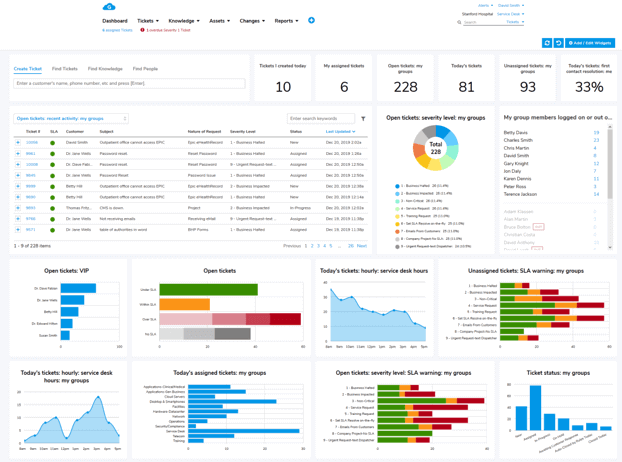
Giva's cloud-based IT Service Management platform is built for exactly this kind of structured, multi-department service delivery. HR teams can configure their own workflows, set SLAs by request type, automate routing and notifications, and run a self-service knowledge base and employee portal, all within the same platform that IT uses for ITSM. That means HR and IT can share infrastructure without sharing queues or visibility.
Giva is HIPAA-compliant, ITIL-aligned, and designed for organizations that need real accountability and audit trails alongside fast, employee-friendly service delivery. It's consistently rated 4.9 out of 5 by independent reviewers, and deployment is measured in weeks, not months.
MetroHealth System, a safety-net hospital, is a real example of this. MetroHealth first brought in Giva's IT Service Management platform to replace its IT help desk software, saving $1 million with 80% of ServiceNow® functionality along the way. Over the following five years, the health system extended the same platform to Facilities and Environmental Services before building a dedicated, HIPAA-compliant self-service interface for HR that now serves 7,500 employees across 20 locations.
Giva gives MetroHealth's HR department these workflows:
- Employees log into the Giva Portal, search the knowledge base, and submit a service request if needed. No need to know who to contact
- Requests are automatically routed to the appropriate HR team for response and resolution
- The portal includes a library of forms and documents so employees can self-serve without opening a ticket
- Standardized tracking follows every request from submission through resolution
Ready to learn more about Giva? Whether you're building your first structured HR service model or expanding an existing ITSM deployment to cover HR, Giva gives you the components to do it properly:
- Intuitive and flexible dashboard
- Multiple service desks for different departments
- Use macros, auto-close rules workflow, and scheduled tasks to quickly create, update, and close incidents
- Summarize tickets or suggest and rewrite agent responses with Giva's AI Copilot capabilities
- Get knowledge base summary answers to searches with Giva's KB Copilot functionality
- Automate email-to-ticket conversion workflows
- Empower users with Giva's self-service portal
- Team efficiency, improvement and productivity reports
- Capture feedback on a continuous basis to measure customer pulse with customer satisfaction surveys
Get a demo to see Giva's solutions in action, or start your own free, 30-day trial today!

Categories: Business